WhatsApp Business App vs API: The Decision That's Costing Mid-Market Brands ₹15L+ Every Year
Here’s the scene that plays out in about half the mid-market founders’ offices we walk into.
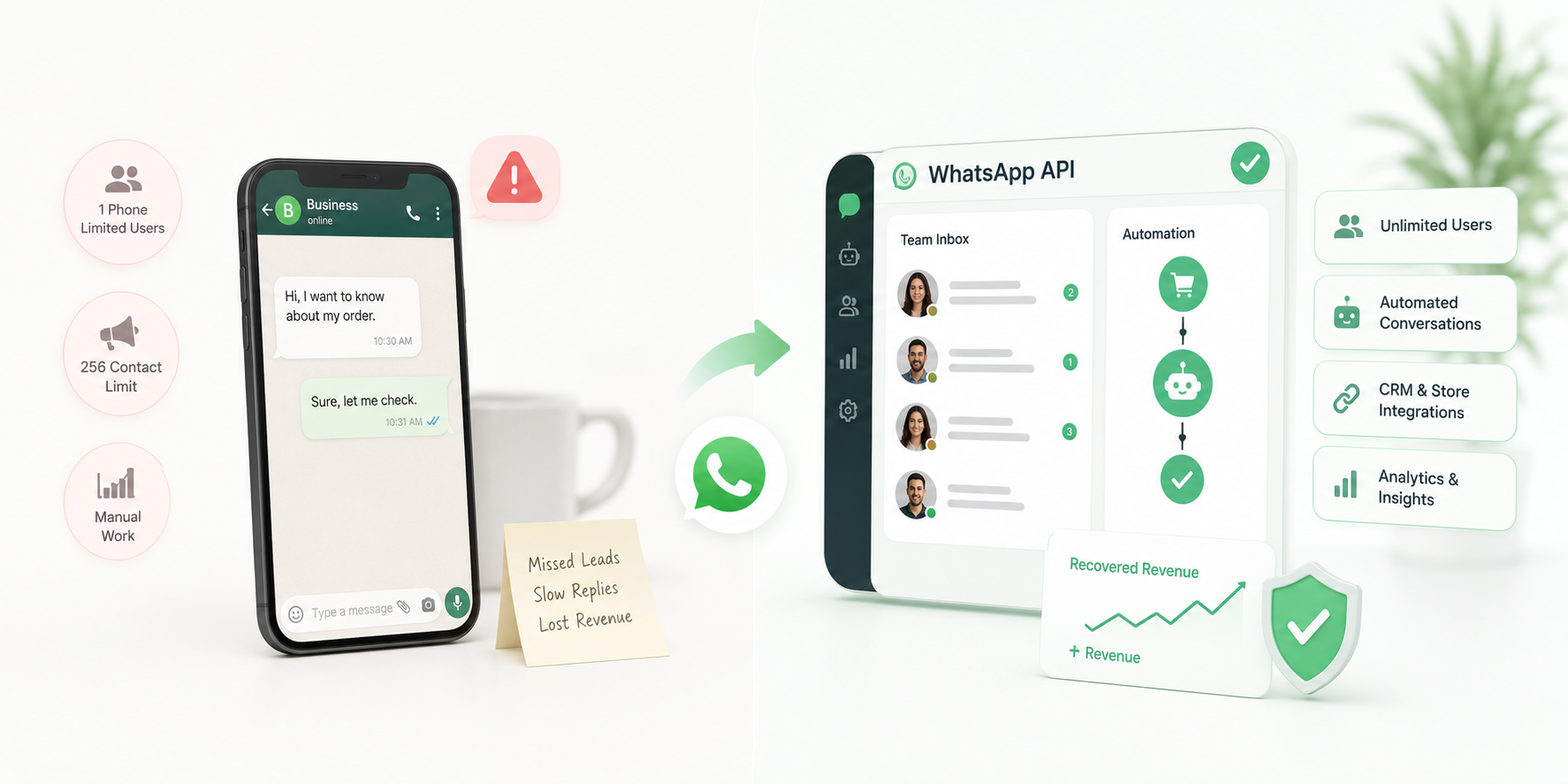
There’s one phone on someone’s desk running WhatsApp Business. It has six staff members taking turns replying from it. The broadcast list maxes out at 256 contacts. Nobody actually knows how many leads slipped through the cracks last week. And somewhere between ₹8L and ₹25L a month is leaking out — through missed leads, slow responses, repeat-purchase revenue the brand never chased, and support hours that could have been automated.
The fix isn’t a new staff member. It’s the WhatsApp Business **API**. And the longer you wait to make the switch, the more expensive the status quo gets.
This post is the honest breakdown — not a vendor pitch, not a “5 reasons you need API!!!” listicle. Just what’s actually different, what it actually costs, and who should move when.
The one-line difference
WhatsApp Business App is a phone app. Built for small businesses. One user, one device, manual replies, 256-contact broadcasts, no integrations.
WhatsApp Business API (now officially “WhatsApp Business Platform”) is an enterprise gateway. Plugs into your CRM, your e-commerce, your AI agents. Unlimited users, unlimited contacts, automation, analytics, multiple team members handling conversations in parallel.
If that sounds dramatic — it is. The gap between the two is huge, and most mid-market teams stick with the app for about 18 months too long.
Side by side, the full picture
| | WhatsApp Business App | WhatsApp Business API |
|—|—|—|
| Built for | Solo founders, 1–5 person teams | Mid-market to enterprise |
| Users per number | 1 phone, 4 linked devices | Unlimited agents in parallel |
| Broadcast size | 256 contacts at a time | Unlimited (Meta template-approved) |
| Automation | Basic “away” and “greeting” messages | Full bots, AI agents, triggered flows |
| CRM/Shopify integration | None (maybe via Zapier hacks) | Native, deep, two-way |
| Catalog + checkout | Basic catalog | Full commerce, in-chat payment, AI shopping |
| Analytics | Message counts | Conversation-level: response time, resolution, CSAT |
| Cost | Free | Per-conversation pricing via Meta, plus a BSP fee |
| Setup time | 10 minutes | 1 to 3 weeks (via a BSP) |
| Green tick (official badge) | Not available | Available after application |
The row most mid-market founders miss is “users per number.” The App literally cannot scale past 5 humans touching the same WhatsApp. The moment your customer service team is 6 people, you’re already bleeding.
The four signals you've outgrown the App
Any two of these and it’s time.
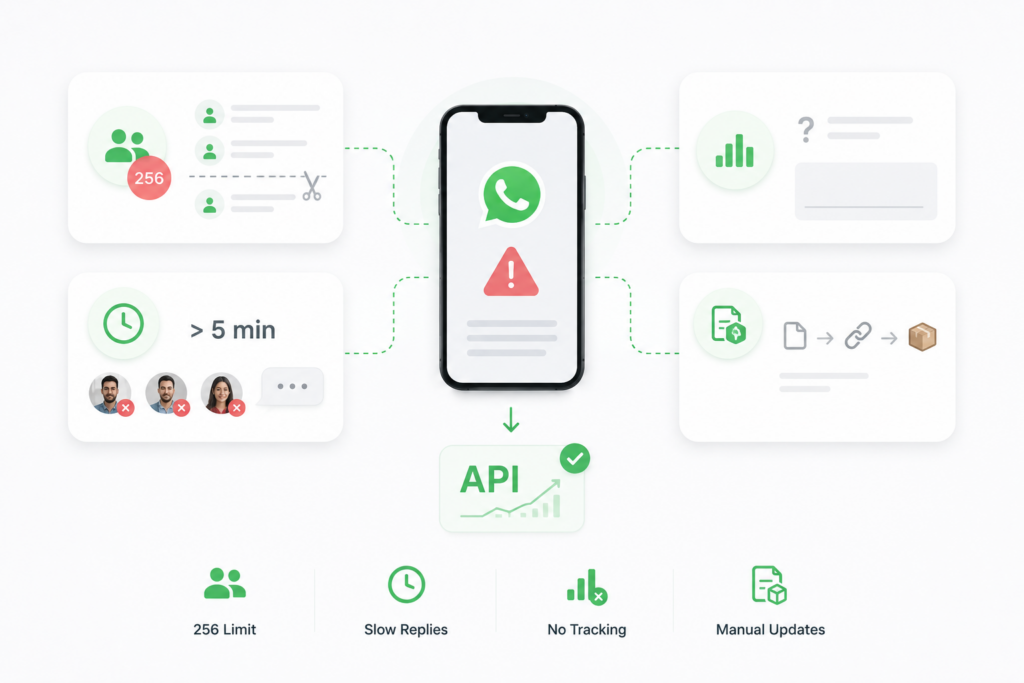
Your broadcast list hit the 256 wall. You’re now manually splitting contact lists into batches, remembering which batch got which message, and hoping nothing duplicates. This is where mid-market marketers start Googling “whatsapp broadcast limit workaround” at 11pm.
Your response time is above 5 minutes. One phone, multiple staff, shared WhatsApp Web tabs — someone always misses the ping. For high-intent leads, the 5-minute threshold is the difference between a booked demo and a lost one.
You can’t track anything. What’s your reply rate? Your resolution rate? Which campaign drove ₹4L in orders last week? The App doesn’t know. The API does.
You’re doing manual “order updates” on WhatsApp. Copy-paste from Shopify. Paste tracking links. Chase RTO. If any of this sounds familiar, you’re paying a human ₹25K/month to do what a webhook should do.
If you’re already reading [7 Real-World AI Agent Use Cases That Are Quietly Replacing Entire Teams], all of this will sound familiar. The API is the plumbing that makes those agents possible. The App can’t run them.
What the API actually unlocks (the part vendors don't explain well)
Beyond scale, three capabilities flip on only after you move to the API:
1. AI agents inside the conversation. A real agent — not a menu bot — that can pull order history, apply your return policy, take the refund action, and escalate when needed. Built on the API, never on the App. If you’re unclear on the difference, read [AI Agents vs Chatbots: Why Your “Smart Bot” Is Already Obsolete in 2026].
2. Triggered flows. Your customer completes a purchase → 2 hours later the bot asks if shipping info is correct → 48 hours later checks in on delivery → 7 days later asks for a review and suggests a bundle. None of this is possible on the App. All of it runs 24/7 on the API.
3. Compliance at scale. Marketing opt-ins tracked, DND enforced, templates approved by Meta, audit logs for regulated industries. For NBFCs, healthcare chains, insurance — this isn’t optional. It’s a board-level requirement.
The cost question everyone asks first
“But the App is free and the API charges per conversation. Isn’t the App cheaper?”
Only if you ignore the hidden costs of the App. Here’s the honest math for a typical mid-market D2C brand doing 8,000 orders/month.
On the App:
– 2 full-time agents managing WhatsApp manually: ~₹1.2L/month
– Lost leads from slow response (conservative 15% slip): ~₹3–6L/month in missed GMV
– Abandoned carts that email/SMS can’t recover: ~₹8–12L/month
– Bulk-message workarounds that keep getting numbers banned: occasional ₹2–5L hit
On the API with a BSP like ConverseAI:
– Platform + conversation fees: ~₹45K–1.2L/month depending on volume
– Recovered carts: +₹2–4L/month
– Reduced support headcount or handle time: ~₹60K–1L/month saved
– Lead response under 30 seconds: typically 2–3x conversion on ad-driven inbound
The App “free” label is misleading. For anyone past ~100 conversations a day, the API pays for itself inside 60 days.
What a BSP is, and why you need one
You can’t connect to the WhatsApp Business API directly. Meta requires you to go through a Business Solution Provider (BSP). They handle the technical onboarding, template approvals, infrastructure, and compliance.
Not all BSPs are equal. Most are glue — a dashboard + a broadcast tool. A few (including ConverseAI) sit at the AI-layer on top, so you get actual agents and automation, not just a send button.
When evaluating BSPs, the questions that actually matter:
– Does it have real AI agents, or just flow-builders dressed up?
– Does it integrate natively with your CRM, Shopify/WooCommerce, Zoho, LeadSquared?
– What’s the pricing structure — flat platform fee or per-conversation markup?
– Does it handle Indian compliance (TRAI DLT, DPDP) and US compliance (TCPA) if you run dual markets?
– Who owns your data and customer opt-ins?
When to stay on the App (yes, this happens)
Be honest with yourself. You should stay on the App if:
– You do fewer than 50 conversations a day.
– You don’t run paid ads driving inbound on WhatsApp.
– You don’t need integrations with anything.
– One person can reasonably handle all of it from a phone.
If that’s you, the API is overkill. Use the free tool. Build the business.
The migration reality
Moving from App to API is not a “download the new version” button. It’s a short project. Typical timeline for a mid-market brand:
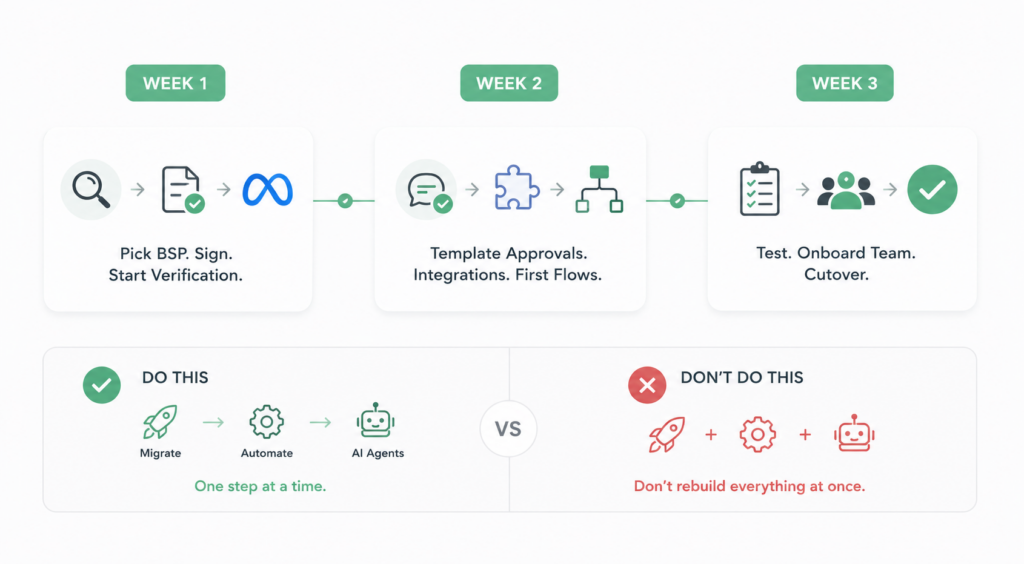
Week 1 goes into picking a BSP, signing, and kicking off the Facebook Business Manager verification.
Week 2 is template approvals, CRM integrations, and setting up your first automation flows.
Week 3 is testing, team onboarding, and cutover.
The common failure mode: brands that try to migrate *and* redesign their entire support operation at once. Don’t. Migrate first. Then layer in automation. Then layer in AI agents. One step at a time.
Frequently asked questions
Q.Can I use the same WhatsApp number I already use on the App?
Yes, but not both simultaneously. When you migrate, that number moves to the API and the App is disconnected.
Q.Will my existing chat history carry over?
No. Chat history from the App doesn’t migrate. Export anything important first.
Q.How much does the API actually cost per conversation?
Meta charges per-conversation based on category (marketing, utility, authentication, service) and country. In India, expect ₹0.50–₹0.90 per marketing conversation. In the US, roughly $0.020–$0.065. A BSP layers its own fee on top.
Q.Will my number get banned?
Not if you use the API correctly. Opt-in templates, DND compliance, quality rating — all handled properly, the API is actually safer than trying to bulk-message from the App.
Q.What’s the minimum business size for the API to make sense?
Rough rule: 100+ conversations a day, or 3+ staff handling WhatsApp, or any paid acquisition pointing to WhatsApp.
The bottom line
The WhatsApp Business App got you to ₹2Cr. It won’t get you to ₹20Cr. The jump to the API is the single highest-ROI operations decision a mid-market brand can make in 2026.
The businesses that moved 12 months ago are the ones running lean support teams, recovering 20% of abandoned carts, and responding to leads in under a minute. The businesses still on the App are hiring more staff and wondering why margins keep shrinking.
Which group are you in right now?
Wondering if the API makes sense for your specific business? Book a free [AI + WhatsApp Readiness Audit](https://theconverseai.com/services/ai-strategy-audit). Thirty minutes, we map your current setup, run the cost math for your volume, and give you a clear go/no-go recommendation. No pitch deck.