
AI Agents vs Chatbots: Why Your 'Smart Bot' Is Already Obsolete in 2026
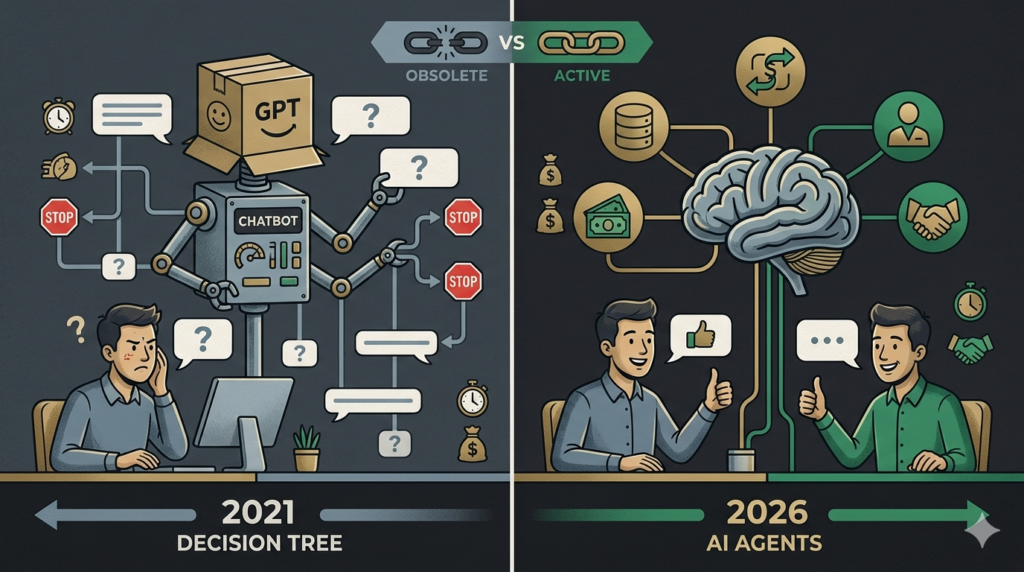
If your customer service page still says “Chat with our intelligent AI assistant!” and the thing behind that button is a decision tree from 2021 with a GPT wrapper slapped on top, this post is probably about you.
Here’s the uncomfortable truth of 2026. The chatbot era is over. Not because chatbots stopped working, but because agents started working. And your customers can feel the difference inside of two messages.
The two-message test
Try this on any “AI chatbot” out there today.
Message 1: “I want to cancel my subscription and get a refund for last month.”
Message 2: “Actually no, keep it active, but update my card.”
A chatbot will usually do one of two things. Either it pattern-matches message 1 to its cancellation flow, ignores message 2, and cancels you anyway. Or it gives up and says “Let me connect you to a human.”
An agent does neither. It updates the card, skips the cancellation, confirms both changes back to you, logs the whole thing in the CRM, and emails a receipt. Start to finish in 30 seconds.
Message 2 is where chatbots die and agents live.
What a chatbot actually is
Every chatbot, even the “AI-powered” ones, works on basically the same shape:
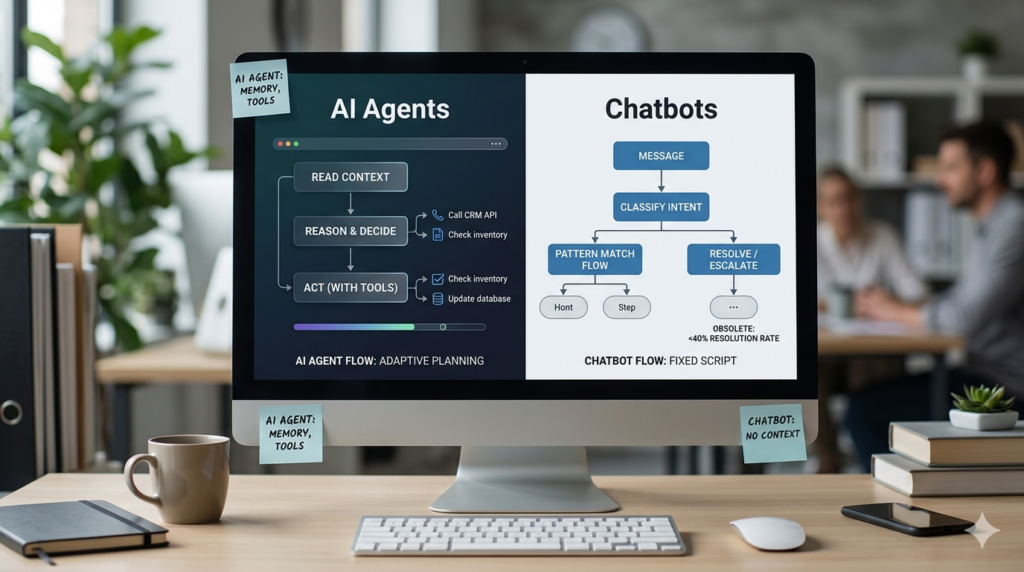
The user sends a message. The bot classifies the intent (billing? shipping? cancellation?). It runs a pre-written flow for that intent. The flow ends, and the conversation either closes or escalates.
It’s reactive by design, and its “plan” only covers one turn at a time. There’s no real memory of what you said two messages ago beyond the current state. There’s no ability to decide “wait, let me check something first.” It executes the script you gave it, nothing more.
Even the modern LLM-powered chatbots are mostly the same setup underneath. A language model sits in front of the old script, making the replies sound a bit friendlier.
Confused about where “generative AI” fits in? Read Agentic AI vs Generative AI: The Difference That Will Decide Your Next Hire.
What an AI agent actually is
An agent inverts the model completely. Instead of “classify, then run script,” an agent does this:
1. Read the full context. Conversation history, user record, system state.
2. Decide what to do next. It could be ask a question, call an API, hand off, wait, or all four.
3. Act.
4. Observe the result.
5. Loop.
It plans. It reasons. It can change its mind mid-conversation. It has tools (your CRM, order DB, payment system, knowledge base) and it picks the right one for the next step.
That’s why the cancel-then-actually-update-card example doesn’t break it. The agent re-plans every turn.
If you want the whole primer, it’s here: What Is Agentic AI? The Plain-English Guide Every Business Owner Needs in 2026.
The comparison your boss actually wants to see
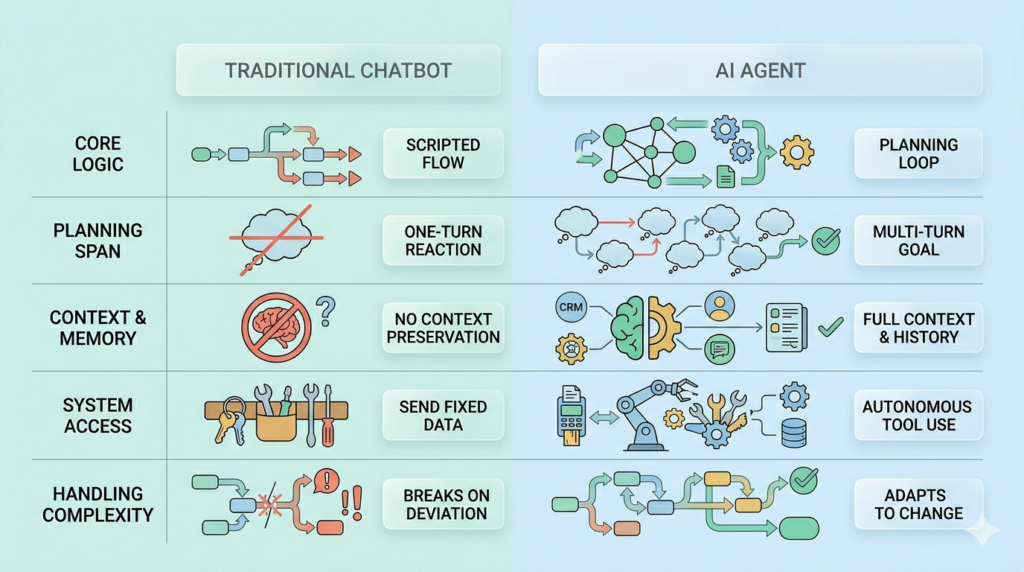
The resolution rate row is the one that matters. A chatbot that “handles” 1,000 tickets a day but resolves only 150 isn’t saving you money. It’s annoying 850 customers on the way to a human agent.
"But we already bought a chatbot platform"
Good news. You probably don’t have to throw it out.
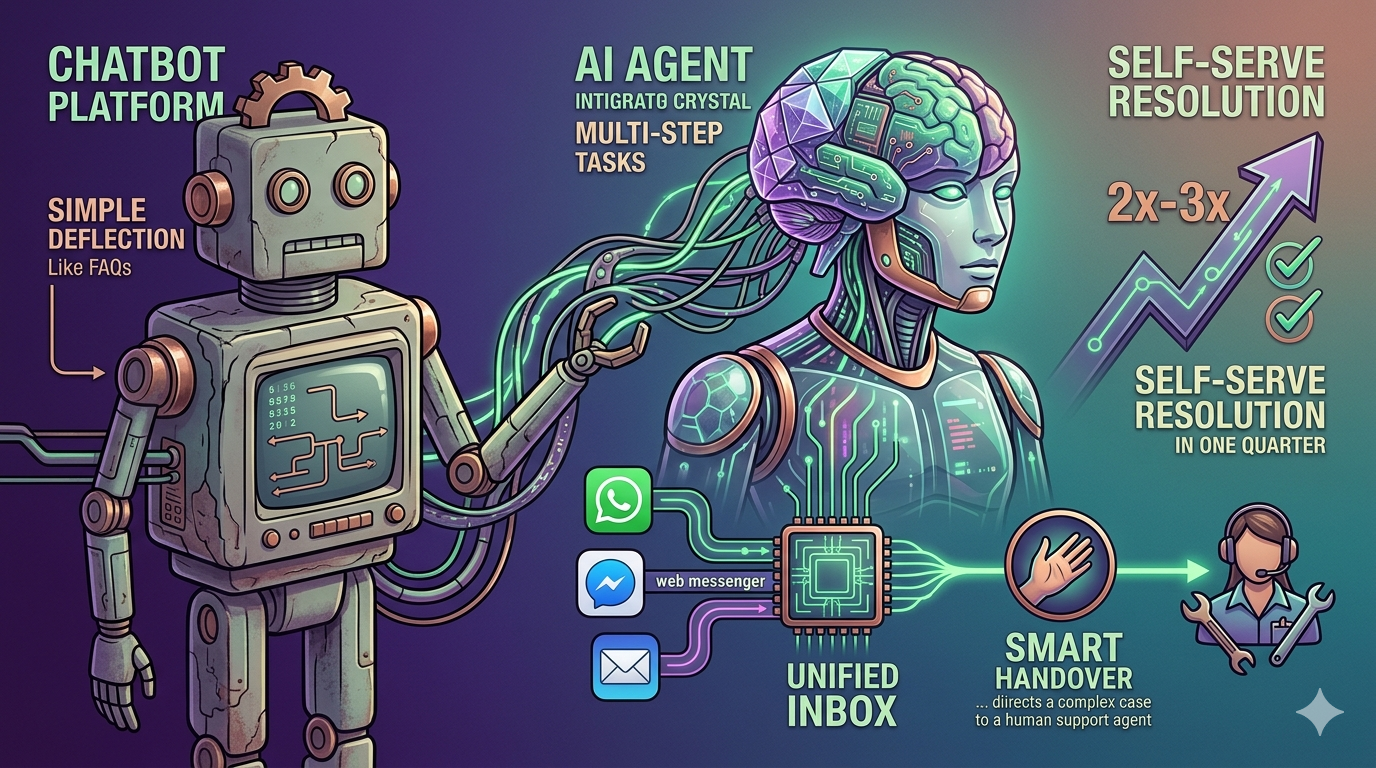
Most modern platforms, including ConverseAI’s, already have the plumbing for chatbot, live chat, and agent all sitting in the same stack. The typical upgrade path looks like this:
Keep the chatbot for simple deflection, things like hours, FAQs, order status. Layer an AI agent on top for anything multi-step, stateful, or business-critical. Use smart handover so the agent pulls in a human only when it genuinely should. Unify the omni-channel inbox so WhatsApp, web chat, and email all feed the same agent brain.
Done well, most teams see a 2x to 3x jump in self-serve resolution within a quarter, without ripping out a single integration.
See the specific workflows in 7 Real-World AI Agent Use Cases That Are Quietly Replacing Entire Teams.
Signs your chatbot needs to retire
Run through this list honestly.
Your “chatbot resolution rate” is below 40%. Customers type “human” or “agent” within two messages. Your CSAT dropped after you added the bot. Your ops team spends more time “training” the bot than using it. You can’t actually answer the question “what did this bot do for us last month?”
Three or more of those and you don’t have a chatbot problem. You have a wrong-category-of-tool problem.
The quiet advantage nobody markets
Here’s the part that isn’t on any pitch deck, but every founder notices.
Chatbots sound like chatbots. “I’m sorry, I didn’t understand that. Please try rephrasing.”
Agents sound like your best human support hire on a good day, because they’re built on top of the same LLMs writing your newsletters. With the right brand voice prompt and a decent knowledge base, a well-deployed agent is genuinely hard to tell apart from a trained support person. Customers stop asking for “a real person” because the thing they’re already talking to feels like one.
That isn’t a feature. It’s the new baseline.
The honest downside
Agents aren’t free to deploy. They need a few things:
Clear, written policies (the agent follows them literally, so vague policies become expensive mistakes). Clean data (bad CRM data means bad agent decisions). Evals, basically tests that verify the agent is behaving before you ship changes. Ongoing monitoring, especially for edge cases.
If your team isn’t willing to put effort into those three, stick with a better chatbot. You’ll save yourself a bad launch.
The bottom line
Chatbots were always a stopgap. They answered the ten most common questions while everything else got routed to humans. Agents actually close the loop. They handle the long tail, the edge cases, the multi-step stuff where humans were making ₹1500 per hour decisions that could have been automated.
If your “chatbot” is still routing more tickets than it resolves, you aren’t using AI. You’re using a filter. And filters don’t scale.
Want to see what an actual AI agent, not a dressed-up chatbot, looks like running on your own data? Book a live demo of Converse AI’s AI Chatbot + Agentic Systems. Or if you need something custom, explore the Agentic Systems & Process Automation service.