
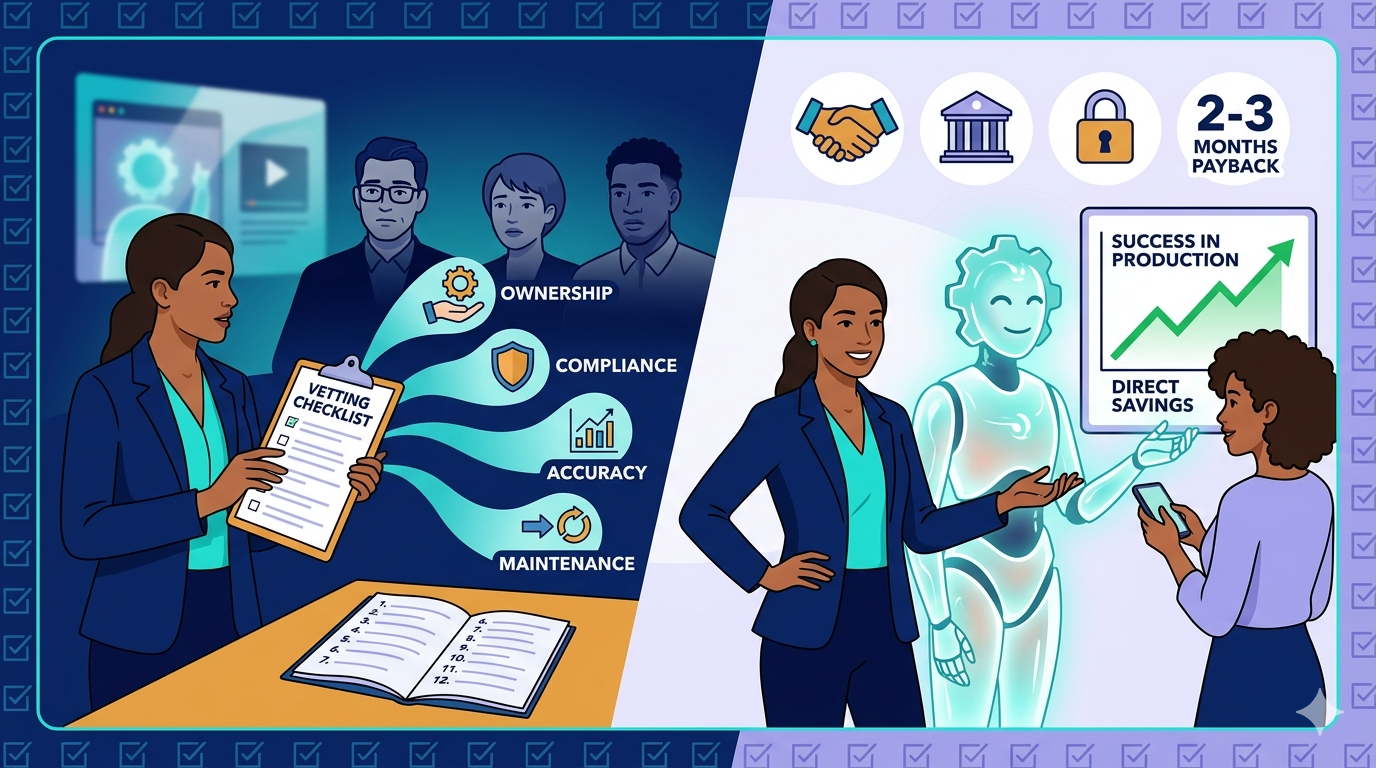
12 Questions to Ask Before You Sign with an AI Agent Vendor
A ConverseAI checklist
Choosing who builds your AI agent is easy to get wrong, because the demos all look great and the pitches all sound the same. The difference between a partner and a problem shows up in how they answer hard questions — about who runs the agent after launch, how accuracy is measured, who owns your data, and what happens when something breaks.
Take this list into every vendor call. Ask all twelve, write down the answers, and compare them side by side. The notes under each question tell you what a good answer sounds like and what should make you pause.
1.After launch, who runs and maintains this — us or you?
Why it matters: An AI agent drifts as your products, policies, and the underlying models change. Someone has to monitor it, catch regressions, and improve it continuously.
Good answer: “We run it for you — monitoring, accuracy reviews, updates, and fixes are part of the engagement.” Or a clear handoff plan plus the tooling and training for your team to operate it.
Watch out for: Silence, vagueness, or “it just works after we build it.” That means the operating burden lands on you the day they leave.
2.Do you build it and hand it over, or build it and run it in production?
Why it matters: These are two different businesses. A build-and-handoff project leaves you as the operator; a build-and-run partner stays on the hook.
Good answer: A straight statement of their model and what “run it” actually includes.
Watch out for: Blurring the line so you assume ongoing operation that isn’t actually in scope.
3.How do you measure accuracy, and how will I see it after we go live?
Why it matters: A demo proves the agent can succeed once. You need to know how often it succeeds on your real data and conversations.
Good answer: They define “correct” for your use case, test against representative cases before launch, and give you ongoing visibility into performance.
Watch out for: Demo-ware — a polished happy path with no measurement behind it.
4.Can you show me work you’ve shipped for a problem like ours — and is it still running?
Why it matters: Use-case fit predicts success. Voice vs. chat, support vs. sales, your industry’s edge cases — they all differ.
Good answer: Specific, even anonymized, examples with mechanism and outcome, including ones still live in production.
Watch out for: Only logos and adjectives, or case studies that were pilots that never reached production.
5.How does the agent connect to our actual systems?
Why it matters: Production agents have to read your CRM, write to your helpdesk, check live data, and hand off to humans cleanly. Shallow integration is where pilots die.
Good answer: Concrete detail on connecting to your stack — CRM, support desk, calendar, telephony, e-commerce — plus how auth, errors, and human handoff are handled.
Watch out for: “It integrates with everything” with no specifics about your tools.
6.Who owns the agent, the configuration, and our data?
Why it matters: You don’t want your logic or your customers’ data trapped inside a vendor’s platform.
Good answer: “You own the outcome and your data, including conversation logs,” in writing.
Watch out for: Fuzzy ownership, or arrangements you can’t leave without rebuilding from scratch.
7.Where is our data stored and processed, and is it used to train models?
Why it matters: You’re handing over customer conversations and often personal data. You’re accountable for it.
Good answer: Clear answers on storage, processing, security, retention, deletion, and a definite stance on whether your data trains models.
Watch out for: Vendors who can’t answer at all.
8.How do you handle compliance for our use case?
Why it matters: Your obligations depend on your industry and data. The right answer is matched to your needs, not a generic badge wall.
Good answer: Honest scoping — “here’s what we do, and we engineer to the compliance requirements your use case demands.”
Watch out for: A parade of certifications they can’t substantiate, or no compliance story at all.
9.How is the engagement priced, and what drives the number up or down?
Why it matters: You don’t need a public price list to judge whether a pricing model is honest.
Good answer: A clear structure — build fee, managed retainer, usage-based, or hybrid — and what’s included in maintenance vs. billed extra.
Watch out for: Dodging the structure, or quoting a fixed package before they understand your problem.
10.Can we start with a pilot on one well-scoped problem?
Why it matters: A pilot de-risks the decision for both sides — you see real performance before a bigger commitment.
Good answer: “Yes — let’s prove value on one painful workflow with a measurable outcome first.”
Watch out for: Only selling the big multi-year program up front, or pressure to skip the pilot.
11.What’s your support and SLA when the agent misbehaves in front of a customer?
Why it matters: When it breaks, response speed and ownership decide how much damage a bad answer does.
Good answer: Defined response times, escalation paths, monitoring and alerting, and a named owner who fixes things.
Watch out for: “Support” that quietly shrinks after the project closes.
12.What happens to the agent when our products, policies, or the AI models change?
Why it matters: Change is constant. An unmaintained agent degrades into a liability that gives customers wrong answers.
Good answer: A continuous improvement process — retraining, updates, and accuracy checks as your business and the models evolve.
Watch out for: Treating the agent as “done” at launch.

How to read the answers
A real partner answers questions 1, 2, 6, and 12 without flinching — they’ve thought about who runs the agent, who owns it, and how it stays accurate over time. If a vendor is sharp on the demo but goes vague the moment you ask who operates and maintains the system after launch, you’re likely buying a build you’ll have to run yourself. For a team without an in-house AI bench, that’s the difference between an agent that’s still working in a year and one that isn’t.
When you're ready, talk to us
ConverseAI builds custom AI agents — chat and voice — and runs them for you in production: we scope the problem, build the agent, and keep it working, so you own the outcome without owning the operating burden. We’re operators, not a services shop learning on client bills, and we’re happy to answer every question on this list about our own work.
On a free AI Opportunity Audit, bring us your problem and we’ll tell you straight whether an AI agent is the right fix, what it would take to build and run one, and whether you should start with a pilot. No package, no price quoted before we understand what you’re solving.
Get a free AI Opportunity Audit →
Brought to you by ConverseAI, a product by Revti Digital. GDPR-compliant; custom solutions are engineered to meet the specific compliance requirements of each engagement. India + US delivery.