
How to Recover 22% of Abandoned Carts on WhatsApp (When Your Wati Setup Is Stuck at 8%)
Quick math for the D2C founders reading this.
If your brand does ₹3Cr/month in Shopify GMV, your checkout abandonment rate is probably 70%. That means roughly ₹7Cr of shopping cart value walks away every month. Even recovering 10% of that through email gets you back about ₹70L of revenue.
Now look at your actual email recovery numbers. They’re probably closer to 3%. WhatsApp pushed that up to 6–8% when you first turned it on two years ago. And then it plateaued.
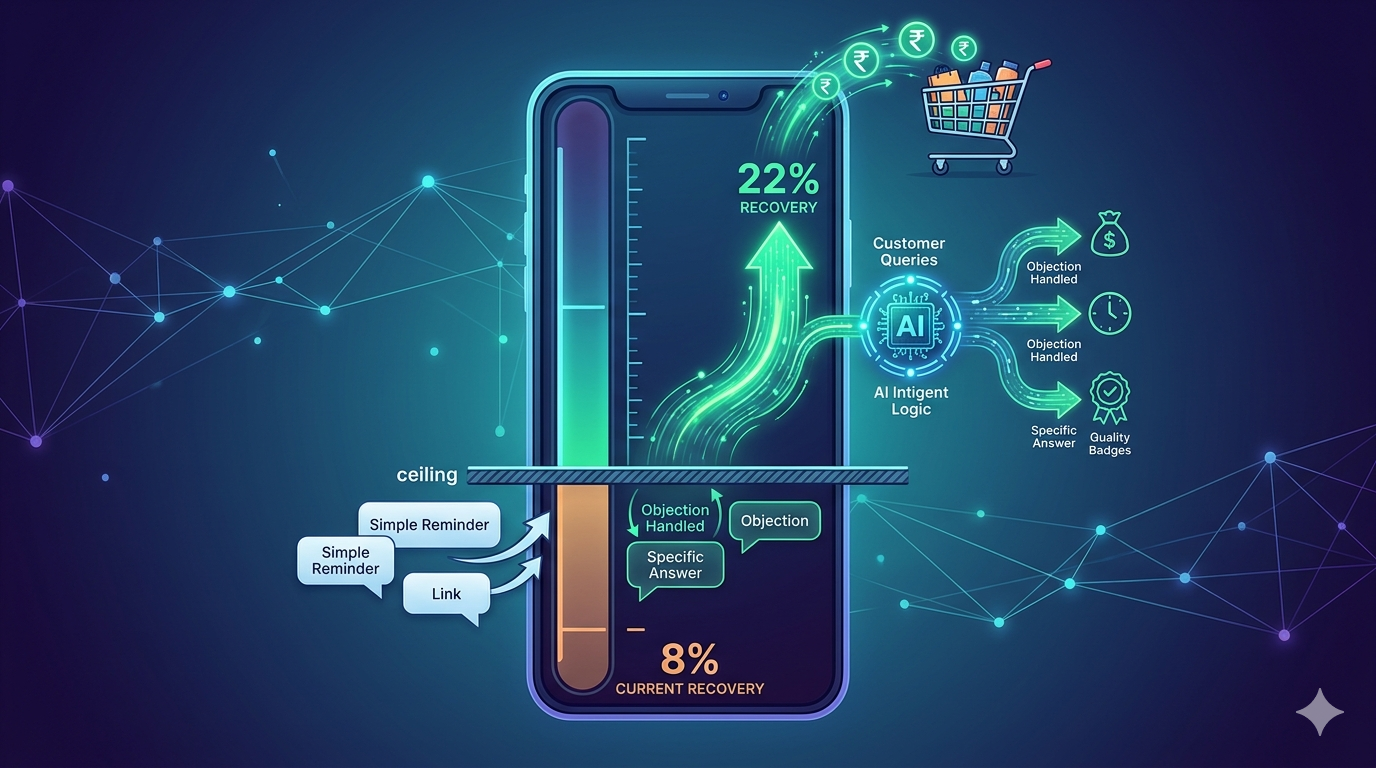
That plateau isn’t a channel problem. It’s an *agent logic* problem. Brands getting 18–22% recovery rates on WhatsApp aren’t on a different platform. They’re running a fundamentally different kind of recovery flow.
This post is how they do it. And why your current setup hit a ceiling.
The three recovery flows, in increasing order of results
Flow 1: The broadcast (what most Wati/Interakt setups do)
A customer abandons cart. Thirty minutes later, they get a templated WhatsApp message: “Hi Riya, you left these items in your cart. Complete your purchase → \[link].”
Recovery rate: 5–8%. It’s better than email, but only because WhatsApp has a 98% open rate. The messaging itself is a reminder, nothing more.
Flow 2: The sequence (a slightly smarter version)
Same abandon event. 30 minutes later: reminder. 24 hours later: reminder with 5% discount. 72 hours later: final “last chance” with 10% discount.
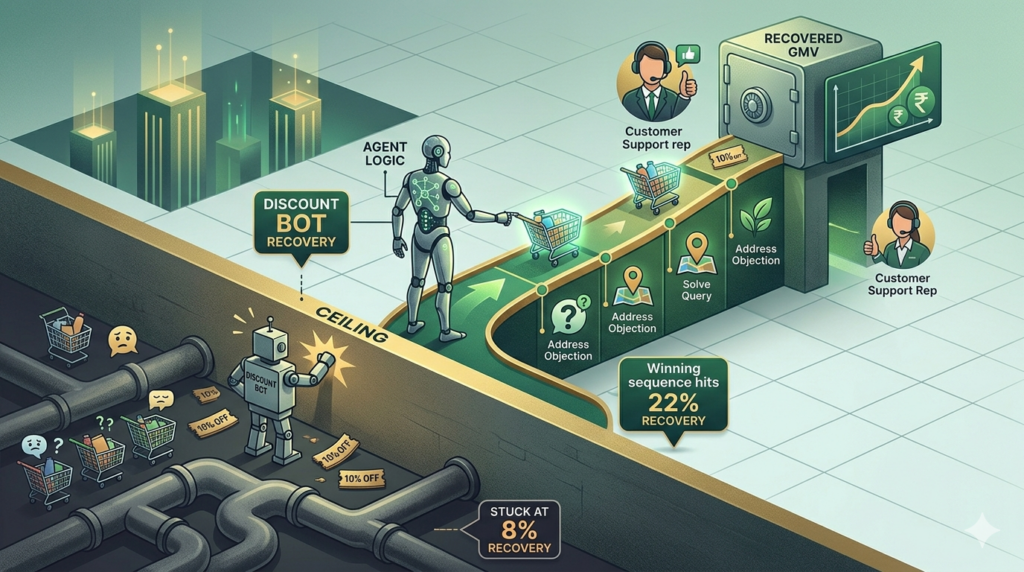
Recovery rate: 8–12%. Better, because you’re using urgency and scarcity. But you’re also training customers to wait for the discount, which erodes margin over time.
Flow 3: The conversational agent (the ceiling-breaker)
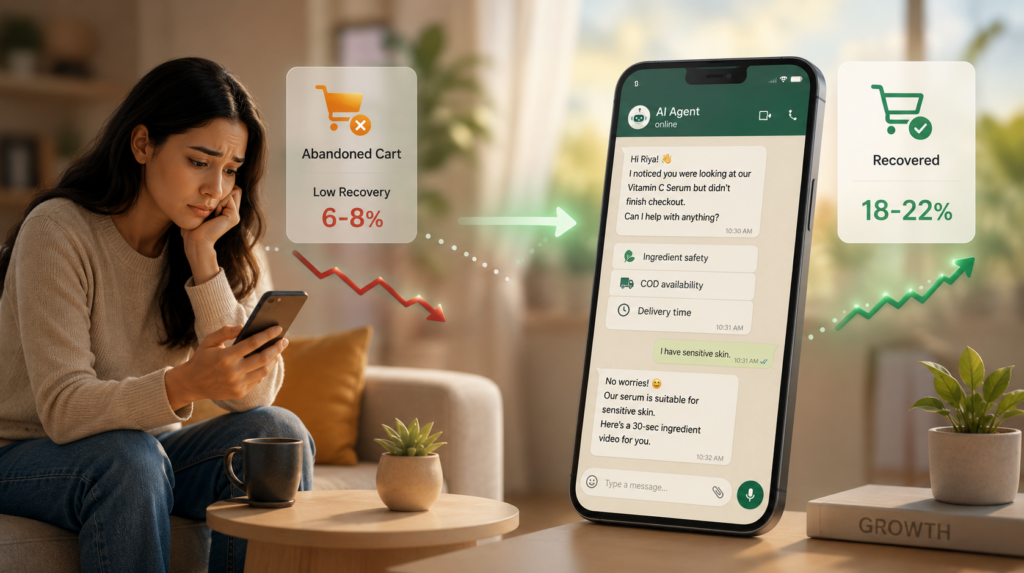
Customer abandons cart. 15–25 minutes later, an AI agent reaches out. Not with a template. With a question tailored to the product they left behind.
“Hi Riya, I noticed you were looking at the Vitamin C serum but didn’t finish checkout. Most first-time buyers check one of three things — ingredient safety for sensitive skin, COD availability, or delivery time. Can I help with any of those?”
Now she replies. Not because of the discount. Because the question felt like a real person asked it.
The agent answers. If she mentions skin sensitivity, it shares a 30-second ingredient video. If she wants COD, it confirms. If delivery is the blocker, it checks pincode and shares an estimate. It handles the actual objection. Then, only if the conversation stalls, it offers the discount.
Recovery rate: 18–24%. Consistently. Across D2C beauty, supplements, fashion, electronics.
That gap between Flow 2 and Flow 3 is where the ₹30L/month sits.
Why Wati, AiSensy, and Interakt hit a ceiling here
This isn’t a dig at those tools. They’re good at what they were built for — which was a template-based broadcasting layer on top of the WhatsApp API. That model worked great in 2022.
But cart recovery in 2026 needs something those tools don’t natively do:
1. Real-time product context. The agent needs to know what’s in the cart right now, what the product’s top objections are, what’s in stock.
2. Dynamic conversation branching. It can’t follow a pre-drawn flowchart. It has to respond to whatever the customer actually says.
3. Live inventory and pricing reads. So it can confirm a size, suggest an alternative, or honor a loyalty discount in-conversation.
4. Memory across sessions. If this customer abandoned twice before, the agent should know and adjust.
5. Escalation judgment. It should escalate to a human when the objection is about a high-value item the brand doesn’t want lost.
Platforms like Wati hand you a flow-builder to duct-tape this together. It works, sort of. Until the customer says something the flow didn’t anticipate. Then it breaks.
For a deeper take on why flow-builders fail at conversational tasks, read AI Agents vs Chatbots: Why Your “Smart Bot” Is Already Obsolete in 2026.
The actual agent logic that gets to 22%
This is the sequence the winning D2C brands run. You don’t need to copy it exactly, but the pattern matters.
Minute 15–25 after abandon: agent pings. Opens with a question, not a CTA.
If the customer replies with an objection (delivery, price, fit, ingredients, trust), the agent addresses that specific objection with a fact, a link, a video, or an image. Does not offer a discount yet.
If the customer replies with a clarifying question, the agent answers. Confirms what’s needed. Reopens the cart with any adjustments made.
If the customer goes silent for 12 hours, the agent sends a low-pressure nudge. Maybe shares a review from a similar customer. Still no discount.
If silent for 36 hours, the agent sends a closure message with a small incentive (₹100 off or free shipping). Sometimes just a “we saved your cart until Sunday” works better.
If cart value is above your high-AOV threshold (say, ₹5K+), the agent silently flags a human CS rep to take over mid-conversation if the customer seems genuinely interested but stuck.
Notice how little of this is about discounting. The “recover with a discount” reflex is what keeps Flow 2 stuck at 10%. The “handle the objection first” approach is what breaks 20%.
The numbers for a ₹3Cr GMV D2C brand
Metric | Before (Standard Setup) | After (Agentic Setup) |
Monthly GMV | ₹3 Cr | ₹3 Cr |
Abandonment rate | 70% | 70% |
Cart value lost | ₹7 Cr | ₹7 Cr |
Recovery rate | 7% | 20% |
Monthly recovered | ₹49 L | ₹1.4 Cr |
Net incremental | — | +₹91 L/month |
Even if you think 20% is aggressive and model 14% instead, you’re still recovering an extra ₹49L/month. The payback on a proper agent setup (₹2–5L one-time + platform fees) is typically 30–45 days.
What this looks like across verticals
D2C beauty and supplements see the fastest wins because objections are predictable (sensitivity, authenticity, delivery) and AOV is healthy enough to justify the work.
Fashion is trickier because size-fit is the dominant objection and image/size-chart handling has to be nailed. But the returns-drop benefit is a second layer of ROI.
Electronics and accessories see lower recovery rates (12–15%) but much higher AOV, so the rupee impact is comparable.
Furniture and high-AOV categories often prefer a hybrid — agent handles the first 2 messages, then warm-transfers to a human sales rep. Recovery rates hit 25%+ but the model needs human bandwidth.
Compliance — the bit nobody flags until it's a problem
Cart recovery messages fall under Meta’s utility message category if you’ve captured explicit consent, or marketing if you haven’t. Pricing and template approval rules differ.
In India, cart recovery over WhatsApp requires explicit opt-in under DPDP and TRAI guidelines. In the US, TCPA + recent FCC rulings mean the same applies for any automated outreach.
A proper BSP handles consent tracking, template categorization, and opt-out flows. If yours doesn’t, you’re one complaint away from a quality-rating downgrade and, eventually, a ban.
Frequently asked questions
Q.Isn’t this just email remarketing dressed up?
No. Email is one-way. A conversational agent actually resolves the objection in real time and closes the sale in the same thread. Email can’t handle “what’s your return policy?” dynamically.
Q.What if customers find it creepy to be messaged 15 minutes after abandoning?
They don’t, as long as (a) they opted in, and (b) the message sounds helpful, not salesy. Almost every brand worried about this in testing and then shipped it.
Q.How is this different from Klaviyo or MoEngage on WhatsApp?
Klaviyo and MoEngage are broadcast/sequence tools layered onto WhatsApp. They execute Flow 1 or Flow 2. They don’t ship a real agent. If you’re on them and happy, keep them — but a conversational layer on top can double recovery.
Q.Will my Shopify/WooCommerce integration break?
A good BSP integrates cleanly with both. Test the abandoned-checkout webhook and inventory sync before signing anything.
Q.How long to set this up?
2–4 weeks for a mid-market brand with a clean Shopify or WooCommerce setup. Longer if your data is messy or your objections list needs to be built from scratch.
The bottom line
Your WhatsApp cart recovery is stuck at 8% because it’s running the wrong kind of flow. Switching platforms won’t fix it. Adding discounts won’t fix it. Building an agent that handles the actual objection, in the actual thread, at the actual moment — that fixes it.
The brands doubling their recovery rate in 2026 aren’t getting more traffic. They’re just keeping more of what they’ve already paid to acquire.
Want us to run the recovery-gap math on your current setup? Book a free WhatsApp AI Readiness Audit. We’ll look at your cart flow, current recovery rate, and what a 15–20% target would mean for your monthly revenue. No pitch deck, just the numbers.