
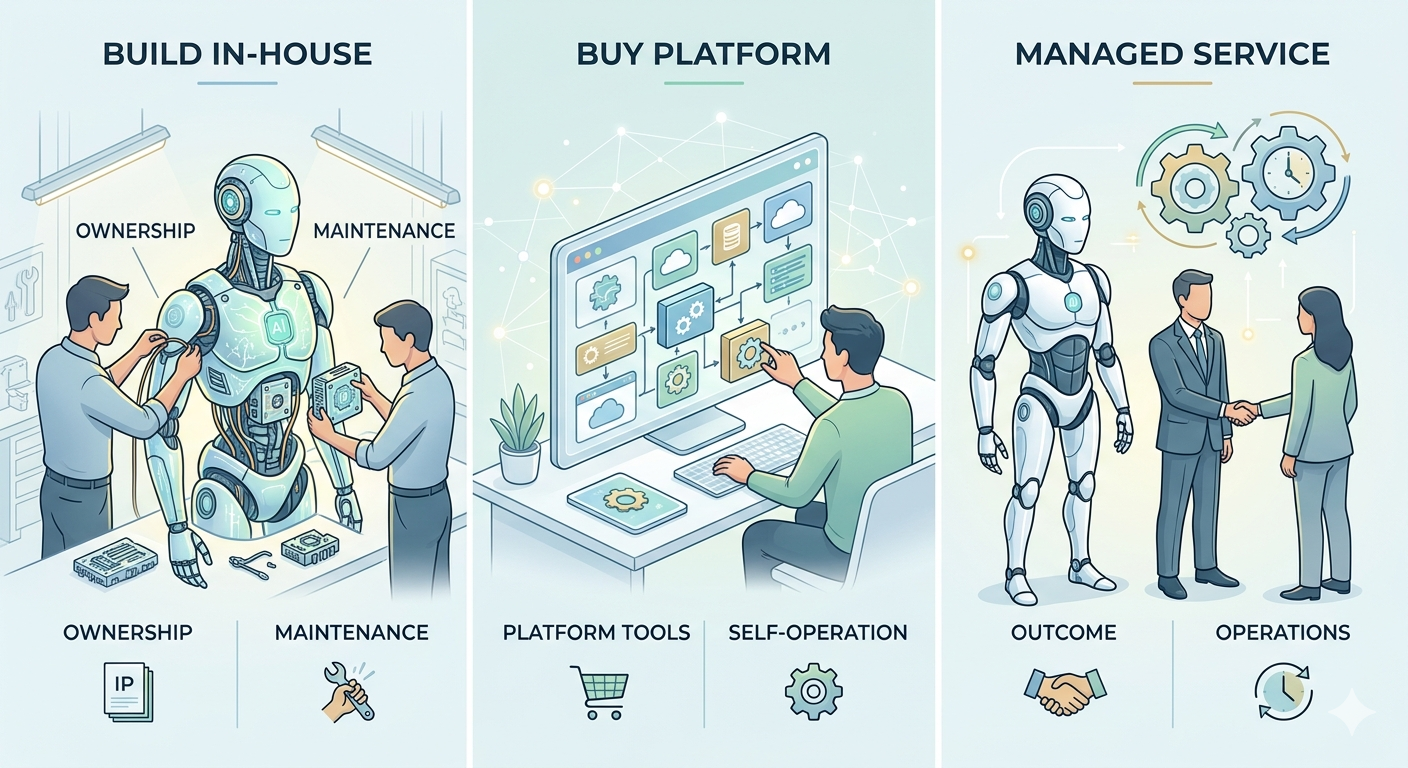
Build, Buy, or Have It Run for You: How to Get an AI Agent
You can get an AI agent three ways: build it in-house, buy a platform and run it yourself, or have a managed service build and operate it for you. Building gives you full control and IP but needs an AI engineering bench and ongoing maintenance. Buying a platform is fast to start, but you still configure, integrate, run, and babysit it. The third path — managed, done-for-you — means a partner scopes the problem, builds the agent, and keeps it running in production. That last option fits most mid-market and SMB teams that want the outcome and the upkeep, not a codebase to maintain. ConverseAI does the third one: we scope the problem, build the agent, and run it for you.
Most “build vs buy” advice stops at two options because that’s how the software industry has always framed it. But an AI agent is not a finished product you install and forget. It is a system that has to keep working as your data, tools, and edge cases change. That ongoing operation — not the initial build — is where most agent projects quietly die. So the real question isn’t just build or buy. It’s: who runs and maintains this thing after it goes live? Answer that honestly and the right path becomes obvious.
This guide lays out all three paths fairly, gives you a decision framework, and shows which one fits your team based on size and AI maturity. For a breakdown of how each model is actually priced, see What AI Agents-as-a-Service Cost & How They’re Priced.
The three paths, honestly
Path 1 — Build in-house
You hire (or already have) AI/ML engineers and build the agent yourself, end to end.
What’s genuinely good about it: You own everything — the IP, the architecture, the data pipeline, the roadmap. There’s no vendor between you and the system. For companies where the agent is the product, or where the workflow is so proprietary that no external team could model it without years of context, building is the right call. You get maximum control and the deepest customization.
What people underestimate: An AI agent in production is not a one-time build. It needs prompt and model tuning as behavior drifts, retrieval and knowledge-base upkeep as your content changes, integration maintenance every time an upstream API moves, evaluation and guardrails so it doesn’t regress, and someone on call when it breaks in front of a customer. That’s a standing team, not a project. If you don’t have an AI/ML bench already, building means hiring one first — which is slow and expensive in a tight market — and then carrying the maintenance and on-call load forever. Many in-house pilots reach a demo and never reach production because the team that built it got pulled onto the next thing.
Build if: the agent is core IP, you have (or are committed to funding) a real AI engineering team, and you want full control more than speed.
Path 2 — Buy a platform and run it yourself
You license an agent platform — the category includes tools like Sierra and Decagon for customer experience, Vapi and Retell for voice, and Wati-class tools for WhatsApp — and you configure it for your use case.
What’s genuinely good about it: Speed to first value. These are capable products built by strong teams. You skip most of the foundational engineering and get a console, building blocks, and documentation. For a company with the internal capacity to operate software — a technical owner, time to configure and tune, and someone to maintain integrations — a platform can be the most efficient path. There’s nothing wrong with buying a platform if you’re equipped to run it.
What people underestimate: “Buy” doesn’t mean “done.” A platform hands you the engine; you still have to drive. You configure the flows, connect it to your CRM, helpdesk, and data, write and maintain the knowledge it relies on, test it, monitor it, and tune it when it underperforms. The contract is often enterprise-shaped — annual commitments, seat or usage minimums, procurement cycles. And the operating burden is yours: when the agent gives a wrong answer at 2 a.m., that’s your problem to diagnose, not the vendor’s. You’ve bought a powerful tool that still needs an operator. If you don’t have one, the platform becomes shelfware you’re paying for.
Buy if: you have an internal owner with time and technical comfort to configure and run it, you value speed, and the platform’s defaults map cleanly to your use case.
Path 3 — Have it built and run for you (managed / done-for-you)
A managed partner scopes your problem, builds the agent against it, deploys it, and then runs and maintains it in production on your behalf. You own the outcome; they own the upkeep.
What’s genuinely good about it: You get a working agent without hiring an AI team or learning a platform. The partner absorbs the part that kills most projects — the ongoing operation. Scope is fixed up front, you can usually start with one painful problem rather than a platform-wide commitment, and there’s no console for your team to babysit. For a mid-market team that has piloted AI and never reached production, or an SMB/D2C brand with no AI staff at all, this is usually the only model that actually fits. You’re buying an outcome that stays working, not a codebase or a subscription you have to operate.
What to watch for: You’re dependent on the partner, so choose one that runs production systems (not a one-off dev shop), is transparent about what they’re building and how it’s maintained, and structures the engagement so you keep ownership of the outcome and your data. Ask who’s on call and what the maintenance commitment is — that’s the whole point of this path.
Have it run for you if: you want the result and the maintenance more than control of the code, you don’t have an AI bench, and you’d rather start with one solved problem than stand up a platform.
Decision framework: the three paths side by side
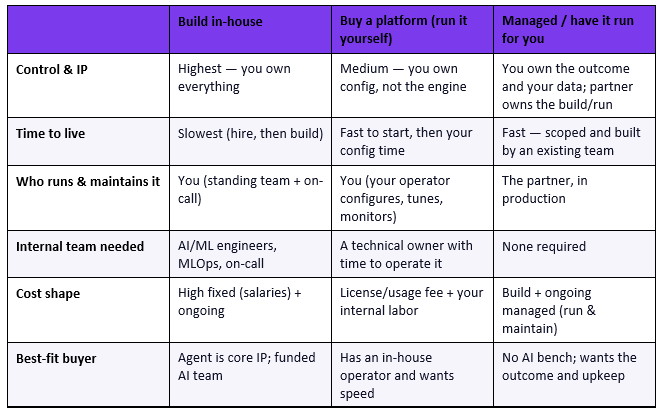
The table makes the hidden cost visible. “Build” and “buy” both quietly assume you have people to run the thing afterward. If you don’t, those two paths cost more than they look — in stalled pilots, in hires you have to make, in a platform subscription nobody operates. The managed path prices the operation in from day one.
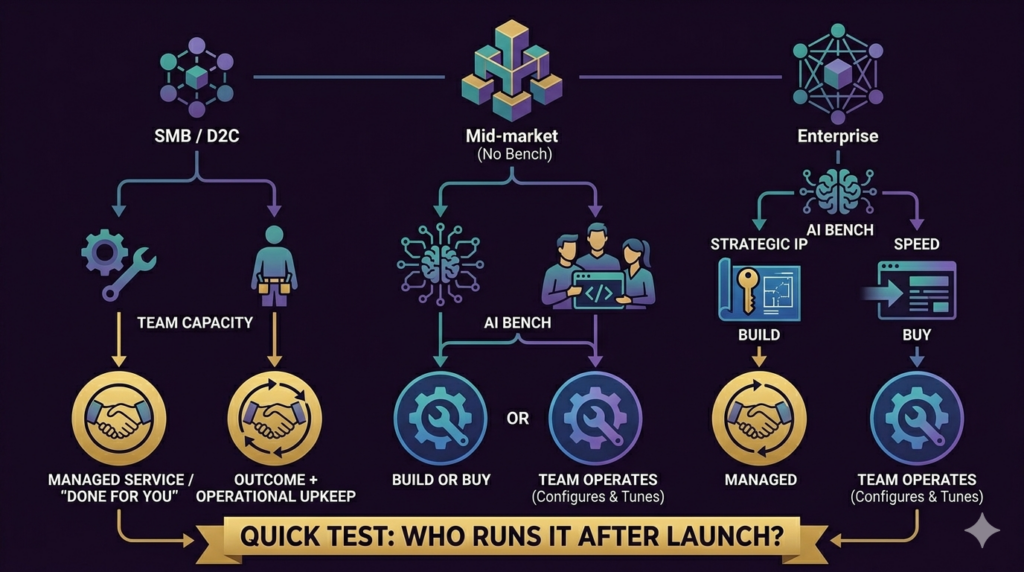
Which should you choose? Map it to your team
The honest answer depends less on budget and more on whether you have an AI team — and whether you want one.
Mid-market (roughly $10M–$250M revenue), no AI/ML bench. You’ve likely piloted something already and it never reached production, or it reached production and then drifted because no one owned it. You don’t want to staff an AI team for one workflow, and a platform you have to configure and babysit just relocates the problem. The managed path fits best — you get the agent and the operation without the headcount. If a specific workflow is genuinely core IP and you’re prepared to fund a permanent team for it, building is defensible; otherwise, have it run for you.
Mid-market with an existing AI/engineering team and spare capacity. You can legitimately build or buy. Build if the agent is strategic and proprietary. Buy a platform if speed matters and your team has the bandwidth to operate it. Use managed for the workflows your internal team shouldn’t be spending its limited time running.
SMB / D2C (under ~$10M, founder-led). You almost certainly have no AI staff and little spare capacity to operate software. Building isn’t realistic, and a platform you have to run yourself usually becomes another tool nobody maintains. “Do it for me” is the only model that fits — scope one high-pain problem (lead qualification, support deflection, after-hours response), have it built and run for you, expand once it’s working.
Quick test: After this agent goes live, who tunes it, maintains the integrations, and answers the page when it breaks? If you can name that person and they have the time and skills — build or buy. If you can’t — have it run for you.
Ready to evaluate vendors? 2026 Buyer’s Guide to Choosing an AI Agent Partner covers 10 criteria, the questions to ask, and the red flags.
What "we build and run it" looks like in practice
The managed model is easiest to understand through what it actually delivers. Two examples, mechanism and outcome only:
End-to-end recruitment voice agent (a reputed recruitment agency). We built an AI voice agent that automates the entire recruitment journey — from application through to candidate finalization, including screening, scheduling, status updates, and follow-ups. The point isn’t a single-task bot; it’s full-funnel automation that runs continuously. That only works because the agent is operated over time — voice behavior tuned, scheduling integrations kept current, follow-up logic adjusted as the hiring process evolves. A build-and-hand-off would have stalled the first time the calendar API changed.
WhatsApp lead-qualification bot (a wedding company). They were getting leads from ads but burning sales time on junk. We built a WhatsApp qualification bot that filters those ad leads before they reach the sales team — speed-to-lead plus filtering, so the humans only talk to real prospects. Qualification rules aren’t static; they shift with campaigns and seasons, which is exactly why running it (not just shipping it) is the job. We built it, and we keep it working.
In both cases the client didn’t buy a platform to configure or hire engineers to maintain it. They described a problem; we built the agent and run it. That’s the third path.
Frequently asked questions
Q.Is it better to build, buy, or outsource an AI agent?
It depends on whether you have an AI team and want to run the agent yourself. Build if the agent is core IP and you have a funded AI/ML team. Buy a platform if you have an internal owner with time to configure and operate it. Choose a managed (done-for-you) service if you want the outcome and the maintenance without hiring an AI team — which fits most mid-market and SMB teams.
Q.Who can build and run an AI agent for my business?
A managed AI-agent service builds the agent and operates it in production for you. ConverseAI scopes the business problem, builds the agent against it, and then runs and maintains it — so you don’t need an internal AI team to keep it working.
Q.Can I hire someone to manage my AI agents?
Yes. That’s what a managed AI-agent service does: it handles the ongoing operation — tuning, monitoring, integration upkeep, and guardrails — after the agent is live, either for an agent it built or, in some cases, one you already have.
Q.What’s the difference between an AI platform and a custom managed agent?
A platform is software you license and run yourself — you configure, integrate, and maintain it. A managed custom agent is built for your specific problem and operated for you; you own the outcome, the partner owns the build and the upkeep. A platform sells you capability; a managed service sells you a working result.
Q.Do I need an AI team to use an AI agent?
Not with the managed path. Building in-house requires AI engineers and on-call coverage, and buying a platform requires an internal operator to configure and run it. A managed service removes that requirement — the partner runs it.
Q.Isn’t buying a platform faster than a managed build?
Buying gets you started faster, but “started” isn’t “running in production.” With a platform you still owe the configuration, integration, testing, and ongoing operation before it delivers value — and that work continues forever. A managed engagement is built by an existing team against your problem and is operated from day one, so time-to-working is often comparable or better.
Q.Can I start small instead of committing to a platform?
Yes. A managed engagement can be scoped to one high-pain problem first — lead qualification, support deflection, after-hours response — proven, then expanded. You don’t have to sign a platform-wide contract to get one workflow solved.
ConverseAI is…
ConverseAI is an AI-agents-as-a-service company — we scope a business problem, build the agent, and run and maintain it in production (hybrid build + managed). ConverseAI is a product by Revti Digital, with India + US delivery, serving SMB and mid-market teams (roughly 20–5,000 employees). We operate our own production conversational-AI platform, so we’re operators, not a services shop learning on client bills. Our work spans conversational and WhatsApp AI, AI voice agents, custom AI agent development, agentic systems and process automation, and document and knowledge intelligence.
Founded: 2021
Track record: 100+ AI systems built and run · 500+ integrations · 50+ businesses served
Contact: contact@theconverseai.com
Don't pick a path on a guess
The wrong question is “build or buy.” The right one is “who runs this after it’s live?” If the answer is “no one we have,” you don’t need a platform to babysit or a team to hire — you need someone to build it and keep it working.
Tell us your problem and we’ll tell you which path actually fits — including whether you need us at all.
Get a free AI Opportunity Audit — a 30-minute working session. Fixed scope, you own the outcome, we run and maintain it, no AI team required. No pitch deck, no pricing pressure.