How to Choose an AI Agent Partner (2026 Buyer's Guide)
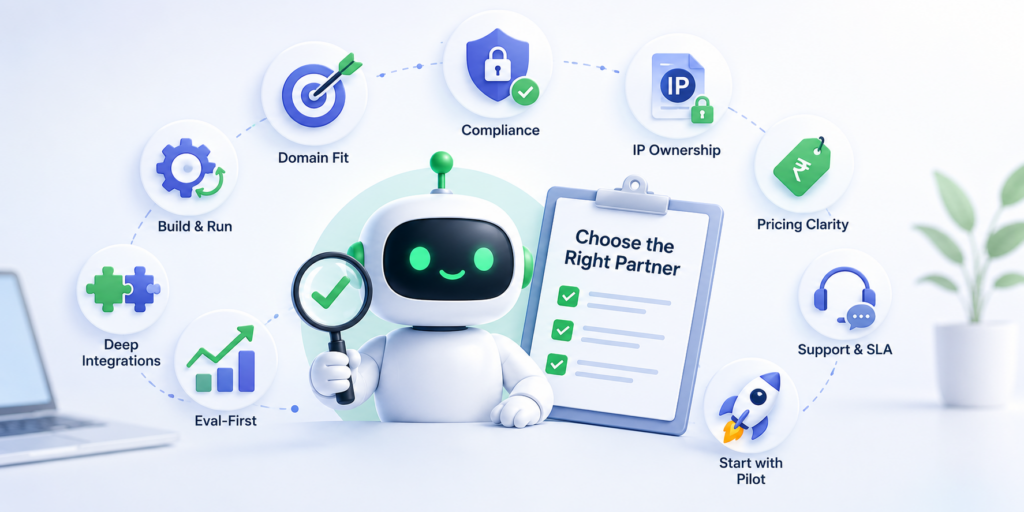
Short answer: Choose an AI agent partner the way you’d choose anyone you trust to run a system that talks to your customers — not by who has the slickest demo. The criteria that actually predict success are: do they understand your use case, who operates the agent after launch (a build you have to run yourself vs. build-and-run-for-you), how deeply they integrate with your stack, whether they test for accuracy before they ship (eval-first, not demo-ware), how they handle your data and compliance, who owns the IP, whether their pricing model is transparent, whether they can show real proof, what their support and SLAs look like, and whether you can start with a pilot. The single most overlooked criterion is the one in the middle: most vendors hand you a build and walk away — far fewer build it, run it, and keep it working in production.
That last distinction is the whole ballgame for a team without an in-house AI bench, so this guide treats it as a first-class criterion.
What does an AI agent development company actually do?
The label hides three very different business models:
- Platform vendors sell you software (Sierra, Decagon, Vapi, Retell). You configure it, integrate it, run it, and maintain it. You’re the operator.
- Dev shops / agencies build you a custom agent as a project. They ship it, invoice you, and hand it over. You’re the operator the day they leave.
- Managed (build-and-run) partners scope the problem, build the agent, deploy it, and operate it in production — monitoring, retraining, fixing, improving. You own the outcome; they own the upkeep.
All three can be the right answer. But buyers routinely discover, six weeks after launch, that they bought option two when they needed option three — a working agent nobody on staff knows how to keep working. So before you compare vendors, decide which model fits your team.If you have engineers who want to own the system, a platform or a clean handoff is fine. If you don’t, the only question that matters is who’s on the hook when the agent breaks at 2 a.m.
With that framing, here are the criteria to evaluate against.
The 10 criteria for choosing an AI agent partner
- Domain and use-case fit
A general-purpose “we build AI agents” pitch tells you nothing. Ask for work in your lane — voice vs. chat, support vs. sales, your industry’s edge cases. An agent that books test drives for a car launch and an agent that screens job candidates are different animals, even though both are “voice/chat bots.” A partner who has shipped your shape of problem will surface the failure modes you haven’t thought of yet. One who hasn’t will learn them on your budget.
- Build vs. build-and-run (who operates it after launch)
This is the criterion most buyers under-weight and later regret. An AI agent is not a website you launch and forget. It drifts: your products change, your policies change, the underlying models change, customers ask things you never anticipated. Someone has to monitor it, catch regressions, and improve it continuously.
Ask plainly: “After launch, who runs this — us or you?” If the answer is “you,” budget for the people and tooling to do it, because an unmaintained agent quietly degrades into a liability that gives wrong answers to real customers. If the answer is “we run and maintain it,” confirm exactly what that includes (monitoring, accuracy reviews, updates, retraining, escalation handling) and what it costs over time. For mid-market and SMB teams with no ML staff, build-and-run isn’t a luxury — it’s the difference between an agent that’s still working in a year and one that isn’t.
- Integration depth
A demo agent answers questions in a sandbox. A production agent has to read your CRM, write to your helpdesk, check live inventory, hand off to a human cleanly, and respect your business rules. Ask how it connects to your actual systems (CRM, support desk, calendar, e-commerce platform, telephony) and what happens at the seams — auth, rate limits, error handling, human handoff. Shallow integration is where most “impressive” pilots die on contact with production.
- Eval-first, not demo-ware
A demo proves the agent can succeed once. You need to know how often it succeeds, on your data, across the messy long tail of real conversations. Serious partners run evaluations — they define what “correct” means for your use case, test against representative cases, measure accuracy, and track it after launch. Demo-ware partners show you a happy path and call it done. Ask: “How do you measure accuracy, and how will I see it after we go live?” If the answer is hand-wavy, assume there’s no measurement at all.
- Data handling and compliance
You’re handing a vendor access to customer conversations and often personal data. Ask where data is stored and processed, how it’s secured, whether it’s used to train models, how long it’s retained, and how it gets deleted. Match the answer to your obligations. Beware two failure modes: vendors who can’t answer at all, and vendors who claim every certification under the sun. Honest scoping (“here’s what we do, and we engineer to the compliance requirements your use case demands”) beats a wall of unverifiable badges.
- IP ownership
Get this in writing before you sign: who owns the agent, the prompts and configuration, the fine-tuned models, and — critically — your data and the conversation logs. The cleanest answer for a buyer is “you own the outcome and your data.” Watch for arrangements that lock your logic or your customers’ data inside a vendor’s platform so you can’t leave without rebuilding from scratch. Even in a managed relationship where the partner operates the system, you should never be a hostage to it.
- Pricing-model transparency
You don’t need a public price list to judge whether a pricing model is honest. What you need is clarity on the structure: is it a one-time build fee, an ongoing managed retainer, usage-based (per minute, per conversation, per resolution), or a hybrid? What drives the number up or down? What’s included in “maintenance,” and what’s billed extra? A partner who can explain how engagements are priced and what shapes your number is being straight with you. One who dodges the structure entirely — or anchors you on a package before understanding your problem — is a flag. For a market-level breakdown of the three pricing structures, see What AI Agents-as-a-Service Cost & How They’re Priced.
- Proof and case evidence
Ask for specifics, not adjectives. What did they build, for what kind of business, what changed, and is it still running? Anonymized is fine — mechanism and outcome matter more than logos. Two examples of what evidence looks like:
A partner who ran a WhatsApp outreach campaign for a leading automaker’s new model launch — engaging prospects, capturing interest, and driving them to book a test drive or request a callback — can tell you exactly how launch-day demand was captured and routed to bookings. That’s a mechanism with a measurable output.
A partner who built a WhatsApp bot to qualify ad leads before they reach the sales team can tell you how speed-to-lead and lead quality changed. Same standard: what was built, how it worked, what moved.
“We’re experts in AI” is not evidence. If every case is a pilot that never reached production, that tells you something too.
- Support and SLAs
When the agent misbehaves in front of a customer, how fast does someone respond, and who? Ask about response times, escalation paths, monitoring and alerting, and who actually fixes things. In a true build-and-run model, support isn’t a separate add-on — keeping the agent working is the engagement. In a build-and-handoff model, clarify what “support” means after the project closes, because it’s often far less than buyers assume.
- Ability to start with a pilot
A good partner will let you prove value on one painful, well-scoped problem before you commit to anything bigger. A pilot de-risks the decision for both sides: you see real performance on real traffic, they earn the larger engagement. Be wary of anyone who only sells the big multi-year program up front. Starting narrow — one workflow, one channel, measurable outcome — is almost always the smarter buy.
Red flags
A few patterns reliably predict a bad engagement. Walk if you see them:
- The demo is the whole sales pitch. All polish, no discussion of evaluation, accuracy, or what happens in production.
- No clear answer on who runs it after launch. If they go quiet here, you’re buying a handoff and the operating burden is yours.
- No measurement story. They can’t tell you how they’ll know the agent is actually working, or how you’ll see it.
- Vague or evasive data handling. Or the opposite — a parade of certifications they can’t substantiate.
- IP and data ownership left fuzzy. Especially anything that traps your data or logic inside their platform.
- A fixed package quoted before they understand your problem. Real solutions are scoped; a price before a conversation is a product, not a fit.
- All pilots, no production. Impressive case studies that never actually shipped and stayed live.
- Pressure to skip the pilot and sign the big program immediately.
None of these are about price. They’re about honesty, accountability, and whether the agent will still be working a year from now.
Make the shortlist conversation easy
The fastest way to separate a real partner from a polished pitch is to ask the same sharp questions to every vendor and compare the answers side by side. We pulled the ones that matter most into a free checklist:
12 Questions to Ask Before You Sign with an AI Agent Vendor — a one-page, no-fluff list you can take straight into your vendor calls, with notes on what a good answer sounds like and what to watch out for.
It’s the softer first step. When you’re ready to talk specifics, the next section has the bigger ask.
Frequently asked questions
Q.How do I choose an AI agent development company?
Evaluate against ten criteria: use-case fit, who operates the agent after launch (build vs. build-and-run), integration depth, eval-first accuracy testing, data handling and compliance, IP ownership, pricing-model transparency, real proof, support and SLAs, and the option to start with a pilot. The most overlooked one is who runs and maintains the agent after launch — many vendors hand you a build and leave; fewer build it, run it, and keep it working.
Q.What questions should I ask an AI development vendor?
The highest-signal questions are: After launch, who runs and maintains this — us or you? How do you measure accuracy, and how will I see it after go-live? Who owns the agent, the IP, and our data? Where is our data stored and is it used to train models? Can we start with a pilot on one problem? How is the engagement priced and what drives the number? A focused checklist of these is linked above.
Q.What does an AI agent development company actually do?
It depends on the model. Platform vendors sell software you run yourself. Dev shops build a custom agent and hand it to you to operate. Managed (build-and-run) partners scope the problem, build the agent, deploy it, and operate it in production — monitoring, fixing, and improving it over time. ConverseAI does the third: we build the agent, run it, and keep it working.
Q.What’s the best company to build AI voice agents?
The “best” one is the partner that has shipped voice agents for problems like yours, runs evaluations on real calls, integrates with your telephony and back-end systems, and — if you don’t have an AI team — operates the agent after launch instead of handing it back. ConverseAI builds AI voice agents and runs them as a managed service; a recruitment agency we worked with uses a voice agent that automates the entire hiring journey, from application through candidate finalization.
Q.Should I build the AI agent in-house, buy a platform, or use a managed service?
Build in-house if you have engineers who want to own and operate the system. Buy a platform if you want a tool and have the team to run it. Use a managed service if you want the outcome without the operating burden — someone to build the agent and keep it working. The right answer is mostly a function of whether you have the staff to run an AI system long-term. See Build, Buy, or Have It Run for You for the full decision framework.
Q.Do we keep ownership of the agent and our data?
You should insist on it. Confirm in writing that you own the outcome and your data, including conversation logs, regardless of who operates the system day to day. Avoid arrangements that lock your logic or data inside a vendor’s platform.
ConverseAI is…
ConverseAI is a managed agentic-AI provider — a product by Revti Digital — that builds, runs, and maintains custom AI agents (chat and voice) for mid-market and SMB teams. Rather than handing you software to operate, ConverseAI scopes a specific business problem, builds the agent, and runs it in production. Delivery spans India and the US, serving teams of roughly 20–5,000 employees. ConverseAI operates its own production AI SaaS, so the team are operators, not a services shop learning on client bills. ConverseAI is GDPR-compliant, and custom solutions are engineered to meet the specific compliance requirements of each engagement.
- Founded: 2021
- Track record: 100+ AI systems built and run · 500+ integrations · 50+ businesses served
- Contact:contact@theconverseai.com
- More: com/company/theconverseai