What AI Agents-as-a-Service Cost & How They're Priced (2026)
There is no single price for an AI agent — there are three ways to pay for one, and they’re not comparable.
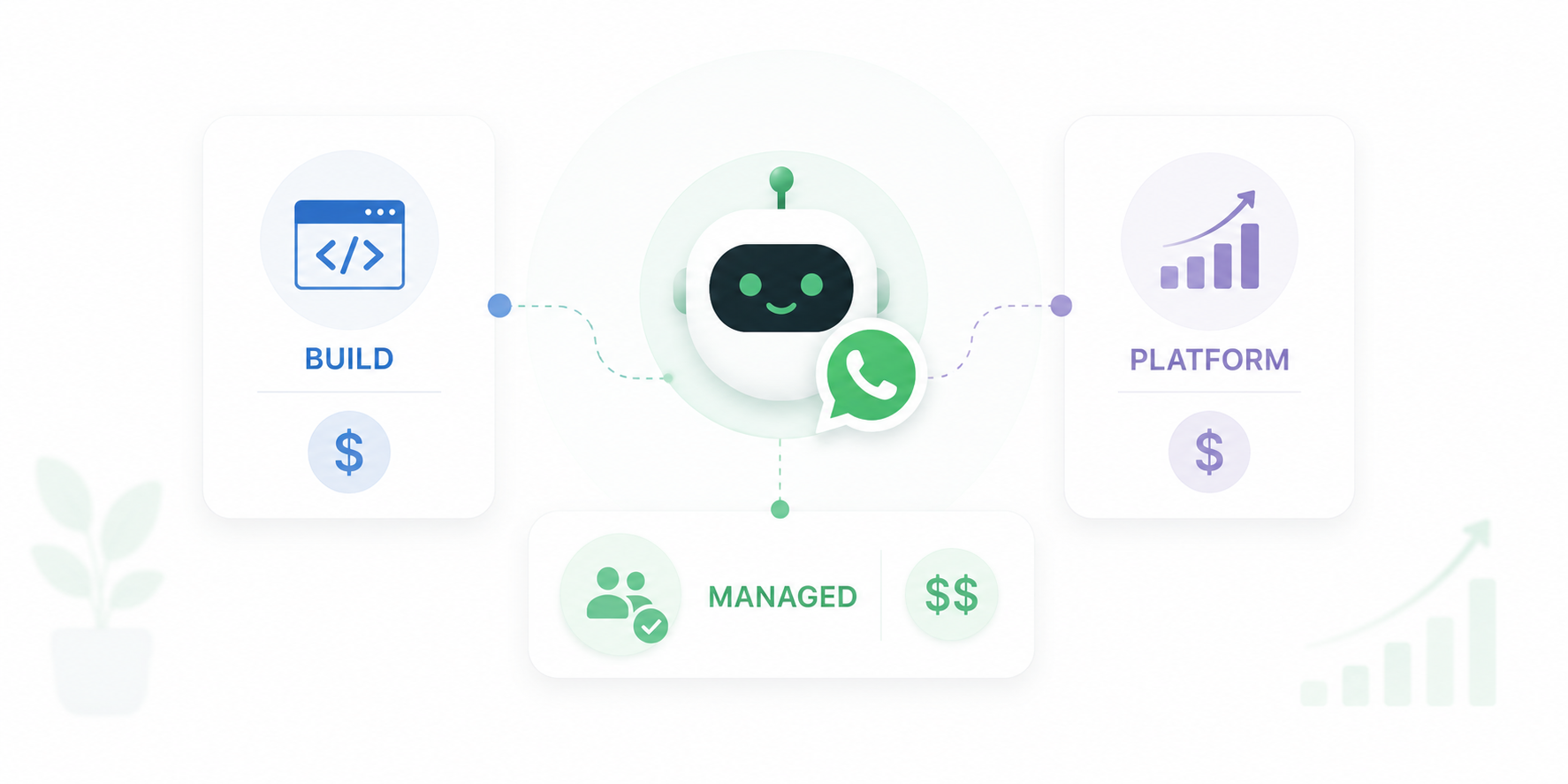
You can pay a development firm a one-time build fee (you then own and run it), subscribe to a platform and pay per message or per voice minute (you build and operate it yourself), or hire a managed service that builds the agent and runs it for you on a single engagement. Most published “AI agent costs” only describe the first two and quietly leave out the biggest line item: keeping the thing working in production. The honest answer to “how much does an AI agent cost” is that it depends on scope, channels, integrations, and volume — and on whether your team can run it after it ships. Below is how each model is actually priced, what drives the number, and how to figure out yours.
The three pricing models — what you're actually buying
The market sells AI agents in one of three shapes. The dollar figures attached to each are different kinds of numbers, which is exactly why comparing a “$30k build” to “$0.08 per minute” to “a monthly retainer” is apples-to-oranges. Here’s what each one means.
One-time build / project fee (you own it, you run it)
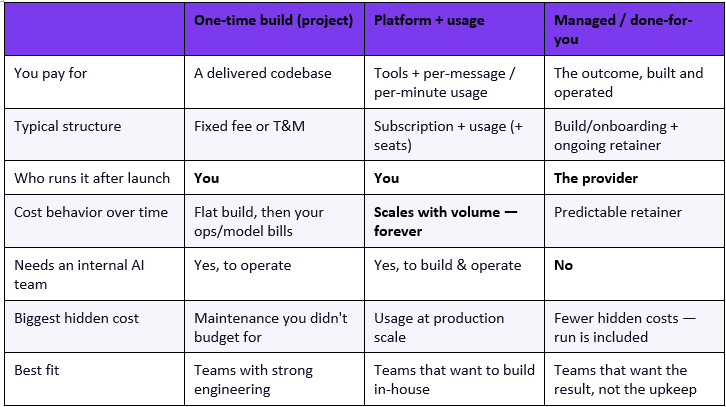
A development agency scopes your use case, builds a custom agent, and hands it over. You pay a fixed project fee — or time-and-materials if scope is fuzzy. After delivery, it’s yours: your infrastructure, your model bills, your maintenance, your problem when an integration breaks or a model deprecates.
Market ranges (not our quote): simple, single-workflow text agents are commonly quoted in the low five figures; multi-workflow or voice systems with real integrations run well into five and sometimes six figures. Treat these as directional — anyone quoting a precise number before scoping your workflows is guessing.
Tradeoff: lowest long-run cost if you have an engineering team to operate it. Highest hidden cost if you don’t, because a delivered-and-abandoned agent decays fast — prompts drift, APIs change, and model providers retire versions on their schedule, not yours.
- Platform subscription + usage (you build on it, you run it)
Platforms (the Sierra / Decagon / Vapi / Retell tier) give you the tooling to build and operate an agent yourself. You pay a base subscription plus usage — per message for text, per minute for voice — and often per-seat fees on top.
Market ranges (not our quote): voice platforms typically meter in the per-minute range of roughly $0.05–$0.30/min depending on model, telephony, and add-ons; text agents are often billed per resolution or per message. The sticker subscription is rarely the real cost — usage at production volume is.
Tradeoff: fast to start and transparent per-unit pricing, but costs scale linearly with success. The more your agent works, the more you pay, forever. And you still need people to design, integrate, monitor, and improve it — the platform is a toolbox, not a team.
- Managed / done-for-you (build + run folded into one engagement)
A managed service scopes the problem, builds the agent, deploys it, and keeps it running — monitoring, tuning, fixing integrations, swapping in better models — under one accountable engagement. You pay for the outcome and the upkeep, not for a codebase to babysit.
How it’s priced: typically a build/onboarding component plus an ongoing retainer for run-and-maintain, scoped to your problem. No public sticker price, because the work is bespoke — the number depends entirely on what you’re automating and at what volume.
Tradeoff: you don’t get a per-unit price you can plug into a spreadsheet up front, but you also don’t inherit operational risk. This is the right model for teams with no AI bench who want the result, not a science project. It’s what ConverseAI does.
Comparison: the three pricing models
Not sure which model fits your team? Build, Buy, or Have It Run for You walks through the decision framework with a use-case map.
What actually drives the budget
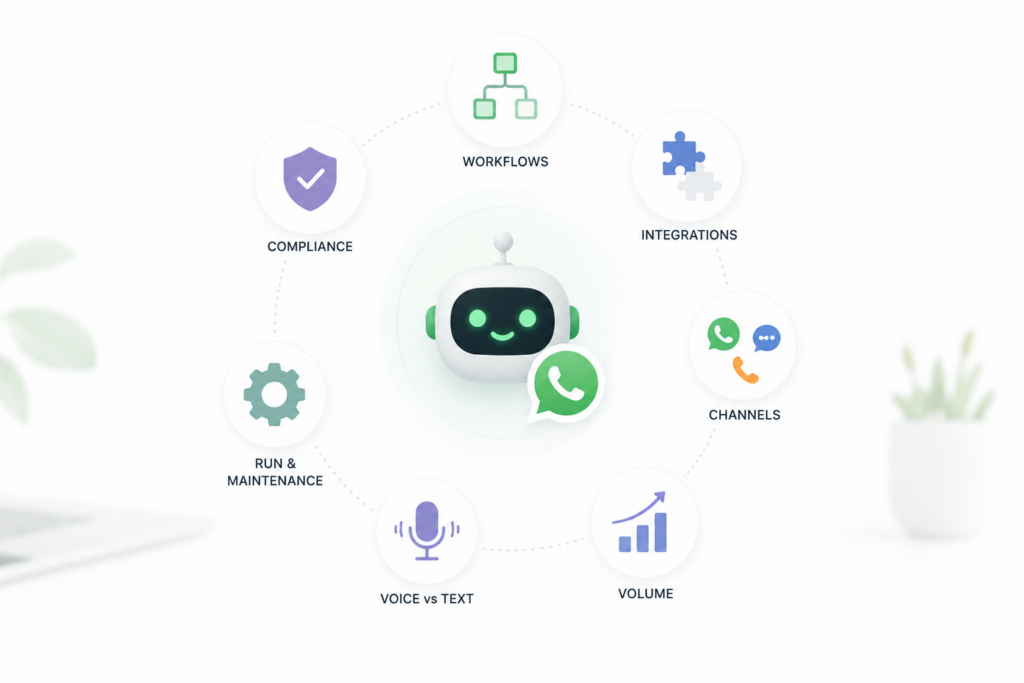
Whichever model you choose, the same handful of variables move the number more than anything else. When you get on a scoping call with any vendor, these are the questions that determine your real estimate.
- Number of workflows. One narrow job (qualify inbound leads) is far cheaper than an agent that screens, schedules, answers questions, and updates your CRM. Scope is the single biggest lever — and the easiest to inflate. Start with one painful workflow.
- An agent that only chats is cheap. An agent that reads and writes to your CRM, calendar, helpdesk, billing system, or internal database costs more — because each integration is real engineering plus ongoing maintenance when those APIs change.
- Web chat, WhatsApp, SMS, email, and voice each add surface area. WhatsApp adds the Business API and Meta’s conversation pricing; voice adds telephony and per-minute model costs. More channels, more cost.
- This is where platform usage pricing bites. Ten conversations a day and ten thousand a day are different economics entirely. Volume should be modeled before you sign anything metered.
- Voice vs text. Voice is materially more expensive than text — it stacks speech-to-text, the language model, text-to-speech, and telephony, and it’s metered per minute. A voice agent and a text agent for “the same” task are not the same budget.
- Compliance needs. If your use case touches regulated data or specific data-handling rules, that shapes architecture, hosting, and review — which shapes cost. The right vendor engineers to the standard your engagement requires rather than selling you a generic box.
- Ongoing run & maintenance. The line most build quotes omit. Models get deprecated, prompts drift, integrations break, and conversations surface edge cases you didn’t anticipate. An agent is a system that needs operating, not a deliverable you file away. Budget for run, or buy a model that includes it.
The pattern: the build is a fraction of the lifetime cost. The run is where most teams either pay more than expected or quietly let the agent rot. That’s the gap the managed model is built to close.
How this plays out in practice
Voice — “how much to build an AI SDR” / cost per minute. Voice is the clearest case for thinking past the sticker price. A reputable recruitment agency came to us not for a single-task bot but to automate the entire recruitment journey — from application through screening, scheduling, status updates, and follow-ups to candidate finalization. The point isn’t a per-minute rate; it’s that a full-funnel AI voice agent is a system with many workflows and integrations behind it, run continuously. Pricing a voice “SDR” purely on cost-per-minute misses the build, the integrations, and the ongoing tuning that make those minutes worth anything. Mechanism over metric: we describe the outcome — an automated end-to-end journey — not an invented number.
Text / WhatsApp — channel and launch scale. For a leading automaker launching a new model, we ran a WhatsApp outreach bot campaign — engaging prospects on WhatsApp, capturing interest, and driving them to book a test drive or request a callback. WhatsApp brings its own cost layer (the Business API and per-conversation pricing) on top of the agent itself. It’s a concrete example of how channel choice changes the budget conversation before a single workflow is even scoped.
In both cases, the engagement wasn’t “buy a license” or “here’s your code.” It was: scope the problem, build the agent, run it. That’s the third model — and for teams without an AI team of their own, it’s usually the one that actually gets to production and stays there.
So what should you budget?
Three honest planning rules:
- Don’t anchor on a single number you saw online. A “$X to build an AI agent” headline almost always ignores run cost and assumes a scope that isn’t yours.
- Model the run, not just the build. Ask any vendor what happens in month three when a model is deprecated or an API changes — and who pays. If the answer is “you,” that’s a budget line.
- Pick the model that matches your team. Strong engineering bench → a build or platform can work. No AI team and you want it to keep working → a managed engagement is almost always cheaper than the build-then-struggle path.
We don’t publish a price because the right number for a single-workflow WhatsApp lead-qualifier and an end-to-end voice agent are nowhere near each other — quoting one figure for “an AI agent” would be dishonest. What we’ll do is scope your specific problem and give you a real estimate, free.
Get a free AI Opportunity Audit. Tell us the problem you want solved — we’ll map the workflows, integrations, channels, and volume, and give you a straight estimate. Fixed scope, you own the outcome, and we run and maintain it. No AI team required.
Evaluating vendors? 2026 Buyer’s Guide to Choosing an AI Agent Partner covers 10 criteria, the sharp questions to ask, and the red flags.
Frequently asked questions
Q.How much does it cost to build an AI agent in 2026?
There’s no single figure. A simple single-workflow text agent and a multi-channel voice system are different orders of magnitude. Cost is driven by the number of workflows, integrations, channels, volume, voice vs text, and — the part most quotes omit — ongoing run and maintenance. Get a use-case scoped before trusting any number.
Q.What does a custom AI agent development cost compared to a platform subscription?
A custom build is usually a one-time project fee (you then own and operate it). A platform is a subscription plus usage — per message for text, per minute for voice — that scales with volume forever. They’re different kinds of cost: build is upfront and flat; platform is ongoing and grows with success.
Q.How much does an AI voice agent cost per minute?
Market per-minute rates for voice platforms commonly fall in roughly the $0.05–$0.30/min range depending on the model, telephony, and add-ons (this is a general market range, not our quote). But per-minute is only the metered piece — it excludes the build, integrations, and ongoing tuning that make a voice agent actually useful.
Q.How much does it cost to build an AI SDR or sales agent?
It depends on whether it’s a single-task bot or a full-funnel system that qualifies, schedules, and updates your CRM, and whether it’s voice or text. A voice SDR stacks speech-to-text, the language model, text-to-speech, and telephony per minute, plus integration work. Scope the workflows first; a per-minute rate alone will mislead you.
Q.Why doesn’t ConverseAI publish a price?
Because the work is bespoke. The right number for a single-workflow lead qualifier and an end-to-end voice agent are nowhere near each other, so a published price would either over- or under-quote almost everyone. We scope your specific problem and give you a real estimate on a free call.
Q.What’s a managed AI agent service and how is it priced?
A managed service builds the agent and runs it for you — monitoring, tuning, fixing integrations, swapping in better models — under one engagement. It’s typically priced as a build/onboarding component plus an ongoing retainer for run-and-maintain, scoped to your problem. It suits teams with no internal AI team who want the outcome and the upkeep handled.
Q.Is it cheaper to build an AI agent in-house or hire a managed service?
In-house can be cheaper if you already have an engineering team to build and operate it. If you don’t, the build is the small part — the run is where in-house projects stall or quietly decay. For teams without an AI bench, a managed engagement that includes run-and-maintain is usually the cheaper path to something that actually stays in production.
ConverseAI is…
ConverseAI is an AI-agents-as-a-service provider — we scope a business problem, build the AI/agentic system, and run and maintain it in production (hybrid build + managed). ConverseAI is a product by Revti Digital, with India + US delivery serving SMB and mid-market teams (roughly 20–5,000 employees). ConverseAI has built and runs 100+ AI systems with 500+ integrations, serving 50+ businesses. Services include Custom AI Agent Development, AI Voice Agents, Agentic Systems & Process Automation, WhatsApp Automation, and Document & Knowledge Intelligence. Custom solutions are GDPR-compliant and are engineered to meet the specific compliance requirements of each engagement. ConverseAI is a Certified Meta Tech Provider Partner.
- Founded: 2021
- Track record: 100+ AI systems built and run · 500+ integrations · 50+ businesses served
- Contact:contact@theconverseai.com
- More:com/company/theconverseai
Want your actual number? Get a free AI Opportunity Audit — describe the problem, and we’ll scope the workflows, channels, integrations, and volume and give you a real estimate. No price tag until we understand what you’re solving.