The 5-Minute Rule Is Dead: Why Your Mid-Market Inbound Needs a 30-Second WhatsApp Agent
Quick question for anyone running paid acquisition. How long does it take your sales team to call a fresh inbound lead?
If the answer is “within the hour, usually,” you’re already losing.
The old Harvard Business Review study from 2011 said contact within 5 minutes was 100x more likely to reach and qualify a lead than contact at 30 minutes. That was 15 years ago. Since then, attention spans have halved, competitors got faster, and every buyer started shopping three options in parallel.
In 2026, the window isn’t 5 minutes. It’s 60 seconds. And if you’re a mid-market business paying ₹600–₹1,200 per lead on Meta or Google, anything slower is lighting money on fire.
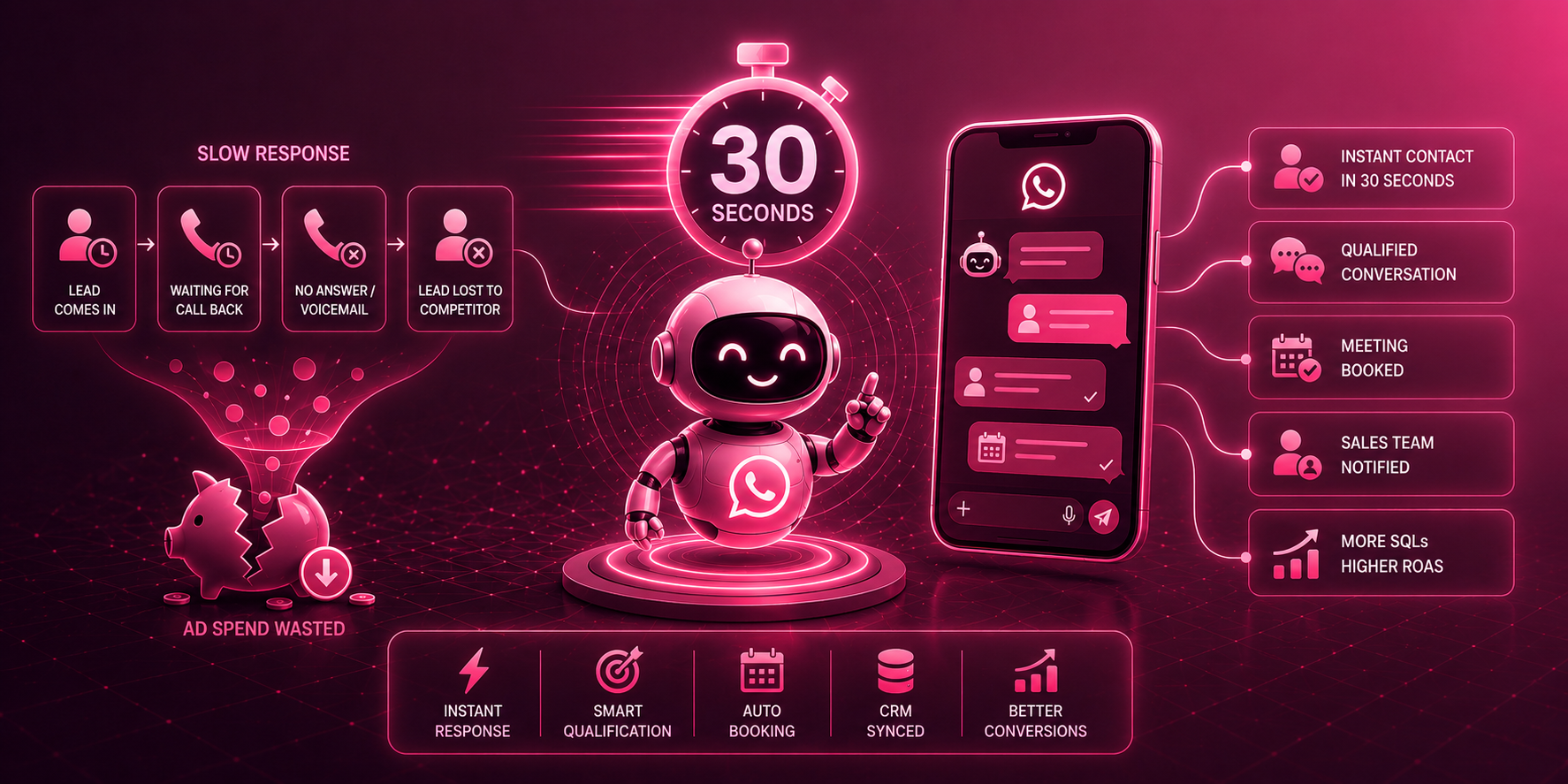
The fix isn’t “hire more BDRs.” It’s a WhatsApp AI agent that responds in 30 seconds, qualifies in the next two minutes, and books the meeting before a human in your team even sees the notification.
The real cost of slow follow-up (mid-market math)
Let’s use round numbers for a mid-market EdTech brand doing lead-gen for a ₹60K online course.
* Monthly ad spend: ₹15L on Meta + Google
* Cost per lead: ₹700
* Leads per month: 2,100
* Current workflow: BDR team calls within 2–6 hours; tries 3 times; 60% of leads never pick up
* SQL conversion: 8%
* Paid enrollments: around 34 a month at ₹60K AOV = ₹20.4L revenue
* ROAS: 1.36x
Now switch to a 30-second WhatsApp agent.
* Contact rate jumps from 40% to 80% (WhatsApp delivery + reply rates beat phone calls)
* Qualification quality actually goes *up* because the lead answers questions in their own time
* SQL conversion moves from 8% to 16–20%
* Paid enrollments: 55–70 a month
* Revenue: ₹33L–₹42L
* ROAS: 2.2x–2.8x
Same ad spend. Nearly 2x revenue. That’s the gap.
Why WhatsApp specifically, and not IVR / email / call back
Calls: 60% don’t pick up unknown numbers. In India this is now closer to 70%, thanks to spam fatigue. Every rep’s day is 70% dead dials.
IVR: 40% drop off at the menu. The people who stay are usually the most price-sensitive or least serious — exactly the wrong filter.
Email: 15–25% open rates on sales outreach, 1–3% CTR. The lead has moved on to your competitor before they even open it.
Web-form auto-response: Reads like a bot. Gets ignored.
WhatsApp: 98% delivery rate, 75–85% open rate, 45–60% reply rate on a well-crafted opener. The customer is already living in the app all day. They respond.
This is why speed-to-lead on WhatsApp outperforms every other channel — not because it’s magic, but because it meets the lead where they already are.
What a 30-second WhatsApp agent actually does
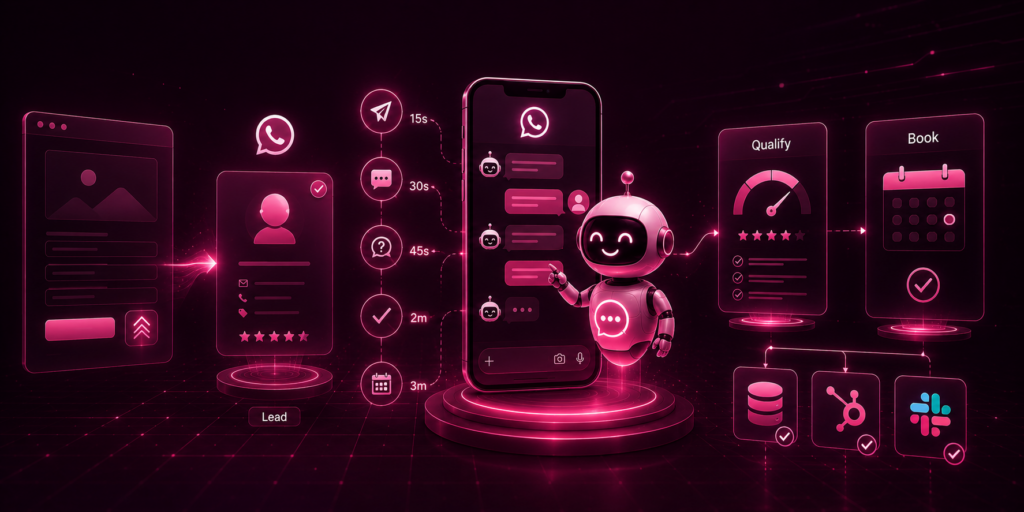
Picture a prospect fills out a form on your landing page at 10:42 PM on a Tuesday. Here’s what happens.
T+15 seconds: Agent sends a personalized WhatsApp message using the name, the source, and the product they showed interest in. Not a template — a natural opener that references what they asked about.
T+30 seconds: Lead replies. Usually with “who is this” or a question about the product.
T+45 seconds: Agent answers the first question. Confirms what the product is. Asks two qualifying questions — typically around budget, timeline, and the specific outcome the lead wants.
T+2 minutes: Agent has enough info to score the lead against your ICP. If they’re hot, it checks calendar availability and books a time directly.
T+3 minutes: Lead receives a calendar confirmation in WhatsApp. Pre-read material is shared. The rep gets a Slack notification with a full lead summary before they even open their laptop in the morning.
Every step of this runs autonomously. The rep’s only job is showing up to a qualified call with a brief already written.
If you’re wondering how this differs from a chatbot, read [AI Agents vs Chatbots: Why Your “Smart Bot” Is Already Obsolete in 2026]. Short version: a chatbot couldn’t book the meeting. An agent can.
The five verticals this hits hardest
Not every business has this pain at the same intensity. The ones paying actual mid-market money to solve it, in order:
1. EdTech / coaching institutes. Parents and students make decisions in the evening. Your team is asleep. Every lead not contacted by morning has enrolled somewhere else by lunch.
2. Real estate (primary sales). Developers spend ₹30–80L a month on portal leads. The 95-minute average response time is the industry’s worst-kept secret. Speed here is worth ₹15–30L/month in closed deals for a mid-size developer.
3. Healthcare (elective + diagnostics). Patients Googling “IVF cost” or “LASIK near me” at 11pm don’t wait till morning. The clinic that responds first in WhatsApp converts 3x more consults.
4. B2B SaaS and professional services. US leads coming in at 2am IST used to wait until 10am. Now the WhatsApp agent qualifies, books the enterprise AE for 9am PST, and the rep wakes up to a full calendar.
5. NBFCs and loan products. The first lender to respond with an approval-in-principle usually wins the loan. WhatsApp + KYC in-chat cuts “time to offer” from 2 days to 15 minutes.
What mid-market buyers are currently using, and why it fails
Most mid-market ops teams have already tried something. Here’s what’s in use and why each one plateaus:
LeadSquared + manual WhatsApp: Dashboard is great. Human response time still takes 6 hours.
Sell.Do / other real-estate CRMs: Focused on lead distribution, not real-time qualification. The call still happens 45 minutes late.
Salesken / Conversa / AI call-listening tools: These analyze calls after the fact. They don’t fix speed-to-lead.
Wati / Interakt / AiSensy with a flow-builder: Triggers the first message fast. Breaks the moment the lead replies with something the flow didn’t anticipate.
Hiring more BDRs: You’ll be at the same problem at 2x payroll.
The reason an AI agent beats all of these is the same reason it beats a chatbot at cart recovery. The conversation is genuinely open-ended. The agent can reason about what the lead said and respond appropriately, rather than following a flowchart.
The setup in 3 weeks, honestly
Here’s what a real deployment looks like for a mid-market brand:
Week 1: scoping. Define your ICP, your qualification questions, your CRM integration points, your calendar tool. Write the brand voice guide. This is the step teams try to skip, and this is where deployments fail.
Week 2: build. Wire up the agent, Meta lead form webhooks, your CRM (HubSpot, LeadSquared, Zoho, Salesforce — all doable), your calendar tool. Set up 15–20 test cases.
Week 3: shadow mode. Run the agent alongside the human BDR team. Every conversation reviewed. Fix the 10–15% of edge cases that inevitably surface.
Go live end of week 3 or start of week 4. Typical payback window: 45–90 days depending on your lead volume and LTV.
Compliance — the part your legal team will ask about
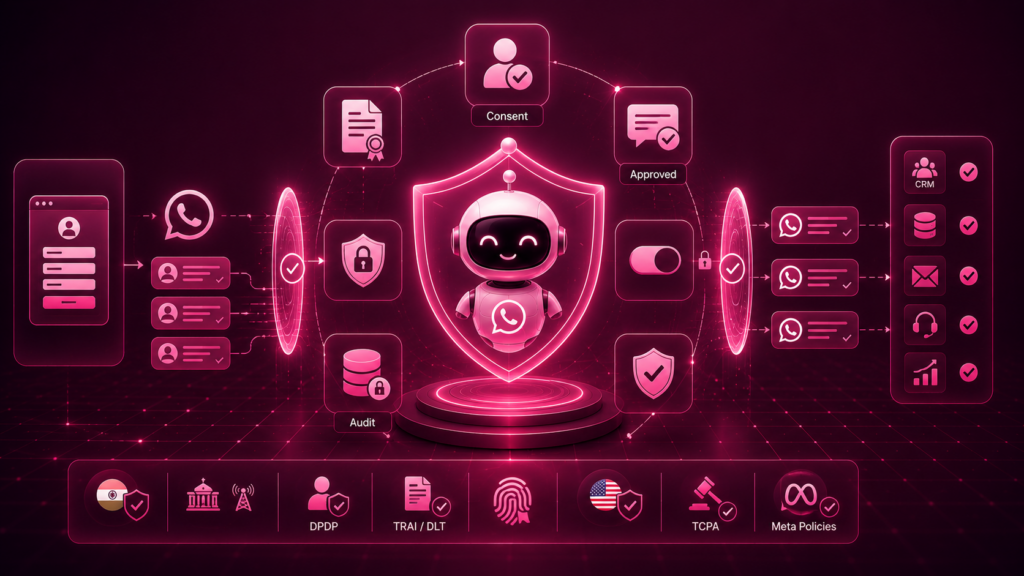
If you run India-side ads, WhatsApp lead outreach falls under DPDP (consent, purpose limitation, opt-out). You also need TRAI DLT template registration for utility or marketing messages.
US-side, TCPA governs any automated messaging. Meta’s own policies add another layer — templates need approval, opt-in must be explicit for non-utility messages.
A competent BSP handles this stack for you. If yours can’t clearly explain how your opt-in flow works, that’s a red flag.
Frequently asked questions
Q.What’s a realistic improvement in SQL conversion?
Most mid-market deployments see 1.5x–2.5x improvement in SQL rate, depending on how bad the current process is. Larger gains come from businesses with very slow current response times.
Q.What if the lead wants to talk to a human right away?
Good agents handle this gracefully. The moment the lead says “can I speak to someone,” the agent books a call with the rep and hands off with full context.
Q.Does this work for low-ticket sales?
Diminishing returns below ₹3–5K AOV. The math works best when each lead is worth ₹10K+ in potential revenue.
Q.Can the agent handle regional languages?
Yes. A well-built agent handles Hindi, Tamil, Telugu, Marathi, Kannada, Bengali in India — plus Spanish, Portuguese for US/LatAm markets. This is actually a major unlock in tier-2/3 India.
Q.How do I know the agent is actually qualifying well?
The right setup gives you a weekly CSV or dashboard of every qualification conversation, the score assigned, and what the rep’s follow-up outcome was. You tune from there.
The bottom line
Slow follow-up isn’t a sales-team problem. It’s an economics problem. Every hour your team takes to respond to a paid lead, the ROAS on your ad spend compounds downward.
A 30-second WhatsApp agent isn’t a nice-to-have in 2026. It’s the baseline for any mid-market brand spending more than ₹5L/month on inbound acquisition. The businesses that deployed it last year are the ones outgrowing their category. The ones that didn’t are wondering why their CAC keeps climbing.
Your next lead is coming in right now. What happens to it in the next 60 seconds?
Want to see what speed-to-lead would look like running on your actual ad flows? Book a free [WhatsApp AI Readiness Audit](https://theconverseai.com/services/ai-strategy-audit). We’ll model your current CAC, current SQL rate, and what a 30-second agent would change. No deck, just the math.