Agentic AI vs Generative AI: The Difference That Will Decide Your Next Hire
Here’s a thought experiment that will probably save you six figures.
Imagine two new employees walk into your office on Monday.
Employee A is a genius writer. Ask them anything and they’ll draft a brilliant email, summarize a 40-page report, or explain quantum physics to your grandmother. But they never leave their desk. They don’t send the email. They don’t file the report. They don’t follow up.
Employee B isn’t as brilliant on paper. Competent, not a genius. But every morning they read their inbox, send the follow-ups themselves, update the CRM, call the supplier when payment is late, and ping you on Slack when they’re stuck.
Who do you actually hire?
That scene, in one snapshot, is the whole agentic AI vs generative AI debate. And most companies are still hiring Employee A without realizing there was a second option.
The definitions, minus the buzzwords
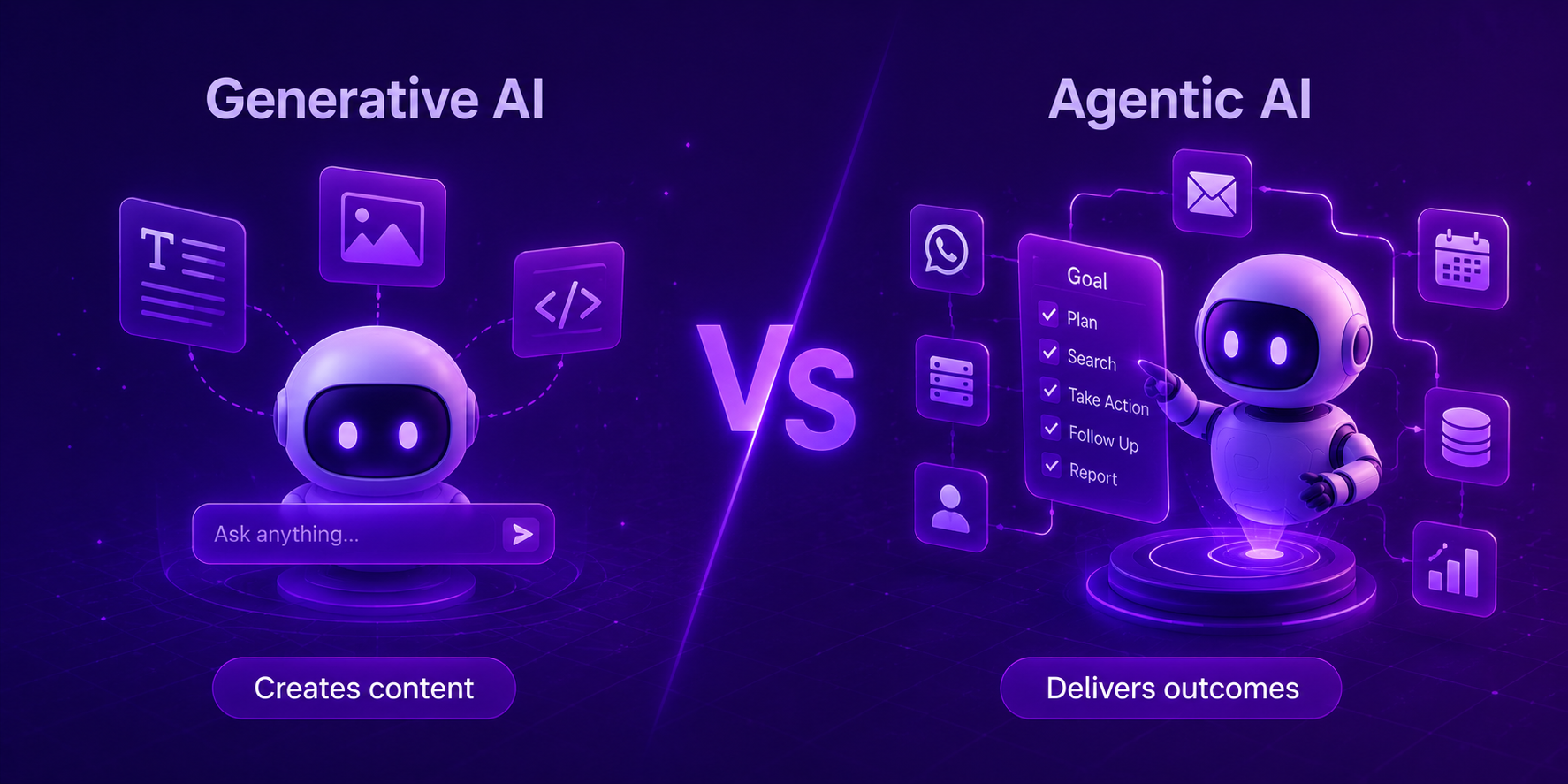
Generative AI creates content. Text, images, code, audio, video. You prompt it, it generates something, and the loop ends there.
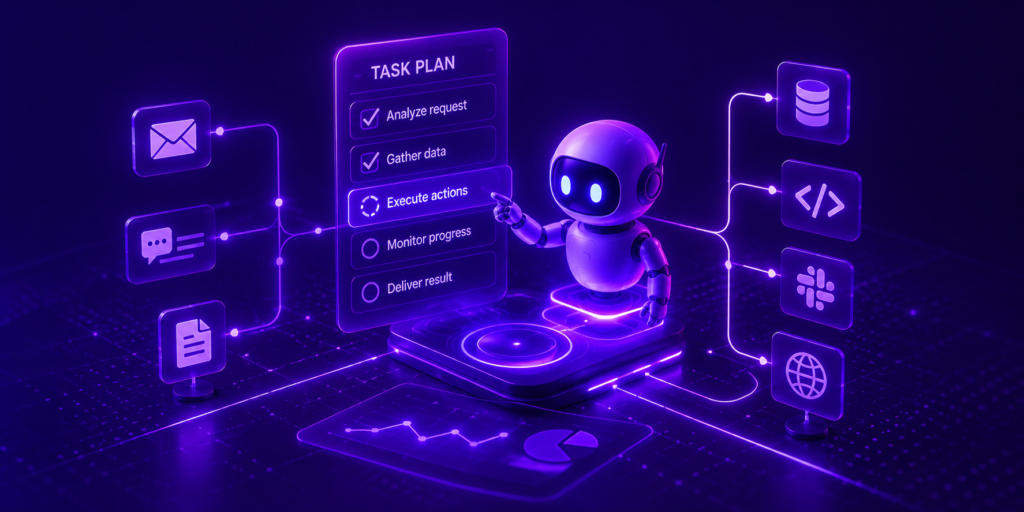
Agentic AI pursues a goal. It uses generative AI as one of its tools, but it also plans, calls APIs, updates systems, remembers what happened last week, retries when something breaks, and hands off to a human when it should.
Think of generative AI as the engine. Agentic AI is the whole car. Engine, wheels, GPS, and a driver who knows where you’re going.
If you’re brand new to this, start with What Is Agentic AI? The Plain-English Guide Every Business Owner Needs in 2026
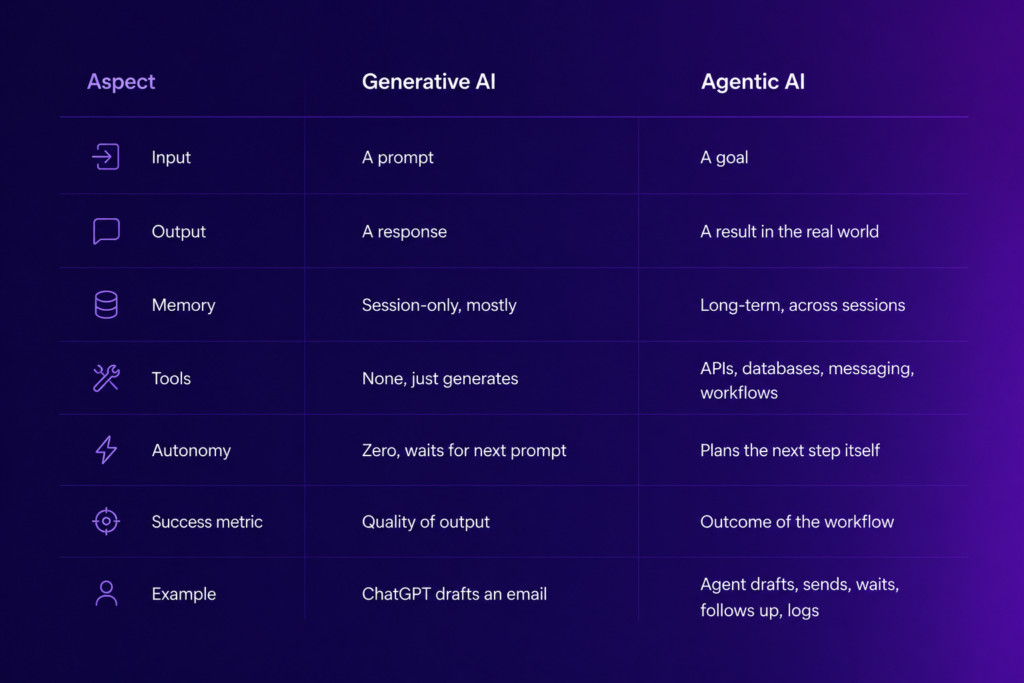
Side by side, what each actually does
Where generative AI wins
Generative AI is the right answer when:
- The output is the product. Marketing copy, a design mock, a code snippet.
- A human will review the output before anything acts on it.
- The task is one-shot. No follow-up, no state, no multi-step logic to carry.
- You want creative variation. Ten ad headlines, five logo directions.
If your use case is basically “help a human work faster,” generative AI is usually enough. Don’t over-engineer this stuff.
Where agentic AI wins
Agentic AI earns its keep when:
- The task has multiple steps across multiple tools.
- It repeats thousands of times, with different inputs but the same shape of workflow.
- Success means a business outcome, not a piece of text.
- A human bottleneck is slowing you down (the support queue, the SDR pipeline, AR chasing).
- You need 24/7 coverage, multilingual, at variable load.
Classic agentic territory: customer support resolution, outbound sales cadences, invoice follow-ups, lead qualification, internal IT helpdesk, onboarding flows.
Full breakdown with real numbers: 7 Real-World AI Agent Use Cases That Are Quietly Replacing Entire Teams
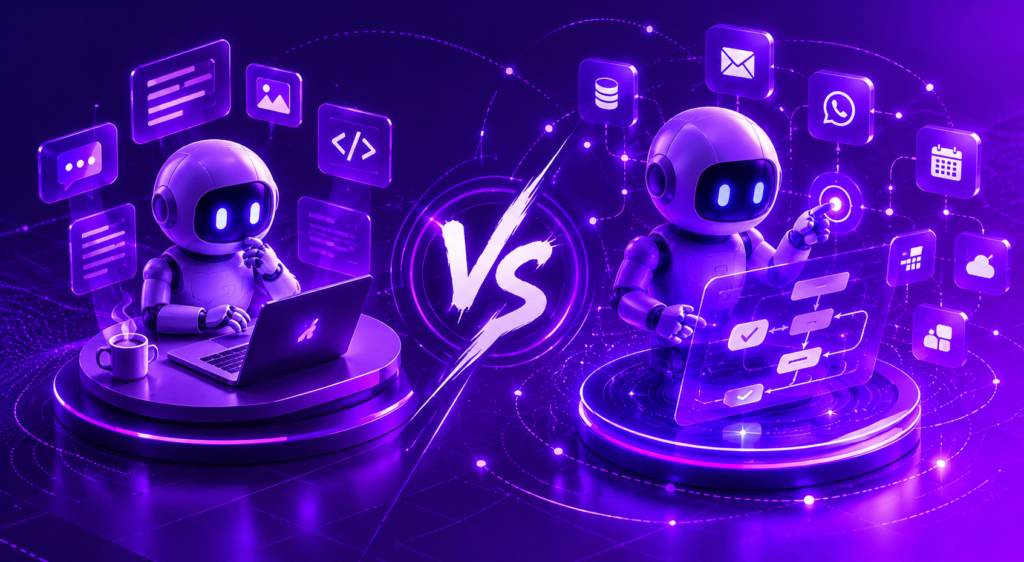
The hidden trap: "we built a chatbot on top of GPT"
This is where most mid-market AI projects quietly go to die.
A team wraps GPT-4 in a UI, hooks it to an FAQ document, calls the whole thing a “support agent,” and ships it. Six months later resolution rates are stuck at 20%, customers hate it, and the team blames the model.
But the model is fine. The thing was never an agent to begin with. No tools, no memory, no ability to *do* anything beyond reply. A generative AI chatbot wearing an agent costume is still just a chatbot.
Real agentic systems need a few non-negotiables:
1. A defined goal, not “be helpful.”
2. Integrated tools. CRM reads, order lookups, refund actions.
3. Memory. This customer’s history, this company’s policies.
4. Evals. How do we know it’s working?
5. Human in the loop for the edge cases.
The deeper take on this is here: AI Agents vs Chatbots: Why Your “Smart Bot” Is Already Obsolete in 2026
The cost difference nobody talks about
Generative AI tools are cheap. ChatGPT Team is $25 per seat. Claude for Work, similar ballpark. Most companies can roll them out in a week.
Agentic AI is a different animal. It’s engineered, not subscribed. A production agent project usually looks like:
Scoping and design, one to two weeks. Build and integrations, three to six weeks. Evals and shadow mode, another two or three. Total investment somewhere between ₹8L and ₹40L, or $10K to $50K, depending on how much complexity you’ve bitten off.
The ROI math is different too. A solid generative AI rollout saves ten to twenty percent of someone’s week. A solid agentic deployment can remove entire roles from a workflow, or, more commonly, let the same team handle five to ten times the volume without hiring.
The 2026 reality: you probably need both
This isn’t an either/or decision.
Use generative AI for content, drafting, internal productivity. Use agentic AI for workflows, customer-facing automation, revenue ops.
The companies pulling ahead this year aren’t the ones with access to the most powerful model. They’re the ones who figured out which problem belongs in which bucket, and stopped trying to solve automation problems with a cleverer prompt.
A quick test for your business
Ask yourself, for any given task: if this was done perfectly, would the output be a document or an outcome?
Document means generative. Outcome means agentic.
Write down your five biggest time sinks and tag each one. If three or more are “outcome,” it’s time to stop prompting and start deploying actual agents.
The bottom line
Generative AI made your team smarter. Agentic AI makes your team optional for repetitive work, which frees them up to do the work that actually needs a human brain.
Pick the wrong one and you’ll spend the next year convincing yourself the model just needs more training. Pick the right one and you’ll spend the next year scaling the results.
Not sure whether your workflow is agentic or generative? Book a free AI Readiness Audit.
We’ll map it, benchmark it, and tell you exactly what to build (or not build). Or if you already know what you want, go straight to our Agentic Systems & Process Automation service.