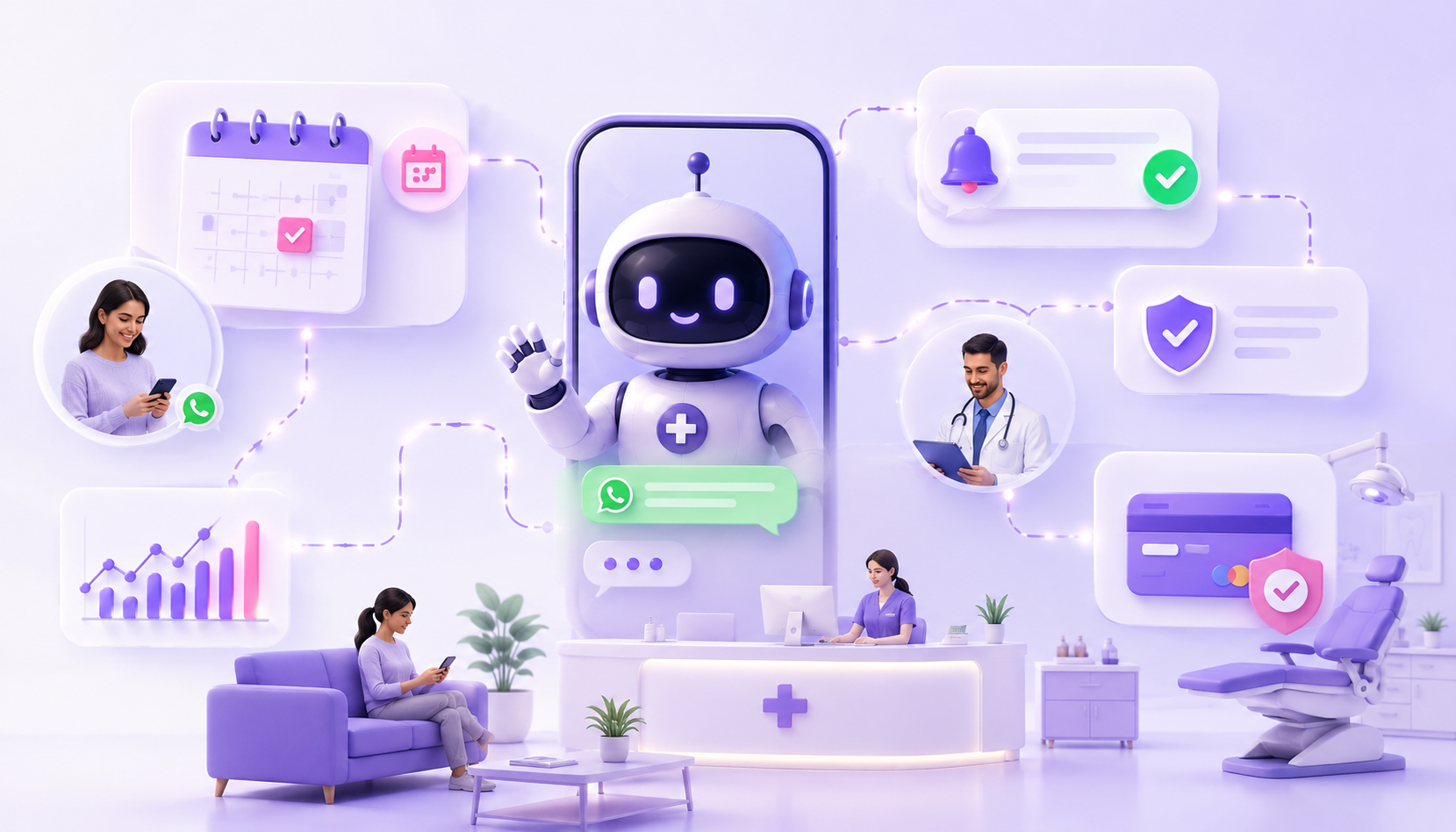
A 30% No-Show Rate Is a 30% Revenue Tax: The WhatsApp Flow That Kills It
If you run a multi-location clinic, a diagnostics chain, or a mid-market dental or aesthetics group in India, chances are you’ve stopped paying attention to your no-show rate. It sits in a report somewhere. It hovers between 25% and 35%. Someone at every management review mentions it, and then everyone moves on.
Here’s the math you’re quietly tolerating.
A 12-chair dental chain does roughly 1,800 appointments a month. A 30% no-show rate is 540 empty slots. At an average consult + procedure revenue of ₹2,500, that’s ₹13.5L of revenue walking out every month. Add in the staff time, the unfilled doctor schedules, the marketing cost of acquiring those patients in the first place, and the real hit is closer to ₹18L.
Over a year, you’re writing off north of ₹2Cr because patients just didn’t show up. And the fix isn’t hiring another receptionist to make reminder calls. It’s a WhatsApp AI flow that costs about ₹60K/month and drops no-shows below 12%.
Why clinics tolerate this number
Every clinic operator has heard the same things forever.
“Patients forget.” They do, sometimes.
“It’s a healthcare thing.” It’s not — dental and aesthetics have the same problem as diagnostics.
“SMS reminders don’t work.” This one’s partially true, and explains the whole problem.
SMS reminders were the standard fix for a decade. 40% open rate, no reply channel, no way for the patient to confirm or reschedule. They set the patient up to either show or ghost. There was no middle option.
WhatsApp changed that. 98% delivery, 80%+ reads within an hour, and — the critical part — the patient can actually **reply**. Confirm. Reschedule. Ask a question about prep. Pay an advance to lock the slot.
Every one of those replies reduces the probability of a no-show.
The three-layer WhatsApp flow that actually works
This is the pattern we’ve seen work across dental chains, diagnostics labs, IVF clinics, dermatology groups, and diagnostic centres.
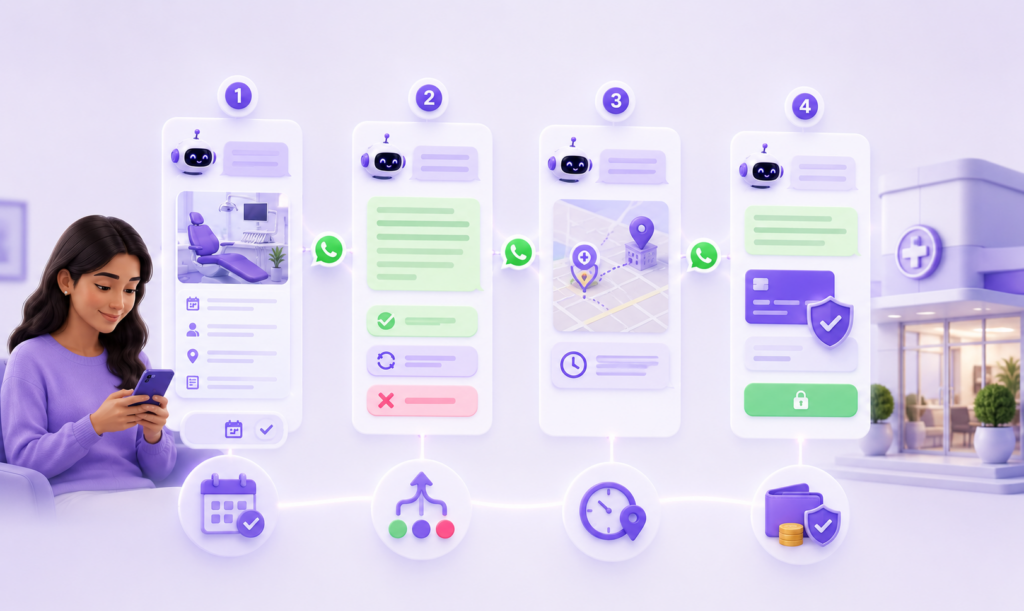
Layer 1: Booking confirmation (T+5 minutes after booking)
Agent sends immediate confirmation with appointment details, location, doctor name, and prep instructions. Patient gets the message while their intent is still fresh. Also invites them to add the appointment to their calendar via a one-tap link.
Layer 2: 48-hour reminder (the most important one)
This is where the magic happens. Not a dumb “your appointment is on Thursday” reminder. An interactive one.
“Hi Priya, reminder that you have your dental cleaning with Dr. Shah on Thursday at 3:30 PM at our Connaught Place clinic. Can you confirm? Reply YES to confirm, RESCHEDULE to move it, or CANCEL if you can’t make it. Prep: no coffee 30 min before.”
The ask for a confirmation is what changes outcomes. A patient who replies YES has mentally committed. A patient who says RESCHEDULE gets 3 alternative slots and books one in 30 seconds without ever calling the clinic. A patient who says CANCEL frees the slot 48 hours out — enough time to fill it.
Layer 3: 3-hour day-of reminder
Short and practical. “Hi Priya, see you at 3:30 PM for your cleaning. Clinic is on the 2nd floor, near the metro. If you’re running late, reply here.”
This second reminder prevents the “I forgot” no-shows and the “I’m stuck in traffic and gave up” drop-offs.
Add an optional layer 4 — a small advance payment collected in-chat to lock the slot — and no-show rates drop below 10% even in high-variability categories like aesthetics and diagnostics.
The full ROI math for a mid-market clinic chain
Let’s run the numbers for a 4-location derma + aesthetics chain.
Before WhatsApp AI flow:
– Appointments per month: 3,200
– No-show rate: 30%
– No-shows per month: 960
– Average revenue per appointment (consult + procedure blended): ₹3,200
– Monthly revenue lost: ₹30.7L
– Receptionist time on call reminders: 4 people × 3 hours/day = ~₹2.4L/month- Total monthly tax: ~₹33L
After WhatsApp AI flow:
– No-show rate: 11%
– No-shows per month: 352
– Monthly revenue lost: ₹11.3L (down ₹19.4L)
– Receptionist time on reminders: 1 person × 1 hour/day = ~₹20K (down ₹2.2L)
– WhatsApp AI platform + setup amortized: ~₹90K/month
– Net monthly gain: ~₹20.7L
Payback on the project: under 45 days for most clinic chains.
Beyond reminders: the stuff that compounds the ROI
Reminder flows are just the entry point. Once patients are talking to your clinic on WhatsApp, the same channel handles:
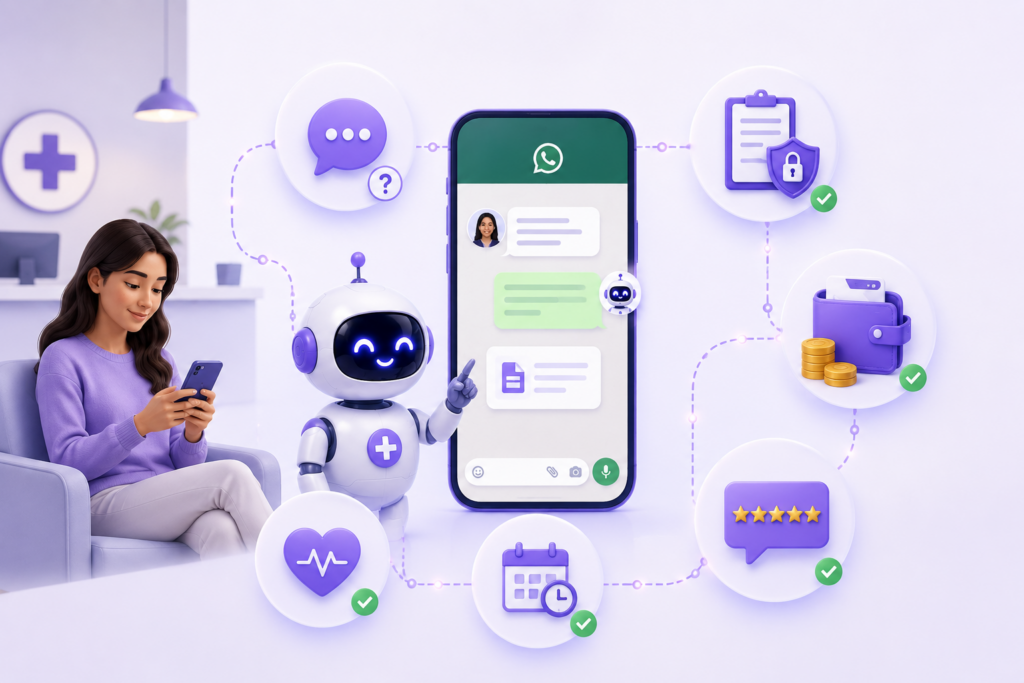
Pre-appointment questions. “Do I need to fast?” “Can I take my medication?” “Is there parking?” Agent answers instantly. Receptionist phone queue drops 50%.
Post-appointment follow-ups. Recovery check-ins, prescription refills, next-appointment scheduling. All conversational, all automated.
Reports and results delivery. Diagnostics labs in particular — reports delivered via WhatsApp with a secure link cut “when will I get my report” calls to zero.
Payment collection. Advances and follow-up dues sent with UPI links directly in-thread. Collection rate jumps from 60% to 85%+.
Review requests at the right moment. Post-appointment, 24 hours later, agent asks for a Google review with a direct link. Review volume typically 4–6x what it used to be.
If you want to see the broader pattern across use cases, read[7 Real-World AI Agent Use Cases That Are Quietly Replacing Entire Teams].
What mid-market clinics are using today (and the gap)
Most have one of these in place:
Practo Ray or similar clinic management software. Great for scheduling and records. Reminder engine is SMS-first, primitive on WhatsApp. No conversational intelligence.
MyOperator or Exotel for IVR reminders. Decent reach, low engagement. Reschedule flow requires a callback.
Manual WhatsApp messages from the front desk. Quality inconsistent across locations. Front desk stretched thin. No audit trail.
Nothing at all. Surprisingly common. “We’ll fix it next quarter.”
None of these handle the conversational reschedule/confirm/pay loop that actually kills no-shows. That’s the gap.
Compliance — the quiet win for healthcare
Healthcare has a data-sensitivity layer most verticals don’t. WhatsApp Business Platform is now HIPAA-compliant for US deployments, and DPDP-aligned for India with proper consent capture.
In practice for a clinic:
– Patient opts in to WhatsApp communication at booking (standard clinic intake form)
– Reminder content is templated and Meta-approved
– Sensitive content (like diagnostic reports) sent via secure one-time links, not as WhatsApp media
– Audit trail for every message, delivery, and consent state
This is stronger than what most clinics have for their current SMS setup, which is usually a WhatsApp group run from the receptionist’s personal phone.
Frequently asked questions
Q.How soon can we go live?
For a single-location clinic, 10–14 days. For a multi-location chain with integrations into a clinic management system, 3–4 weeks.
Q.Will this integrate with Practo Ray, Cliniko, or our custom EMR?
Yes, via API. Practo’s API is well-documented; custom EMRs take 1–2 extra weeks of integration work.
Q.Do we lose the personal touch patients expect from healthcare?
No — if done right. The agent handles logistics (confirmations, reschedules, prep instructions), freeing the human front desk to focus on patients who need actual attention. Patient NPS typically goes up, not down.
Q.What about emergency or urgent symptoms patients might mention in chat?
Agent is trained to recognize urgency keywords (chest pain, bleeding, etc.) and immediately escalate to a human — with an explicit message to the patient to call the clinic or emergency services.
Q.Can we run Hindi + regional languages?
Yes. Regional language handling is actually a bigger win in smaller cities, where patients don’t engage with English SMS or IVR.
Q.Is this GDPR/HIPAA compliant for international patients?
The WhatsApp Business Platform supports both when configured correctly. Medical tourism clinics routinely use it for international patient communication.
The bottom line
A 30% no-show rate isn’t a patient behavior problem. It’s a reminder-channel problem. Every mid-market clinic still tolerating it is paying a 30% tax on their own revenue — silently, month after month, year after year.
The fix is the kind of project that pays for itself in under 60 days, improves patient experience, and makes your front desk team’s job easier. There’s basically no version of this project that has a negative ROI.
The only question is how much more revenue you’re willing to leave on the table before you fix it.
Want the no-show math run on your actual clinic’s data? Book a free [Clinic WhatsApp AI Readiness Audit](https://theconverseai.com/services/ai-strategy-audit). We’ll look at your current no-show rate, appointment volume, and EMR setup, and tell you exactly what the payback would be. Sector-specific — we’ve done this for dental chains, diagnostics, IVF, derma, and multi-specialty groups.