Why Your Collection Calls Hit 12% Contactability — and WhatsApp Hits 68%
If you run collections at a mid-market NBFC, fintech lender, BNPL, or B2B distribution company in India, here’s a number that should worry you.
Your call-based contactability has been sliding for 18 months straight. It was 22% in early 2024. By end of 2024, most portfolios reported it around 14%. In 2026, most of our NBFC clients are seeing it flirt with 10–12%.
Meanwhile your DPD-30 bucket is growing. Your cost-to-collect is north of 4% of collected value. Your team is working the same phones with the same scripts, and the numbers are getting worse.
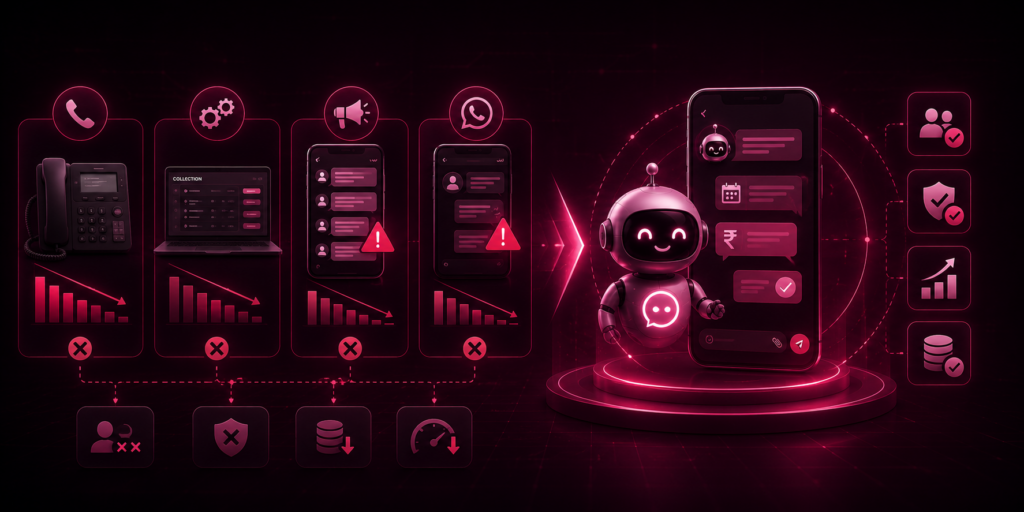
And here’s the part nobody wants to say out loud: the phone channel is done as a primary collection tool. It isn’t coming back. The borrower isn’t going to start picking up unknown numbers again. Regulation and spam fatigue killed it.
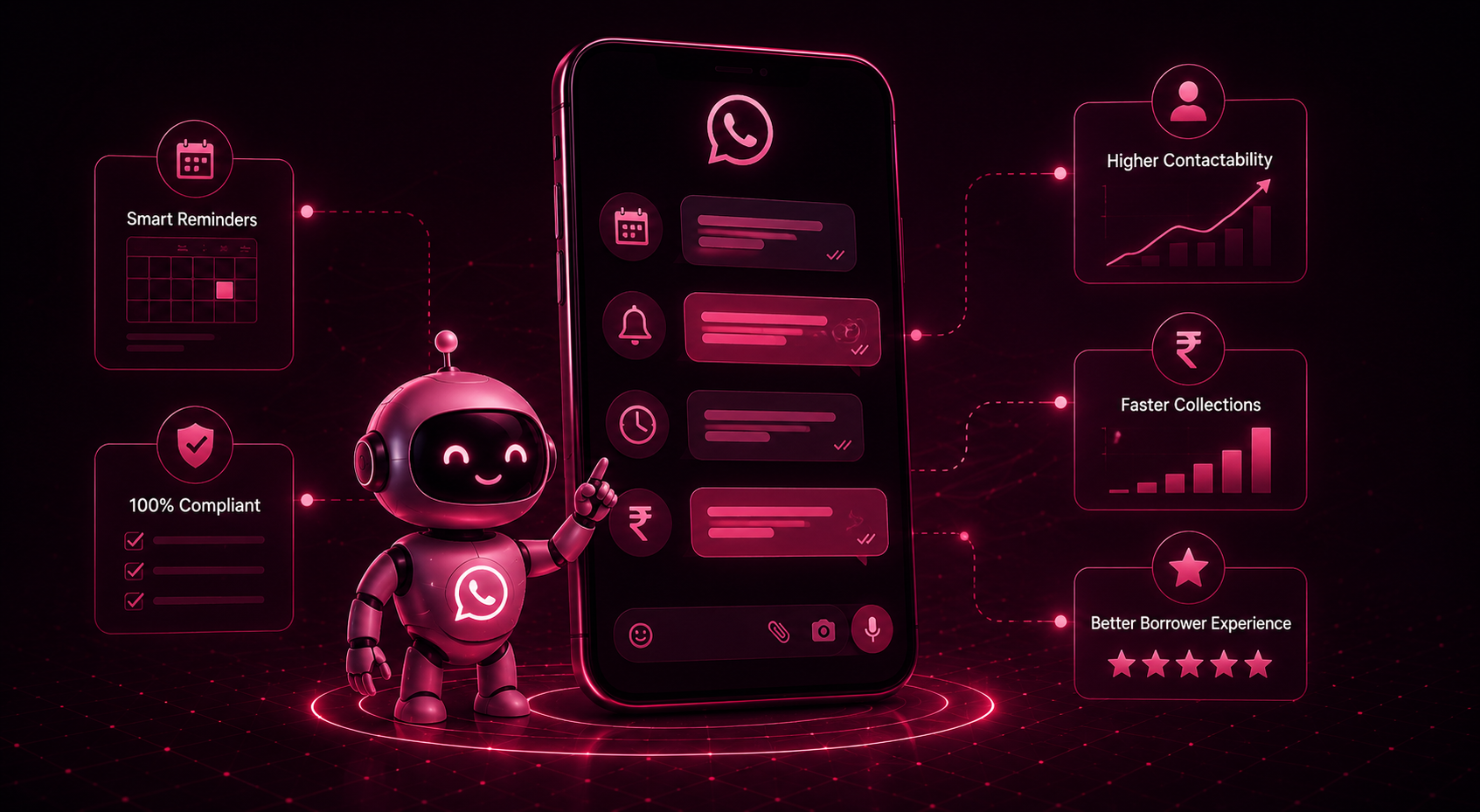
The mid-market NBFCs and lenders that figured this out first moved dunning to WhatsApp AI. Their contactability jumped from 12% to 68%. Cost-to-collect dropped to under 1.5%. And — contrary to what the compliance team feared — their audit position got *stronger*, not weaker.
Here’s how.
The contactability number, properly explained
Contactability isn’t the same as answer rate. It’s the percentage of attempts where the borrower was actually reached and a meaningful conversation happened.
On phone in India in 2026, this looks roughly like:
– Attempts per borrower per day: 3–5
– Numbers that ring: 85%
– Numbers that are answered: 14%
– Conversations that get past “who is this”: 9%
– Conversations that discuss the actual debt: 7%
That 7% is what “contactability” really means on the call channel. Which is why collection team headcount has to keep scaling linearly with portfolio — and why cost-to-collect keeps creeping up.
On WhatsApp:
– Messages sent: 100%
– Messages delivered: 98%
– Messages opened within 60 minutes: 82%
– Replies to first message: 45–55%
– Meaningful conversation (debt acknowledged, payment plan discussed, or dispute raised): 65–70%
This isn’t a marginal improvement. It’s a structural channel shift.
Why WhatsApp works for collections specifically
1. Non-confrontational channel. Borrowers don’t duck a WhatsApp message the way they duck a phone call. There’s no anxiety of being pressured in real time. The borrower can read the message, think, and reply on their own terms.
2. Text creates a record. Unlike a phone call, WhatsApp creates a written trail that both the borrower and the lender can reference. Disputes get resolved faster. “You never told me the amount” goes away.
3. Self-serve payment in the same thread. The agent can send a payment link, and the borrower clicks, pays, and confirms — all without leaving the conversation. Call channel can’t do this.
The borrower experience is genuinely better too. Collections stops feeling like harassment and starts feeling like a finance service. CSAT on WhatsApp-led collection typically comes in 25–30 points higher than call-led.
What a collection agent on WhatsApp actually does
This isn’t broadcast. It’s structured, step-wise, and compliant.
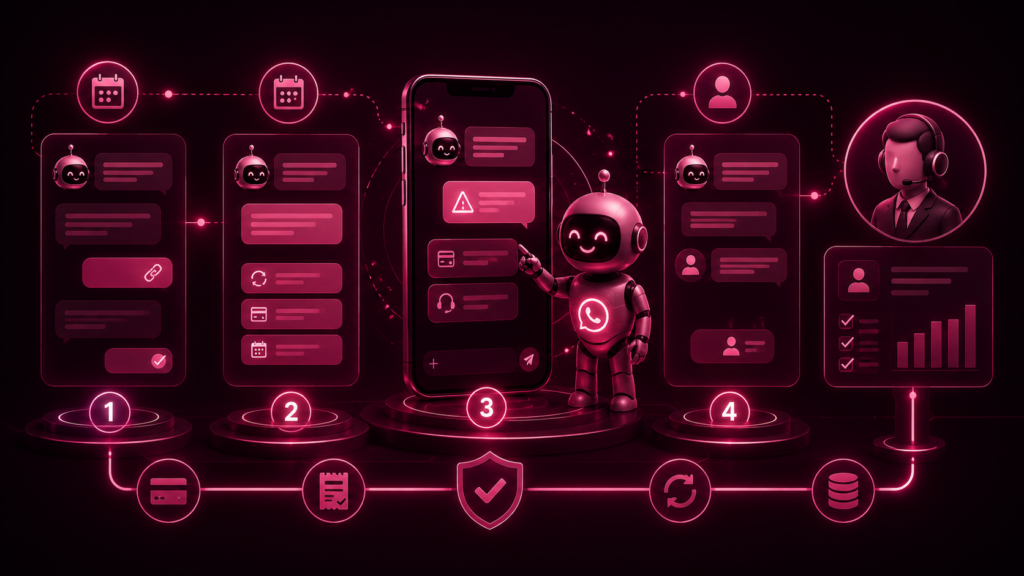
Day 1 (DPD-1): Gentle reminder. “Your EMI of ₹4,850 is due today. Pay here: [link]. Reply PAID if already cleared.” That last line is key — it stops chasing paid borrowers.
Day 3 (DPD-3): Slightly firmer. Agent asks if there’s any issue. If the borrower says “yes, I lost my job,” the agent offers a pre-approved hardship route (reschedule EMI, partial payment plan) within your policy bounds.
Day 7 (DPD-7): Agent explains consequences clearly. “If this isn’t resolved by [date], it will be reported to the credit bureau. We want to help you avoid that. Here’s a payment plan option, or reply HUMAN to talk to an officer.”
Day 15+ (DPD-15+): Escalation. Agent hands off to a human officer with full conversation history attached. The officer picks up a warm lead, not a cold dial.
Throughout: payment links in-thread, receipt auto-generated, CRM updated. No spreadsheet, no manual follow-up, no “did we already call this borrower today” confusion.
The compliance layer (this is why most NBFCs hesitate, and why they shouldn't)
The RBI’s Fair Practices Code and the DPDP Act lay out specific guardrails for collection activity. On WhatsApp, a properly configured AI agent is actually *easier* to keep compliant than a human call center.
– Call-hours restriction (7 AM to 7 PM): Agent enforces this automatically. No messages go out outside window. Humans forget; agents don’t.
– Language restriction (no harassment, threats, or abusive language): Pre-approved message templates. Agent cannot improvise outside policy.
– Consent + opt-out: Built into every conversation. Borrowers who reply STOP are opted out within seconds and flagged in the CRM.
– Record-keeping: Every message, delivery receipt, read receipt, and borrower reply is stored and audit-exportable.
– No third-party disclosure: Agent never mentions the debt to anyone but the borrower. Wrong-number messages auto-end.
When the RBI or DPDP audit lands, you’ll have cleaner logs from WhatsApp than you’d ever have from a call center.
If you want the broader picture on AI agents and guardrails, read [What Is Agentic AI? The Plain-English Guide Every Business Owner Needs in 2026].
The cost-to-collect math for a mid-market NBFC
Round numbers for an NBFC with a ₹500Cr AUM, around 80,000 active borrowers, typical unsecured personal-loan mix.
Current state (phone-led collection):
– Collection team: 85 telecallers + 6 supervisors, ~₹6.8L/person loaded cost/year = ~₹5.7Cr/year
– Cost-to-collect as % of collected value: 4.2%
– DPD-30 bucket: 12% of AUM = ~₹60Cr
– Roll-rate to NPA: 3.8%
Post-shift (WhatsApp AI-led with human escalation):
– Collection team: 35 officers (mostly for DPD-15+ and disputes) = ~₹2.4Cr/year
– WhatsApp AI platform + integration: ~₹75L/year including setup amortized
– Cost-to-collect: 1.4%
– DPD-30 bucket: down to 8% = ~₹40Cr
– Roll-rate to NPA: 2.6%
Annual impact: ~₹2.4Cr direct cost saved, ~₹8–12Cr better working capital from DPD reduction.
Payback on the project: 4–6 months.
The verticals this hits hardest (in terms of real willingness to pay)
1. Unsecured personal loan NBFCs. Highest call-fatigue, highest value from DPD reduction. Almost universally buying in 2026.
2. BNPL. Micro-EMIs, massive borrower count, impossible to call-collect economically. WhatsApp is the only sensible channel.
3. Insurance renewal collections. Policy lapses because the renewal reminder is an SMS nobody reads. WhatsApp agent changes that.
4. B2B distribution receivables (FMCG, pharma, textiles). Distributors on WhatsApp all day. Invoice follow-ups in the same thread they’re placing orders.
5. Education loan and fee collection. Parents respond to WhatsApp. They don’t pick up calls from unknown numbers. Tuition centers see 40%+ improvement.
What mid-market NBFCs are using today, and the gaps
Most are running one of these setups:
In-house dialer + Exotel/Knowlarity: The standard for 5 years. The productivity problem is exactly what this post is about.
Spocto, Credgenics: Specialized collection tech. Strong on workflow and compliance, adding WhatsApp as a layer but the AI-agent quality is still thin.
In-house WhatsApp broadcasts: The founder-led hack. Gets one message out, hits 256-contact limits, quality-rating gets flagged, number risks being banned.
Wati / Interakt broadcasts: Compliance barely addressed, no real escalation logic, no NBFC-tuned templates.
None of these are bad choices. They’re the honest evolution of the market. What’s changed in 2026 is that *agent-layer* collection is finally mature enough for mid-market to deploy without a 6-month pilot.
Frequently asked questions
Q.Is sending collection messages on WhatsApp legal in India?
Yes, with explicit consent at loan origination and proper opt-out handling. The RBI’s Fair Practices Code applies the same way it does to calls. Most standard loan agreements now include WhatsApp consent clauses by default.
Q.Will my DSA or field agents still have a role?
Yes. Field recovery stays human. What changes is DPD-0 to DPD-30 bucket, which moves almost entirely to WhatsApp AI, freeing field teams for the genuinely hard cases.
Q.Can this integrate with our LOS/LMS (Perfios, Jocata, FinOne, etc.)?
Yes, via webhooks and APIs. Expect 2–4 weeks of integration work depending on how clean your LMS data is.
Q.What happens if the borrower is abusive or threatens harm?
Agent de-escalates with pre-approved language, logs the interaction, and routes to a human officer. There are defined stop-conditions the agent will not override.
Q.How do we handle Hindi, Tamil, Telugu borrowers?
A well-tuned agent handles vernacular natively. Contactability actually goes up in vernacular markets because most competitors only message in English.
The bottom line
Call-based collections is a shrinking channel with rising costs. This isn’t a temporary dip — it’s a secular shift. The mid-market NBFCs that got ahead of it are running leaner teams, lower DPD, and stronger audit positions than the ones still adding telecaller headcount.
You don’t need to replace your entire collection stack. You need to move the top of the funnel — the DPD-0 to DPD-15 bucket where most of the volume lives — to a WhatsApp AI agent. The human team stays for the hard cases, where they’re actually needed.
The longer you wait, the more ground you lose to competitors already compounding on the shift.
Want to see what the cost-to-collect math looks like on your actual portfolio? Book a free [Collections AI Readiness Audit](https://theconverseai.com/services/ai-strategy-audit). We’ll review your DPD buckets, current cost-to-collect, and model what WhatsApp-led dunning would do to both. Sector-specific — we’ve done this for NBFCs, BNPL, and B2B wholesale.