
How to Build Your First AI Agent: A 2026 Roadmap for Non-Technical Founders
You don’t need a PhD. You don’t need a 10-person ML team. You don’t need to fine-tune a foundation model.
What you actually need, in 2026, to ship your first AI agent: one painful workflow, a willingness to write down how it should work, and about eight weeks.
That’s genuinely it. The tools have caught up over the last year. The real bottleneck isn’t technical anymore. It’s clarity. This is the roadmap.
Step 0: Decide you're actually building an agent
Before you do anything, be honest about what problem you’re really solving.
If the answer is “help our team write faster,” you want generative AI, not an agent. Go buy ChatGPT Team or Claude for Work. Done.
If the answer is “handle X workflow end-to-end across multiple systems without a human in the middle,” now you’re in agent territory.
Skipping this step is the number one reason AI projects fail. You cannot build an agent if a prompt would have done the job.
Step 1: Pick the most boring workflow you can find (week 1)
This sounds counterintuitive. It isn’t.
The best first agent solves a workflow that is:
High volume. Happens 50 or more times a week. Boringly consistent. Same shape every time. Multi-system, touching 2 to 4 different tools. And low-stakes on failure. A wrong action is recoverable, not a deleted database.
Classic first-agent candidates:
– Inbound lead triage and routing
– Order status and tracking queries
– PTO and HR FAQ responses
– Invoice status lookups
– Tier-1 refund processing, within a defined cap
What to avoid for your first project: anything customer-facing where the agent has write access to money, anything legal or medical, anything with fuzzy “use your judgment” policies. Save those for agent number three, once you’ve learned the hard way how this actually plays out.
Step 2: Write the playbook (week 1 to 2)
This is the step teams skip, and then later blame the AI.
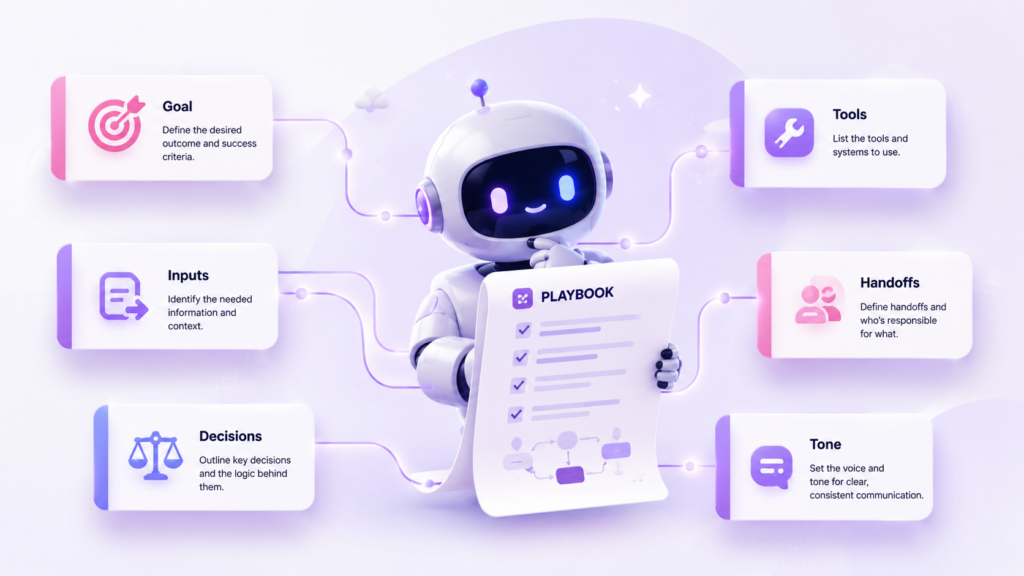
Open a Google Doc. Answer these questions:
1. Goal. What does “success” actually look like, in one sentence?
2. Inputs. What does the agent see at the start? A new ticket, a form fill, a WhatsApp message.
3. Decision tree. What are the main branches? Example: “If the order is less than 30 days old and under ₹5,000, auto-refund. Else escalate to the support lead.”
4. Tools needed. Which systems does the agent read from? Which does it write to?
5. Stop conditions. When must the agent hand off to a human, no exceptions?
6. Tone. How should it sound? Share 3 examples of what a great human response looks like.
If you can’t write this doc in 2 to 3 hours, the workflow isn’t well-defined enough yet. That’s a process problem, not an AI problem. Fix it before building anything.
Step 3: Decide, buy or assemble or build (week 2)
Buy a platform. Tools like ConverseAI, Intercom Fin, or Salesforce Agentforce ship pre-built agent workflows for the common use cases (support, sales, WhatsApp). Best when your workflow fits a known pattern. Cost is ₹10K to ₹1L a month. Time to live is 1 to 3 weeks.
Assemble with no-code. Tools like n8n, Zapier AI, or LangFlow let you wire up an agent from components. Best when your workflow is semi-unique and you have someone on the team who’s ops-savvy. Cost runs ₹20K to ₹50K setup plus infra. Time to live is 3 to 6 weeks.
Custom build. Needed when your workflow is genuinely unique, involves proprietary systems, or requires strict IP ownership. Best done with a partner who’s actually shipped 10+ agents. Cost is ₹8L to ₹40L. Time to live is 6 to 12 weeks.
Rule of thumb: if a platform already exists for your use case, start there. You can always custom-build version 2.
Step 4: Integrate the tools (week 3 to 5)
This is where roughly 70% of the actual effort lives. The AI part is often just 30%.
For each system your agent touches, you need to sort out:
Read access. Can the agent see what it needs (orders, customer history, docs)? Write access. Can it actually take the action (issue a refund, update a record, send a message)? Rate limits. Will the APIs handle your volume? Error handling. What happens when a tool call fails halfway through?
If you’re using a platform, most of this is plug-and-play through their integrations. If you’re custom-building, budget most of your engineering time right here. Not on “making the LLM smarter.”
Step 5: Write evals (week 4 to 6)
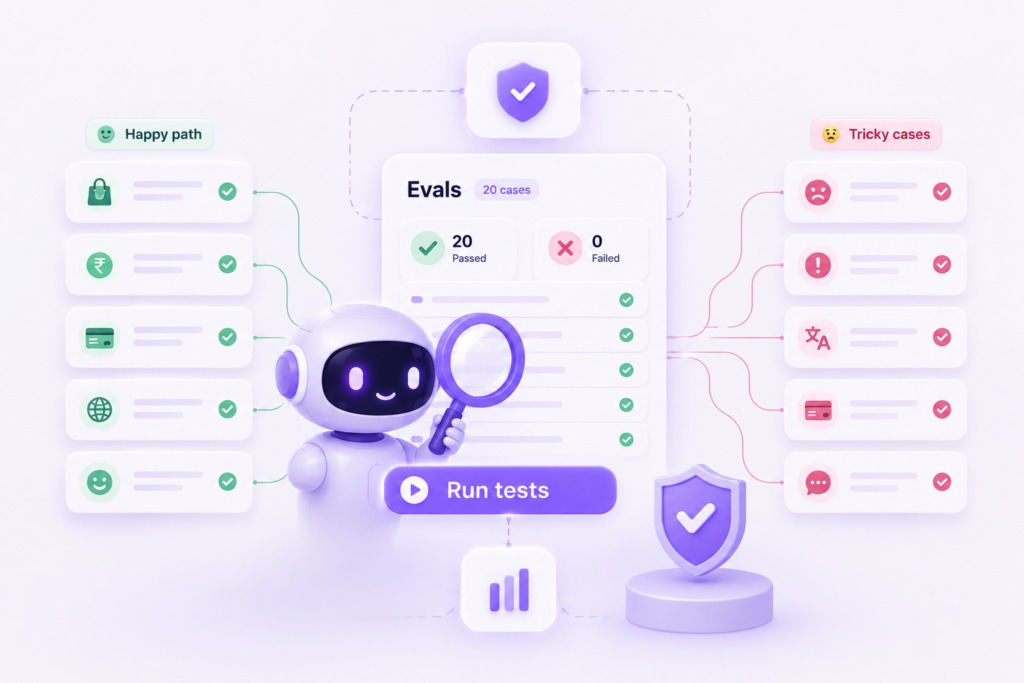
“Evals” is a fancy word for “tests for your agent.” A list of real-world scenarios and the correct behavior for each.
Start with 20 cases. 10 happy-path, 10 tricky. Example for a refund agent:
– Order under ₹5K, under 30 days old, issue refund
– Order over ₹5K, escalate
– Customer asks to refund AND change card, do both, don’t silently skip the card update
– Customer switches to Hindi mid-conversation, switch languages, keep going
– Customer is rude, stay polite, stick to the policy
Run these tests before every change you make. If the agent breaks a case that previously passed, you just caught a regression. This is the difference between “our agent works” and “our agent works reliably.”
Step 6: Shadow mode (week 6 to 7)
Do not ship the agent live to customers on day one.
Instead, run it in shadow mode. The agent handles tickets and drafts the action, but a human approves before anything actually happens. You’ll catch 90% of the agent’s weirdness in week one, fix it, and ship with confidence in week two.
Skip this step and you’ll learn the expensive way.
Step 7: Gradual autonomy (week 8 onwards)
Once shadow mode is clean:
Week 8, the agent handles the 3 most common scenarios autonomously. Humans still approve the rest. Week 9 and 10, expand to about 80% of volume. Week 11 onward, full autonomy within the trained scope, with clear escalation rules for anything outside.
Keep the human approval flow around even after go-live, but only for edge cases. That’s your pressure valve.
The honest numbers
What a realistic first-agent build actually looks like:
Time: about 8 weeks, with 40 hours per week of combined effort across product, engineering, and ops. Cost when you build with a partner: ₹10 to ₹25L, or $15K to $35K, for a well-scoped first agent. Cost when you buy a platform: ₹15K to ₹1L per month, with minimal engineering time. Payback: usually 3 to 6 months, assuming you picked the right workflow.
Anyone telling you “production-ready in 5 days” is shipping a demo, not an agent.
Mistakes that kill most first-time projects
– Starting with a fuzzy workflow. Fix the process first.
– Trying to build three agents at once. Ship one, then expand.
– Skipping evals. You’ll regret it the week after launch.
– Giving the agent write access on day one. Shadow mode exists for a reason.
– Hiring a freelancer who’s “done some LangChain projects.” Agents need systems thinking, not just prompt engineering.
The bottom line
Your first AI agent is a business project, not really a tech project. The hard part is clarity. What should it do? When should it stop? How will you know it’s working?
The tooling has gotten shockingly good. The gap, almost always, is in the playbook, not the model.
Pick one boring workflow. Write the playbook. Ship in 60 days. Then do the next one.
Want a partner who’s already shipped this exact roadmap for 30+ businesses? Start with a free [AI Readiness Audit](https://theconverseai.com/services/ai-strategy-audit), or go straight to [Custom AI Agent Development](https://theconverseai.com/services/custom-ai-agents) If WhatsApp and customer support is your use case, have a look at [ConverseAI’s AI Chatbot](https://theconverseai.com/products/ai-chatbot) first. You might not need to build at all.