What Is Agentic AI? The Plain-English Guide Every Business Owner Needs in 2026
Back in 2023, every founder I knew was asking the same thing. Should we use ChatGPT? By 2024 the question shifted to whether they should fine-tune a model. This year, it’s changed again.
Now the question is: should we deploy an agent?
And if you don’t know what an agent actually is, that question is impossible to answer honestly. So let’s fix that. No jargon, no hype, no consultant fluff.
The one-sentence definition
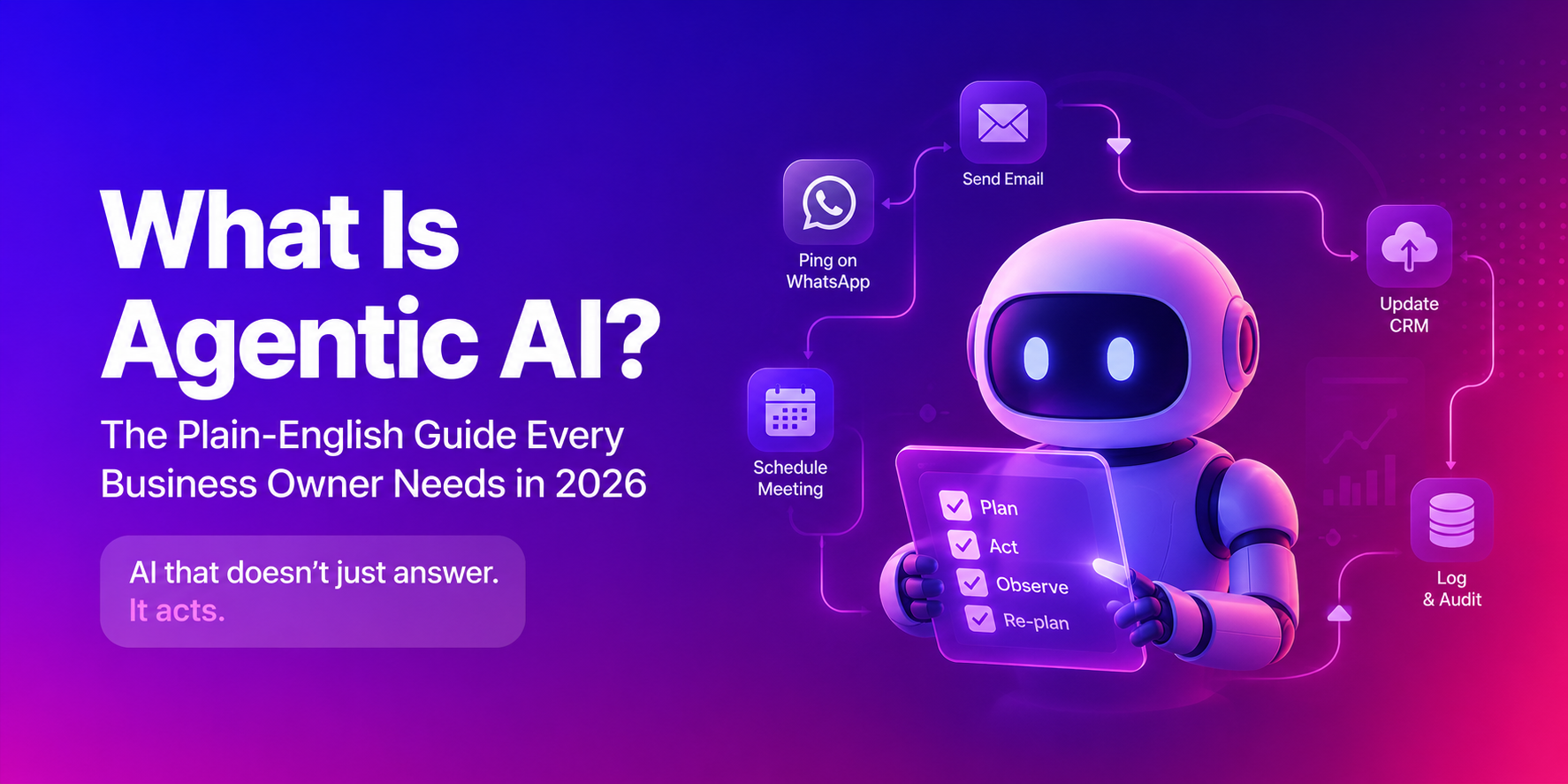
Agentic AI is AI that doesn’t just answer. It acts.
A generative AI writes you an email. An agentic AI writes the email, schedules the meeting, updates your CRM, pings the client on WhatsApp if they don’t reply in 48 hours, and logs the whole trail so your ops team can audit it later.
The shift is from assistant to operator. From “help me do this” to “go do this, and tell me when it’s done.”
Why the word "agent" matters
A real AI agent has four things that a chatbot or a plain LLM prompt just doesn’t:
1. A goal. Not a question. “Collect payment from overdue customers” rather than “draft a reminder email.”
2. Tools. It can send emails, call APIs, update databases, read files, trigger workflows.
3. Memory. It remembers what happened yesterday, last week, across ten thousand conversations with ten thousand customers.
4. Enough autonomy to pick the next step. It plans, tries, fails, re-plans.
Take any one of those away and you don’t really have an agent. You have a chatbot with better PR.

How agentic AI actually works, in 60 seconds
Picture a new hire who happens to be extremely well-behaved.
You give them a goal. Something like “reduce abandoned carts this month.” They read the playbook you’ve given them (your knowledge base, your SOPs, your tone of voice). They pick the right tool for the next step.
WhatsApp reminder? Discount code? Handoff to a human? Then they do it, watch what happens, and decide the next move. At the end, they log everything so you can audit, improve, and scale.
That’s it. The real magic isn’t the model itself, it’s the loop underneath: plan, act, observe, re-plan. Modern agent frameworks (LangGraph, CrewAI, custom stacks) basically give this loop structure and guardrails.
Want the deeper breakdown of where agents and generative AI split?
Read Agentic AI vs Generative AI: The Difference That Will Decide Your Next Hire.
Where businesses are actually making money with agents (today, not "someday")
Forget theory. These are live deployments, mostly mid-market companies in India and the US.
Customer support. An agent reads the ticket, checks order history, issues a refund if policy allows it, and escalates if not. Resolution time drops to under a minute on the cases it handles end-to-end.
Sales outbound. An agent researches a prospect, writes a personalized opener, sends it, handles the reply, books the meeting. Your human SDR only shows up for qualified calls.
Accounts receivable. An agent chases overdue invoices across email and WhatsApp, negotiates within pre-approved ranges, escalates genuine disputes to your finance team.
Onboarding. An agent KYCs a new customer, verifies documents, creates accounts across six internal tools, and answers their setup questions for the first 30 days.
Field service dispatch. An agent matches tickets to technicians based on skill, location, and load. It re-routes when anything changes mid-shift.
Notice what these have in common. They’re all repetitive, rule-heavy, multi-step workflows where maybe 80% of the work is boring. That’s agent territory.
See the full list in 7 Real-World AI Agent Use Cases That Are Quietly Replacing Entire Teams.

What agentic AI is not
Marketing has muddied this badly, so let’s be blunt about it.
It’s not just a smarter chatbot. A chatbot answers. An agent acts. If your “AI” can’t call an API or update a record, calling it an agent is a stretch.
It’s not AGI. Agents are narrow by design. A good one is great at one workflow. The moment you ask it to do twenty unrelated things, it falls apart.
It’s also not magic. Agents need tools, context, guardrails, evals, and a human in the loop for anything high-stakes. Skip those and you’ll have a very expensive cautionary tale on your hands.
How to know if your business is ready for agents
Run this quick readiness check.
You have a repetitive workflow that eats more than ten hours a week of human time.
That workflow has clear inputs, clear outputs, and a written playbook (or one you could write without much pain).
It touches at least two systems. A mistake the agent makes is recoverable, not catastrophic. And you have someone internally who’ll own the system once it’s live.
Tick four out of five and you’re ready. Tick two and you need a proper AI Readiness Audit before you spend a rupee on building anything.
The honest timeline
Real agent projects, from scoping to production:
Weeks 1 to 2 go into picking one workflow, mapping it, and defining what success actually means. Weeks 3 to 6 are the build: writing the agent, wiring up tool integrations, writing evals. Weeks 7 and 8 are shadow mode, where the agent runs but a human approves every single action before it hits the real world. Week 9 onwards is gradual autonomy, with measurement and tuning.
Anyone selling you a “production-ready agent in 5 days” is either shipping a demo or lying. Good agentic systems are engineered. They aren’t prompted into existence.
The bottom line
Agentic AI isn’t a trend. It’s the natural next step after every employee in your company started quietly using ChatGPT in 2023. The question stopped being “can AI write?” and became “can AI actually do?”
Increasingly, the answer is yes. If you pick the right workflow, ship a narrow agent, and build in the guardrails, it works. If you try to boil the ocean, it won’t.
Ready to see if your business has an agent-shaped hole in it? Book a free 30-minute AI Readiness Audit with ConverseAI. We’ll map one workflow, tell you whether an agent fits, and give you a build-or-buy recommendation. No pitch deck involved.