Wati Alternative & AiSensy Alternative: Why Some Businesses Need an Agentic WhatsApp System Instead
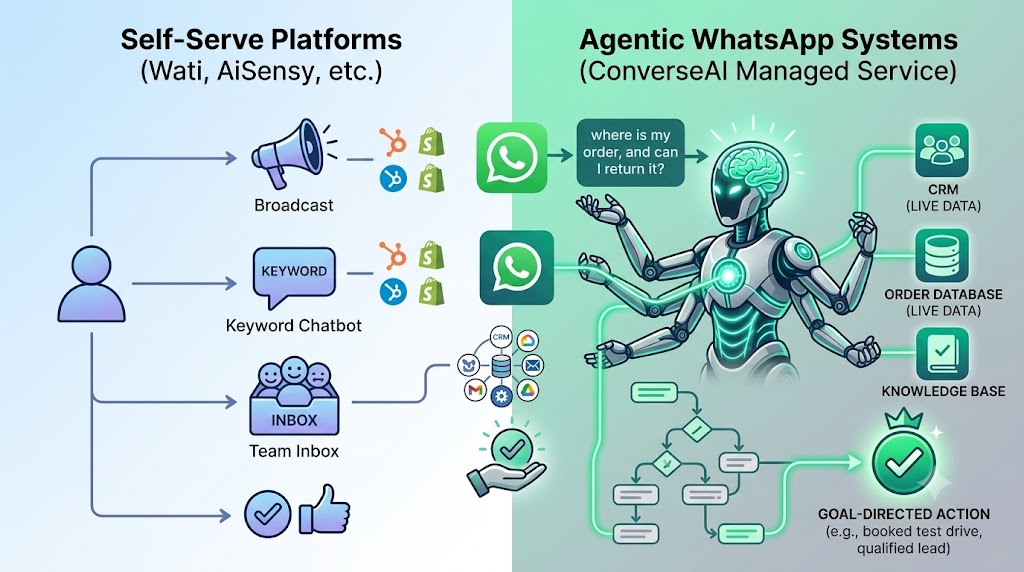
Wati alternative: Wati and AiSensy are built for broadcast campaigns and keyword-triggered chatbots — they do those things well. But if you need a WhatsApp AI agent that understands natural language, accesses live data from your systems, and handles multi-turn conversations without manual flows, that is a different category entirely. ConverseAI builds and manages those agentic systems for you.
Wati, AiSensy, and Interakt are WhatsApp Business API platforms built for broadcast campaigns, keyword-triggered chatbots, and team inbox management. They are good at those things. If what you actually need is a WhatsApp AI agent that handles multi-turn conversations, pulls live data from your systems, and takes action on its own — that is a different category of product, and no self-serve platform currently offers it. ConverseAI builds and manages those agentic systems for you.
What Wati, AiSensy, and Interakt actually are
Before comparing anything, it helps to be precise about what these platforms do — because the marketing language around “WhatsApp AI” has gotten loose enough to obscure real differences.
Wati is a WhatsApp Business API platform built primarily for SMBs. Its core features: bulk broadcast messaging (promotional campaigns, updates, notifications), a drag-and-drop chatbot builder that works on keywords and button flows, a shared team inbox for live agent conversations, and integrations with tools like HubSpot, Shopify, and Zapier. Pricing starts around $49/month for the entry tier and scales by message volume and team seats. It is strong in the Indian SMB market and increasingly used by Southeast Asian and Middle Eastern businesses. Setup is self-service. You configure it, you run it.
AiSensy is an Indian WhatsApp marketing platform with a similar positioning: campaign broadcasts, a chatbot builder, live chat, and basic analytics. It is popular with D2C brands in India for sending promotional messages at scale — discount announcements, flash sales, abandoned cart nudges via broadcast. Its chatbot functionality is flow-based: you map out decision trees, assign keywords, define responses. There is no reasoning engine behind it. Pricing follows a broadcast-volume model. Like Wati, you operate it yourself.
Interakt (by Haptik) is another Indian entry in the same category — WhatsApp API access, campaign management, chatbot flows, and a commerce layer for Shopify stores. It adds a product catalog browsing feature that makes it useful for D2C brands with simple “browse and buy” WhatsApp flows. Same structural limitations apply.
These are infrastructure and tooling providers. The platform is what you buy. The configuration, the campaigns, the chatbot flows, the ongoing operation — that is what you do.
How much does Wati cost?
Wati pricing starts at around $49/month on the entry tier, with costs scaling based on message volume, number of active contacts, and team seats. Higher tiers unlock additional integrations, more team users, and advanced analytics. WhatsApp Business API message costs — set by Meta and billed separately — vary by conversation type: marketing, utility, or service. For most Indian SMBs sending moderate message volumes, the total monthly spend typically falls between $100 and $300. AiSensy and Interakt follow similar volume-based pricing models. None of these costs include the setup, configuration, or ongoing management of your chatbot flows — that is work you do yourself.
What is the difference between Wati and AiSensy?
Both are WhatsApp Business API platforms targeting Indian SMBs, and their core feature sets overlap significantly: broadcast campaigns, chatbot flow builders, shared team inboxes, and third-party integrations. Wati has broader international market penetration and slightly more enterprise-oriented integrations with tools like HubSpot and Salesforce. AiSensy is more focused on D2C brand marketing use cases in India and offers competitive pricing for high broadcast volumes, making it popular for flash-sale campaigns. Neither platform offers agentic AI reasoning — both rely on rule-based chatbot builders for automated conversations. If you’re evaluating either as a Wati alternative capable of genuine conversational AI, neither closes that gap.
What these platforms are genuinely good for
This is worth stating plainly, because the goal here is not to dismiss tools that do real work for real businesses.
If your primary WhatsApp need is broadcast campaigns — sending promotional messages, order updates, shipping notifications, or re-engagement blasts to an opted-in contact list — Wati, AiSensy, and Interakt handle this well. They have the WhatsApp Business API access, the template message management, the compliance tooling, and the campaign analytics you need. For a D2C brand in India sending 50,000 promotional messages a month, these platforms are cost-effective and fit for purpose.
If you need a basic chatbot that answers FAQs, routes to a human agent, or guides a customer through a simple menu (what’s your order number? here are your options) — the flow builders on these platforms can handle that. The setup requires manual configuration, the logic is rule-based, and it will not handle anything outside the flow you’ve defined, but for predictable, low-complexity interactions it works.
If you need a shared inbox for your support team to manage WhatsApp conversations — all three platforms offer this, and for small teams it is adequate.
The market these platforms serve is real and large. The question this page answers is what happens when your WhatsApp requirements go beyond that.
Where the platforms fall short: the agentic gap
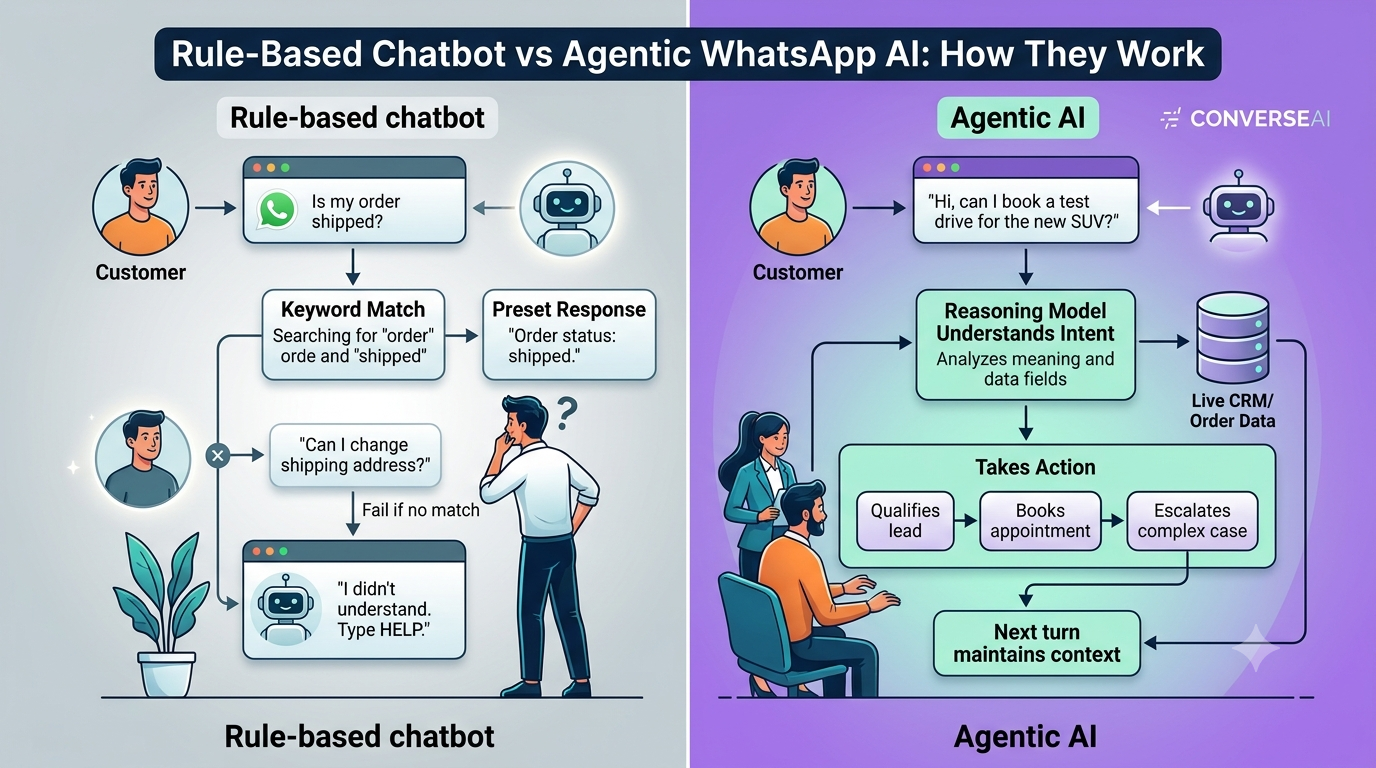
The chatbot builders on these platforms work by matching what a customer types to a keyword or a button they pressed, then returning the response you pre-configured for that match. There is no understanding of what the customer actually means. There is no memory across turns — each message is treated in isolation unless you have explicitly built state tracking into your flow. There is no live data access — if a customer asks where their order is, the chatbot cannot tell them unless you have built a very specific Zapier integration that covers that exact scenario. There is no adaptive reasoning — if the customer’s message doesn’t match a keyword, the bot falls through to a default response (usually “I didn’t understand that. Type HELP to see options”).
This is not a criticism. It is how rule-based chatbot builders are designed. They are fast to configure, deterministic, and cheap to run. For interactions that are genuinely simple and predictable, that is exactly what you want.
The problem is that most real WhatsApp use cases are not that simple:
A customer asks about their order, then asks about a return, then asks if a replacement can be sent to a different address. Each turn depends on the previous one. The chatbot needs to hold context.
A lead asks about pricing, gives a vague answer about their business size, then asks a follow-up about integration with their specific CRM. Qualifying them requires adapting to what they say, not routing them through a preset tree.
A vehicle showroom wants to run a WhatsApp campaign where interested prospects can ask questions about specific models, book a test drive, and get a callback from the nearest dealership — all in one conversation. The conversation cannot be fully mapped in advance.
These scenarios require an AI that reasons about what the customer is saying, accesses live data from your systems, and takes goal-directed action — not a flow chart.
That is what agentic WhatsApp systems do. And it is not something any self-serve platform currently provides. Businesses evaluating a true aisensy alternative or interakt alternative for complex conversational flows consistently find the same gap: the tooling exists, but the intelligence layer does not.
Platform tools vs. agentic managed systems: a direct comparison
If you are looking for a wati alternative that closes the conversational AI gap — not just a cheaper broadcast tool — the distinction below clarifies what you are actually choosing between.
| WhatsApp Platform (Wati / AiSensy / Interakt) | Agentic WhatsApp System (ConverseAI) |
Query handling | Rule-based: keyword matching and preset button flows | Reasoning AI: understands natural language, handles multi-turn, adapts to the conversation |
Data access | Static: responds from configured text only | Live: pulls real-time data from your CRM, fulfilment system, database, or API mid-conversation |
Proactivity | Broadcast-triggered: you send the campaign | Goal-directed: the agent follows up, qualifies, escalates, or books based on conversation state |
Multi-turn memory | Limited: requires manual state management in the flow builder | Native: the agent holds context across the full conversation |
Maintenance | You do it: update flows, fix broken keywords, manage template approvals | ConverseAI does it: monitoring, updates, fixes, and iteration are included |
Who runs it | You: self-serve configuration and ongoing operation | ConverseAI: fully managed — you define the outcome, we build and run the system |
Pricing model | Monthly subscription + message/seat-based tiers | Bespoke engagement: scoped to your use case, no public tiers |
Best for | Broadcast campaigns, simple FAQ routing, team inbox management | Conversational lead qualification, WISMO deflection, agentic sales flows, complex multi-step interactions |
This model — where the vendor operates the system on your behalf — is also how businesses approach other managed AI services when the use case demands expert-built, continuously maintained intelligence rather than a self-serve tool they configure themselves.
What it looks like in practice
Automotive brand — WhatsApp launch at scale
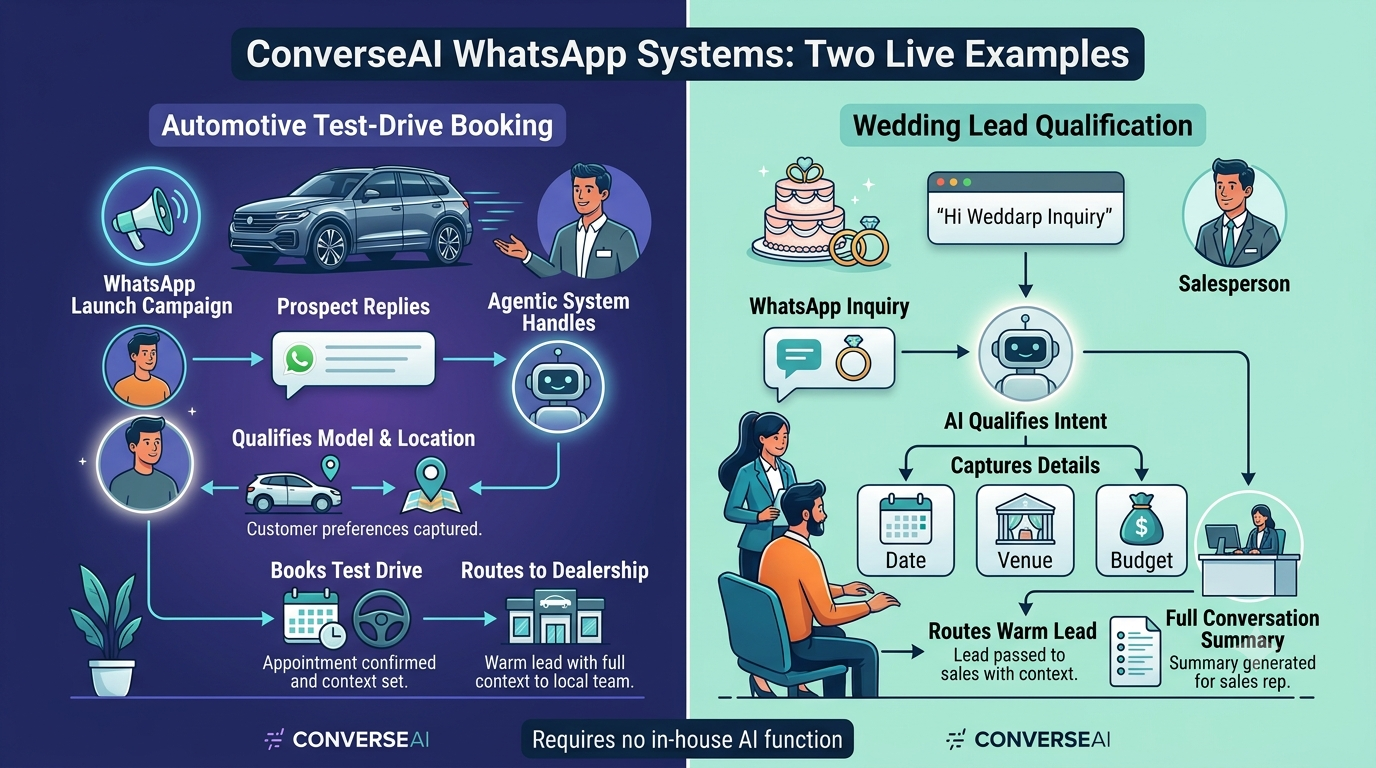
A leading automotive brand was preparing to launch a new vehicle model and needed to engage a large pool of qualified prospects on WhatsApp — a channel that matched how buyers in their market actually communicate — and convert that engagement into test drive bookings and dealership callbacks. A broadcast campaign would get the message out. What happened after a prospect replied was the problem: the follow-up had to feel personal, move fast, and adapt to what the prospect said.
We built an agentic WhatsApp system that handled the entire post-broadcast conversational layer: receiving inbound replies at launch scale, asking qualifying questions about preferred model variant and location, booking test drives or scheduling callbacks, and routing high-intent prospects to the nearest dealership with conversation context attached. The system handled thousands of simultaneous conversations without latency. The dealership teams received pre-qualified, context-rich leads. No flow builder could have handled the variety of things those prospects actually said.
Wedding company — WhatsApp lead qualification
A wedding services company was spending significant sales team time on WhatsApp conversations that were too early-stage to be worth a call — leads asking general questions about availability, packages, and pricing without yet being ready to book. They needed a system that could handle the first four to six exchanges, qualify intent, capture the key details (date, venue type, guest count, budget range), and route ready-to-talk leads to a human sales rep — without the prospect feeling like they hit an automated wall.
The agentic qualification system now handles that first layer. Qualified leads arrive in the sales team’s inbox with a structured summary of the conversation. Unqualified leads are nurtured with useful content. The sales team’s time is spent on conversations that are actually worth having.
FAQ
Q.Is ConverseAI a replacement for Wati or AiSensy?
Not a direct replacement — it is a different category of product. Wati and AiSensy are self-serve platforms you license and operate yourself. ConverseAI is a managed service: we build an agentic AI system custom-scoped to your use case and then run and maintain it for you. If you need broadcast campaigns and a basic chatbot you manage yourself, those platforms may be all you need. If you need a conversational AI that reasons, accesses live data, and handles complex interactions without you operating it, that is what ConverseAI builds.
Q.What is the difference between a rule-based chatbot and an agentic AI system on WhatsApp?
A rule-based chatbot returns preset responses to keywords or button inputs. It has no understanding of meaning, no memory across turns, and no ability to access external data. An agentic AI system uses a reasoning model to understand what the customer is actually saying, holds context across a multi-turn conversation, accesses real-time data from your systems (order status, CRM records, availability calendars), and takes goal-directed action — booking, qualifying, escalating — rather than just answering. The underlying technology is categorically different.
Q.Can ConverseAI also send broadcast campaigns and manage a team inbox?
Agentic conversational systems are our primary offering. WhatsApp broadcast capability can be incorporated as part of a broader engagement where it makes sense — for example, an outbound sequence that hands off to an agentic qualification flow when a prospect replies. We are not a broadcast platform sold as a subscription, but we can build broadcast-to-conversation pipelines where the use case warrants it.
Q.How long does it take to build and deploy an agentic WhatsApp system?
It depends on the complexity of the use case and the integrations required. Simple agentic systems with one or two integrations can be live in weeks. More complex builds involving multiple data sources, custom workflows, and compliance requirements take longer. We scope this during the discovery call before any engagement begins.
Q.Is ConverseAI suitable for businesses currently using Wati or AiSensy?
Yes — and this is a common transition. Businesses that started with a broadcast platform and outgrew its chatbot capability are a significant portion of the companies we work with. We assess what is already in place, identify what the current tool cannot do, and scope a system that handles the gap. In some cases, the existing platform continues to run broadcast campaigns while ConverseAI runs the conversational layer.
About ConverseAI
ConverseAI is an agentic AI systems firm founded in 2021, a product of Revti Digital. We build and operate custom AI agent systems for businesses across India and the US — 100+ agentic AI systems built and running, across 50+ businesses, with 500+ integrations delivered to date. We are a certified Meta Tech Provider Partner. Our systems are GDPR-compliant and engineered to meet the specific compliance requirements of each engagement.
ConverseAI does not sell platform licenses or self-serve software. Every engagement is custom-scoped: we build the system, run it, and keep it working. The delivery model is the differentiator — not the tooling. Beyond WhatsApp, our systems extend to AI voice agents for business and other conversational channels, giving clients a unified agentic layer across every touchpoint.
Related Reading
Ready to understand what an agentic WhatsApp system can do for your business?
If you are evaluating Wati, AiSensy, or similar platforms and wondering whether your use case is better served by an agentic system — the fastest way to find out is a direct conversation.
Book a free discovery call → theconverseai.com/book-demo
No sales deck. No pricing tiers to navigate. We listen to what you need WhatsApp to do and tell you honestly whether an agentic system is the right fit.
Ready to get started?
Tell us what you need WhatsApp to do — book a free discovery call.
Book your free discovery call → theconverseai.com/book-demo