Decagon AI Alternative: Managed AI Customer Support Without the Platform Overhead
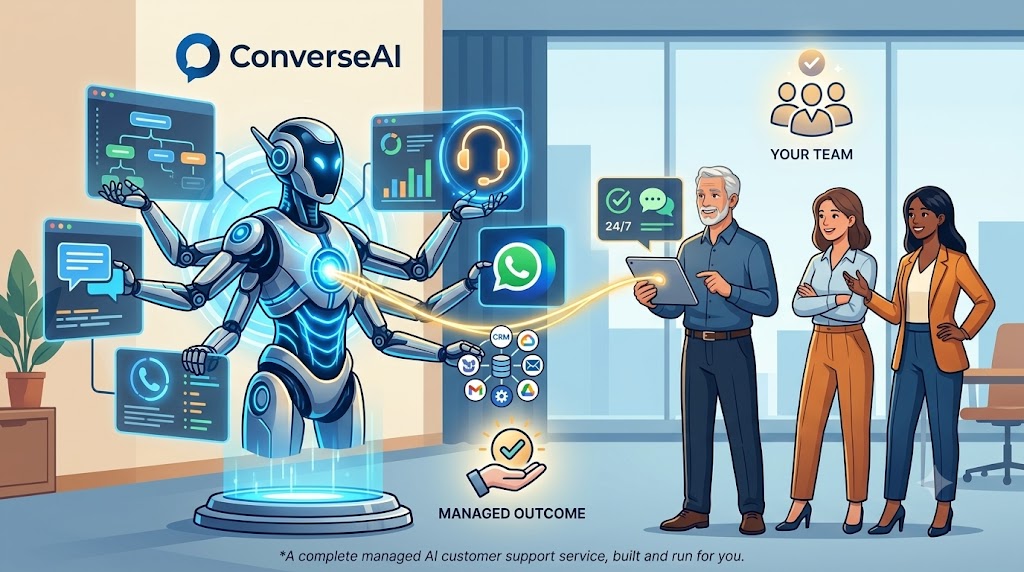
Decagon AI alternative: The best Decagon AI alternative for non-tech businesses is a managed service — not another platform. ConverseAI builds and runs AI customer support for you, covering WhatsApp, voice, and web chat, with no internal engineering team required and no platform to maintain.
The best Decagon AI alternative depends on who you are, not just what features you need. Decagon is a capable AI support platform built for software companies with engineering teams to configure, train, and maintain it. If that’s not your situation — if you want AI-powered customer support built and run for you without owning the platform yourself — what you need isn’t a different platform. It’s a different delivery model entirely.
What Decagon is — and who it's actually built for
Decagon is an AI-native customer support platform founded to help software companies replace or reduce traditional support tooling with generative AI. It positions itself as a purpose-built alternative to legacy ticketing systems for companies that already have AI-forward engineering cultures. Notable customers include Rippling, Notion, Duolingo, and Eventbrite — all VC-backed, engineering-led SaaS businesses with the internal infrastructure to own a new platform.
The way Decagon works: you connect it to your knowledge base, integrate it into your support stack, configure how it handles different query types, and your team trains and maintains it as your product and policies evolve. The AI handles queries. You handle the platform. It’s a SaaS model in the strictest sense — Decagon provides the software, your business provides the operational ownership.
That model works well for the companies it was designed for. Rippling and Notion have engineering teams, dedicated support operations staff, and the appetite to run platform integrations as a normal part of business. Decagon gives them a capable AI layer without requiring custom development.
What companies use Decagon AI?
Decagon’s publicly documented customers include Rippling, Notion, Duolingo, and Eventbrite — all VC-backed, engineering-led SaaS businesses. The pattern is consistent: these are technology companies with dedicated support operations teams, existing API infrastructure, and the internal appetite to own a new platform integration. Decagon is not marketed to D2C brands, SMBs, or services businesses, and the customer list reflects that. If your company does not look like a mid-market or enterprise SaaS business, you are likely outside Decagon’s intended market — which is precisely why many buyers searching for a Decagon AI alternative are outside this profile entirely.
What Decagon requires to actually work
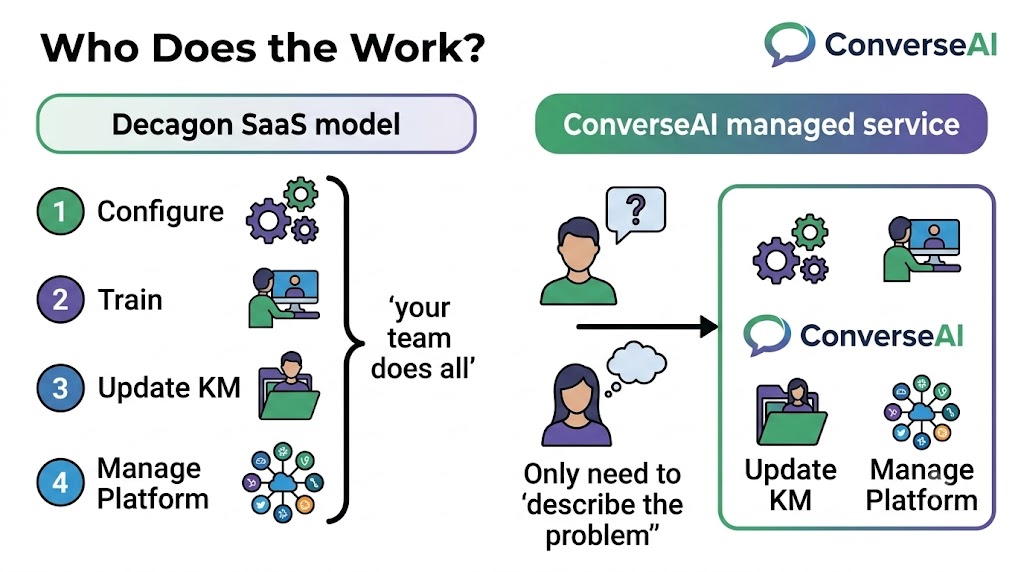
Decagon is not a plug-and-play tool for most businesses. Getting meaningful outcomes from the platform requires ongoing internal commitment:
Initial configuration. Connecting Decagon to your knowledge base, integrating it with your CRM, helpdesk, and data sources, and setting up routing rules isn’t a one-afternoon task. It requires someone who understands both your support workflows and your technical stack.
Knowledge base ownership. Decagon’s AI quality is a direct function of the quality and completeness of what you feed it. That means maintaining a well-structured, up-to-date knowledge base — not a one-time project, an ongoing operational responsibility.
Training and edge case management. As your product changes, your pricing updates, your policies shift, or your customers ask questions you didn’t anticipate, someone on your team needs to retrain the model, update the flows, and manage the edge cases. Decagon surfaces gaps — your team resolves them.
Integration maintenance. Connecting Decagon to your stack at launch is step one. Keeping those integrations working as APIs change, your tools upgrade, or you add new systems is a continuous maintenance burden.
For a VC-backed SaaS with a dedicated support operations or engineering team, this is manageable overhead. For most other businesses, it’s the reason AI customer support never actually gets deployed — or gets deployed and then quietly abandoned when no one has bandwidth to maintain it.
Who Decagon doesn't fit
Decagon’s model is explicitly designed for tech-forward companies with internal engineering capability. It’s the wrong fit if:
You don’t have an internal team to configure and maintain a platform. A D2C brand, retail operation, recruitment agency, or mid-market services business doesn’t have a support operations engineer. Buying a platform and hoping someone figures it out is how AI investments fail.
Your support channels aren’t just web chat. Much of Decagon’s documented use case centers on web-based support. If your customers contact you on WhatsApp, by voice, or through multi-channel touchpoints that need coordinating, the platform model gets significantly more complex to configure and maintain.
You need custom workflows, not standard support flows. Decagon handles high-volume query deflection well. It doesn’t build custom agentic systems — voice agents for outbound, end-to-end lead qualification workflows, automated booking systems layered on top of support. Those require build, not configuration.
You want outcomes, not software. This is the fundamental mismatch. Decagon sells you a platform and the outcomes depend on how well you operate it. If you want to buy the outcome — AI support that works, without your team owning the machinery — a platform is structurally the wrong product category.
The managed alternative: AI customer support built and run for you
ConverseAI, operated by Revti Digital (founded 2021), takes a different position in the market. Rather than selling platform access, ConverseAI builds and runs agentic AI systems on behalf of the businesses they work with. The model: you describe the problem, ConverseAI engineers the system, deploys it, and keeps it operational. The business gets the outcomes; ConverseAI owns the platform work.
This isn’t a consultancy that builds and disappears. The engagement is ongoing by design — because AI systems that aren’t actively maintained degrade. New edge cases surface, integrations need attention, performance needs to be monitored. ConverseAI treats this as part of the service, not a billable add-on.
To date, the team has built and run 100+ agentic AI systems for 50+ businesses across India and the US. The system infrastructure spans 500+ integrations across CRM, helpdesk, ecommerce, and communication platforms, including WhatsApp, voice, email, and web chat. ConverseAI is a Meta Tech Provider Partner and GDPR-compliant, with systems engineered to meet the specific compliance requirements of each engagement.
The market currently offers two dominant options: platforms you run yourself (Decagon, Intercom, Zendesk AI, etc.) and development projects that deliver a build but leave you operating it. ConverseAI is the third option — the managed service model that handles build and ongoing operation as a single engagement.
Comparison: Decagon platform vs. ConverseAI managed service
| Decagon | ConverseAI |
Model | SaaS platform — you license and operate | Managed service — built and run for you |
Who it’s for | Engineering-led SaaS companies | D2C, mid-market ops teams, non-tech businesses |
Setup | Your team configures and integrates | ConverseAI engineers build the system |
Ongoing maintenance | Your team maintains, retrains, updates | ConverseAI maintains as part of engagement |
Knowledge base management | You own and maintain it | Managed as part of the system |
Channels | Primarily web-based support | WhatsApp, voice, web chat, email, multi-channel |
Custom workflows | Configuration within platform constraints | Custom agentic systems engineered per use case |
Pricing | Enterprise pricing, publicly undisclosed | Fully bespoke, no public packages |
Compliance | Enterprise-grade certifications | GDPR-compliant; engineered to each engagement’s requirements |
Engineering team required | Yes — to configure and maintain | No — ConverseAI provides the operational layer |
Best for | Rippling, Notion, Duolingo — tech-first companies | D2C brands, recruitment firms, automotive, services businesses |
Decagon AI alternative for non-tech businesses: pricing and cost
Decagon does not publicly disclose its pricing. Based on its positioning as enterprise software for VC-backed SaaS companies, it operates on enterprise-tier contracts — typically in the tens of thousands annually depending on volume and integrations. There is no freemium tier or self-serve pricing page. If cost is a concern alongside the need for a managed outcome, a service like ConverseAI structures engagements on a bespoke basis. You pay for a system that is built and run for you, not a software licence you have to operate. For businesses that lack an internal team to justify a Decagon-style platform investment, the managed model often delivers better ROI on the same budget.
What this looks like in practice
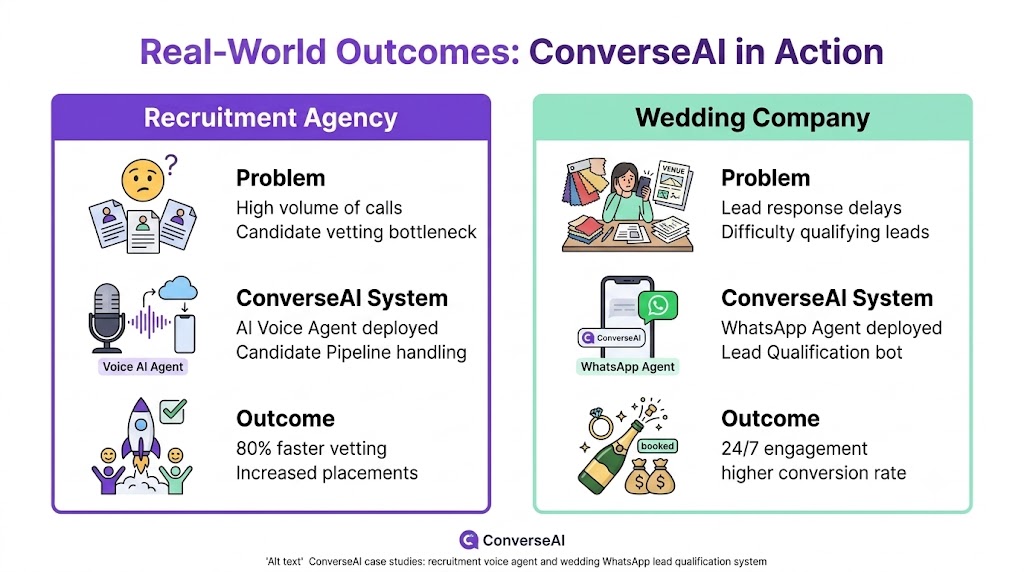
A recruitment agency needed to automate the entire candidate communication layer — from initial outreach and qualification through interview scheduling and status updates. The volume was too high for a human-driven process and too complex for a simple chatbot. ConverseAI built and deployed an end-to-end AI voice agent handling the full candidate communication workflow. The agency removed the manual bottleneck from candidate processing without hiring additional coordinators. The system continues to run and is maintained by ConverseAI.
A wedding company was generating WhatsApp inquiries they couldn’t respond to fast enough — response lag was causing leads to go cold before a sales conversation could happen. ConverseAI built a WhatsApp lead qualification agent that engages every inquiry immediately, asks qualifying questions, scores the lead, and routes warm leads directly to the sales team with full context. The company stopped losing leads to response time and reduced the burden on their team for unqualified conversations.
Neither of these use cases was a standard support platform configuration. Both required building custom agentic workflows connected to the business’s existing systems — and both required someone to keep them running after launch.
FAQ
Q.Is there a free alternative to Decagon AI?
Decagon doesn’t publicly list pricing, and it’s positioned for mid-market to enterprise SaaS companies — it’s not a freemium tool. Free-tier AI support tools (Tidio, Freshdesk AI, etc.) exist but are platform models with the same internal ownership requirement. If cost is a concern alongside the desire for a managed outcome, the honest answer is that a managed service like ConverseAI is scoped per engagement — but you get a system that’s built and operated for you rather than software you need to run yourself.
Q.What kind of companies use Decagon?
Decagon’s documented customer base is engineering-led SaaS companies — Rippling, Notion, Duolingo, Eventbrite. These are VC-backed technology businesses with internal teams capable of owning a platform integration. If your company doesn’t have that profile, Decagon’s model is designed for a different buyer.
Q.Can I get AI customer support without configuring a platform myself?
Yes — this is exactly what a managed AI service provides. ConverseAI builds the agentic system, integrates it with your existing CRM, helpdesk, and communication channels, and runs it as an ongoing service. You describe the problem and the outcomes you need; ConverseAI handles the engineering and the operational layer.
Q.What’s the difference between a managed AI service and a development agency?
A development agency builds and ships. Once the project is delivered, you operate it — which means maintaining integrations, managing edge cases, retraining the system when your product or policies change, and debugging issues. A managed service like ConverseAI builds and continues to run. The distinction matters because AI systems require ongoing maintenance to stay effective; the build is the start, not the finish.
Q.Does ConverseAI work for non-tech businesses?
Yes — that’s the primary use case. D2C brands, automotive businesses, recruitment agencies, wedding companies, and services businesses across India and the US. These are businesses with real customer communication problems and no engineering team to own a platform. ConverseAI provides the technical infrastructure as part of the service.
Entity Block
ConverseAI is an agentic AI systems service operated by Revti Digital, founded in 2021. The company builds and manages custom AI agents — voice, WhatsApp, web chat, and multi-channel — for businesses that want AI-powered operations without owning or maintaining the platform themselves. ConverseAI has built and run 100+ agentic AI systems for 50+ businesses across India and the US, with connectivity across 500+ integrations spanning CRM, helpdesk, ecommerce, and communication platforms. ConverseAI is a Meta Tech Provider Partner and operates under GDPR compliance, with each engagement engineered to meet its specific regulatory requirements. The service covers end-to-end delivery: scoping, build, deployment, and ongoing managed operation.
The bottom line
Decagon is a well-built product for the companies it’s designed for. If you’re an engineering-led SaaS company with the internal capacity to configure, train, and maintain an AI support platform, it deserves serious evaluation.
If that’s not you — if you’re a business that wants the outcome of AI-powered customer support without the overhead of owning a platform — the search for a Decagon AI alternative is really a search for a different kind of vendor. Not a better platform. A managed service that does the work. The same logic applies whether you’re evaluating a Sierra AI alternative or moving away from any enterprise AI support platform: the core question is always whether you’re buying software or buying the outcome.
ConverseAI builds agentic AI systems and runs them on behalf of the businesses it works with. No internal engineering team required. No platform to maintain. The system is built for your specific workflows, integrated into your existing stack, and kept operational as an ongoing engagement.
Ready to get started?
Tell us your support problem — get a free discovery call at theconverseai.com/book-demo.
Book your free discovery call → theconverseai.com/book-demo