
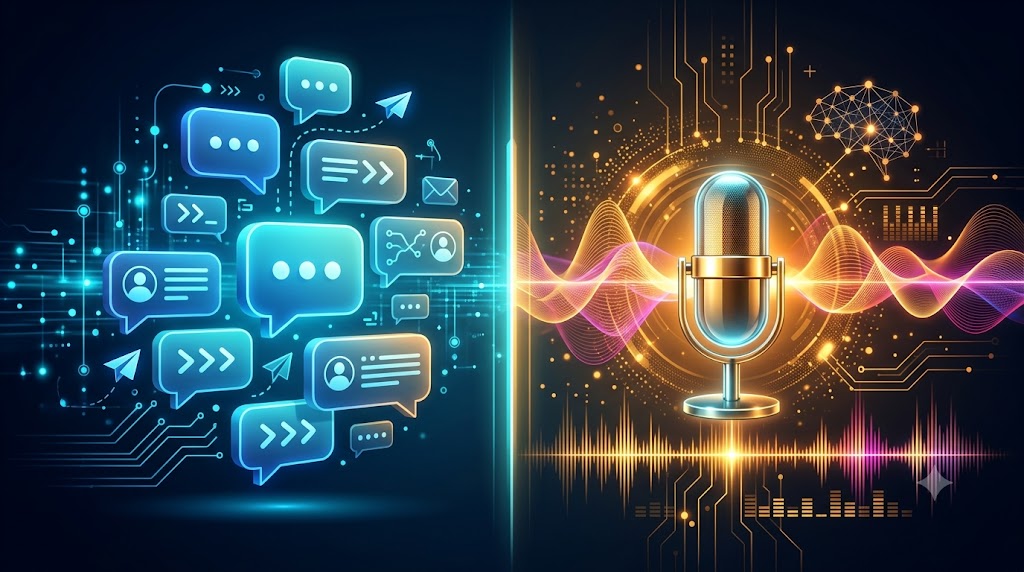
Featured Snippet: Voice agents and chatbots solve different problems. Voice agents handle phone-based conversations — typically 5–15 minutes, higher stakes, with real-time sentiment detection. Chatbots handle text-based interactions on websites, WhatsApp, or Messenger — typically 2–3 exchanges, lower commitment, instant. The right choice depends on your channel, your customer's intent, and how complex the conversation needs to be.
Voice Agents vs Chatbots: When to Use Each (And When to Use Both)
Most businesses frame this as a binary choice. Voice or text. Phone or chat. AI that talks or AI that types. That framing is wrong, and it costs people money.
The real decision is more specific: what kind of conversation are you trying to automate, and what channel does your customer actually expect to use? Pick the wrong answer and you get one of two failure modes — a voice agent deployed on use cases too simple to justify the cost, or a chatbot trying to handle a collections call and producing zero results.
We have built and operated over 100 AI systems for 50+ businesses since 2021. The comparison below reflects what we have actually seen in production, not benchmarks from demos.
What Chatbots Actually Are
A chatbot is a text-based AI that operates on channels your customers already type on: your website, WhatsApp, Facebook Messenger, or an in-app chat widget.
The defining characteristics are:
Asynchronous and low-commitment. The customer types when they want. They can walk away mid-conversation and come back. There is no hold music, no awkward silence.
Short by nature. Most chatbot interactions resolve in 2–3 exchanges. The customer asks something, the bot answers, they either convert or they leave.
Scalable text translation. Adding a new language to a chatbot typically means translating the response library or prompts. Not trivial, but far simpler than adding a language to a voice system.
Lower setup complexity. No telephony stack, no ASR, no TTS engine tuning. A chatbot can go from spec to production faster than a voice agent.
Chatbots are well-suited for interactions where the customer already knows roughly what they want — FAQ resolution, order status, basic qualification, appointment scheduling through a form-style flow.
Resolution rates for simple FAQ-type queries run 40–70%, depending on how well the knowledge base is maintained and how narrow the topic set is. That range is honest. A chatbot on a tightly scoped use case (e.g., "check my loan status") will sit at the high end. A chatbot trying to handle anything and everything without escalation paths will sit at the low end or below it.
See our AI chatbot product for a sense of how we configure chatbots in production.
What Voice Agents Actually Are
A voice agent is an AI that conducts phone calls. It speaks, listens, understands spoken language, and responds in real-time — handling the full conversation from greeting to resolution or handoff.
Key differences from chatbots:
Phone-native. The interaction happens on a channel where the expectation is a flowing, natural conversation — not bullet-point menus.
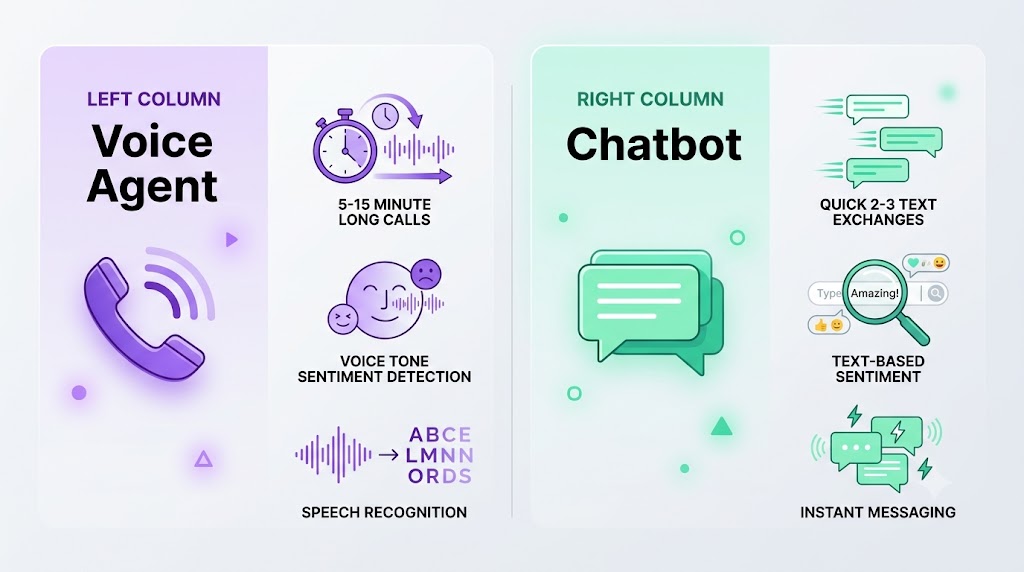
Longer conversations. Voice agent calls typically run 5–15 minutes. This is not inefficiency; it reflects the nature of the use case. A collections call, a loan qualification, a post-discharge patient check-in — these cannot be compressed into two text bubbles.
Real-time sentiment detection. A voice agent can detect frustration, hesitation, or urgency in the caller's tone and adjust — escalating to a human, slowing down, or changing approach. A chatbot reading text has no equivalent signal.
Higher resolution rates. Properly deployed voice agents achieve 60–80% resolution on use cases they are designed for. Legacy IVR systems (the ones with "press 1 for billing") sit at 15–25% resolution. Voice agents are not IVR. The gap is structural — see our voice agents vs IVR comparison for the full breakdown.
Higher complexity to deploy. You need a telephony integration, ASR, TTS, intent handling, CRM write-back, and language-specific voice tuning. This is a real engineering surface area.
Our complete AI voice agents guide covers the architecture and use case depth if you want to go further.
The Core Differences
Dimension | Chatbot | Voice Agent |
Modality | Text (website, WhatsApp, Messenger) | Voice (inbound/outbound phone calls) |
Typical interaction length | 2–3 exchanges | 5–15 minutes |
Sentiment detection | Limited (text tone only) | Yes (voice tone, pace, hesitation) |
English accuracy | High | Very high (95%+ ASR) |
Hindi accuracy | Good (20–30% quality gap vs. English) | Moderate (72–85% ASR, 40–50% quality gap) |
Tamil accuracy | Moderate (20–30% quality gap) | Lower (65–75% ASR, 40–50% quality gap) |
Multilingual scaling | Easier (translate text/prompts) | Harder (ASR + TTS per language) |
Setup complexity | Lower | Higher (telephony + ASR + TTS + voice tuning) |
CRM write-back | Yes, standard | Yes, standard |
Resolution rate | 40–70% (simple FAQs) | 60–80% (designed use case) |
Cost per interaction | Lower | ₹8–15/min |
Best for | FAQs, order status, basic qualification, WhatsApp flows | Collections, lead qualification calls, complex support, appointment reminders, outbound campaigns |
The multilingual column deserves emphasis. Chatbot translation quality drops 20–30% from English to Hindi or Tamil. For voice, the gap is 40–50% — driven by ASR accuracy variance and regional accent diversity, which has no equivalent in text. If regional language accuracy is a hard requirement, it changes the deployment calculus on both channels, but more so on voice.
When a Chatbot Is the Right Choice
Use a chatbot when:
The interaction is short and self-serve. If a customer is asking "what's my outstanding balance?" or "when does my order arrive?" — a chatbot handles this cleanly in one or two exchanges. No need to involve a voice system.
Your channel is already text-based. If customers are already engaging with you on WhatsApp or your website, a chatbot meets them where they are. Adding a phone number for a simple FAQ is adding friction, not reducing it.
You need high volume at low cost. Chatbots scale horizontally without per-minute telephony costs. For high-frequency, low-complexity interactions, the economics favour text.
The customer prefers async. Many users — especially for loan status, e-commerce support, or document requests — do not want to be on a live call. They want to type a question at 11 PM and get an answer.
You are qualifying leads before investing in calls. A WhatsApp chatbot can screen inbound leads on 2–3 criteria (budget, timeline, intent) and filter out unqualified enquiries before a human or voice agent touches them.
When a Voice Agent Is the Right Choice
Use a voice agent when:
The use case is collections or debt recovery. Collections conversations are not resolved by text menus. They require negotiation, tone calibration, payment plan discussion, and real-time response to objections. Voice agents in NBFC collections contexts routinely outperform human teams on cost-per-recovery metrics. See voice agents for collections for the detail.
Calls convert better than chat for your funnel. In most B2C sales contexts — auto loans, insurance, real estate — a phone call closes faster than a chat conversation. A voice agent that calls a qualified lead within minutes of their enquiry captures intent at its peak. Our lead qualification with voice agents guide covers the conversion dynamics.
The conversation is complex. Anything requiring multi-step data gathering, back-and-forth clarification, or adaptive responses based on what the customer says — these are voice territory. A chatbot that requires 12 exchanges to resolve a complex support issue is a bad chatbot, not an efficient one.
You are running outbound calling at scale. A real example from our own deployments: Salasar Auction runs 5,000–7,000 outbound calls per month in Hindi and English. No human team scales there without a massive headcount spike. A voice agent handles the volume, maintains consistent quality, and writes outcomes back to the CRM automatically.
Appointment reminders and patient engagement. Healthcare no-shows cost providers significantly in lost revenue and patient outcomes. A voice agent that calls the day before, confirms, reschedules if needed, and updates the system — this is a direct operational improvement that a text reminder can partially replicate but cannot match for complex cases.
A dedicated recruitment use case: one of our deployments runs an end-to-end voice agent for a candidate pipeline — initial screening, experience verification, and scheduling — with no chatbot component. The conversation depth required makes text-only impractical.
See customer support voice agents for support-specific deployment patterns.
The Hybrid Strategy: Chat First, Voice When It Matters
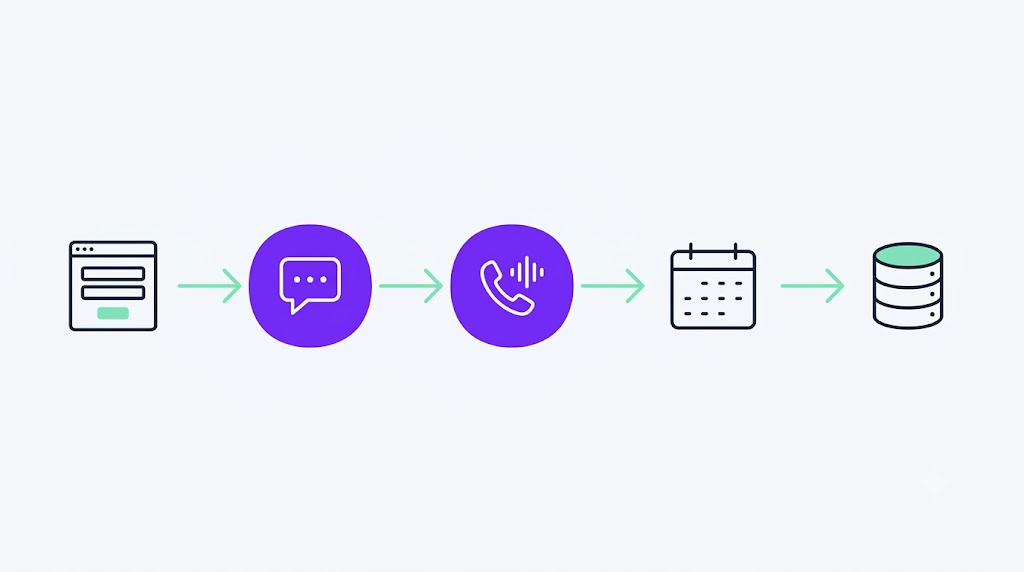
The most effective deployments we have seen do not choose. They sequence.
The pattern works like this:
WhatsApp chatbot qualifies inbound leads. Asks 2–3 screening questions (budget range, timeline, use case). Costs almost nothing per interaction. Filters out the 60–70% of enquiries that are either too early or clearly unqualified.
Hot leads trigger an outbound voice agent call. The qualified leads — the ones who answered yes to intent and fit — get a call within minutes. The voice agent picks up from where the chat left off, references the answers already captured, and moves toward booking.
Support chatbot escalates to voice for complex cases. Most support queries resolve on WhatsApp. The ones that do not — billing disputes, technical failures, multi-step troubleshooting — escalate to a voice call, either a live agent or a voice AI depending on complexity.
Automotive use case: A car dealership uses a WhatsApp chatbot to qualify new leads from ad traffic. Leads that confirm "yes, I want a test drive" within the chatbot flow are immediately called by a voice agent to confirm the booking slot. The chatbot conversion rate on test-drive intent sits significantly higher than the same journey done purely by phone, because the text channel removes the friction of speaking to a salesperson before you are ready.
This hybrid model also handles the cost argument cleanly. The expensive per-minute voice time is spent only on conversations that warrant it. The cheap text interactions handle everything else.
A Note on Multilingual
Both channels support multiple languages. Neither channel handles multilingual perfectly. The differences matter.
For chatbots: Adding Hindi or Tamil to a chatbot primarily involves translating the knowledge base, response templates, and intent detection. The quality gap between English and regional languages runs 20–30% — lower response accuracy, some NLP gaps in colloquial usage, and occasional translation artefacts. Manageable, and improving fast.
For voice agents: Adding Hindi or Tamil to a voice agent requires language-specific ASR models, TTS voice tuning, and validation against regional accent variation. The quality gap runs 40–50% from English. In numbers: English ASR sits above 95% accuracy. Hindi ASR sits at 72–85%. Tamil at 65–75%.
That 40–50% gap is not a product failure — it is a physics-of-speech problem. Spoken language has far more variability than written text: accents, background noise, speech rate, elision. The technology is improving, but the gap is real and you should factor it into deployment decisions.
Practical guidance: If your primary user base speaks Tamil or a regional dialect heavily influenced by local accent variation, test extensively before scaling. For Hindi-dominant markets (Northern India, much of Central India), current ASR is good enough for most business use cases with the right model selection and training.
FAQ
Q: Is a voice agent the same as an IVR?
No. An IVR (interactive voice response) is a menu system — "press 1 for sales." It cannot handle natural conversation, understand intent from full sentences, or adapt based on what a customer says. Voice agents resolve 60–80% of conversations. IVR resolves 15–25%. The comparison is detailed in our voice agents vs IVR guide.
Q: Can a chatbot detect customer frustration?
A chatbot can detect sentiment signals in text — aggressive language, repeated questions, short terse replies — but it has no access to vocal tone, pace, or hesitation. Voice agents have the richer signal. For use cases where emotional calibration matters (collections, complaints, retention), voice has a structural advantage.
Q: How long does it take to deploy a voice agent vs a chatbot?
Chatbots have a shorter path to production — typically 2–6 weeks for a well-scoped deployment. Voice agents take longer — typically 4–10 weeks — because of telephony integration, voice tuning, ASR configuration, and more extensive testing requirements. Setup complexity is higher on voice; ongoing operation at scale is where the ROI shows up.
Q: Do voice agents and chatbots both write back to CRM?
Yes. Both can be configured to write call/conversation outcomes, captured data, and disposition codes back to your CRM (Salesforce, HubSpot, Zoho, custom systems). This is standard in any production deployment, not an add-on. The CRM integration is often where the real operational value shows up — making the AI's work visible in the systems your team already uses.
Q: What industries use voice agents the most?
Collections and NBFC lending, automotive sales, healthcare appointment management, recruitment, real estate, and insurance are the highest-volume voice agent verticals in the markets we operate in. Chatbots are dominant in e-commerce, SaaS customer support, hospitality, and financial services FAQs.
Q: Can a voice agent handle inbound and outbound calls?
Yes. A single voice agent system can be deployed for inbound (customer calls in), outbound (agent calls the customer), or both. Outbound is particularly powerful for proactive use cases — payment reminders, lead follow-up, appointment confirmation — where waiting for the customer to call is a conversion loss.
Q: What happens when a voice agent cannot resolve a call?
A properly configured voice agent has escalation logic. When the conversation hits something outside its scope — an edge case, a highly agitated customer, a regulatory requirement for human involvement — it transfers the call to a live agent with a summary of what was discussed. The handoff is seamless; the human picks up with context, not from zero.
Q: Are chatbots cheaper to run than voice agents?
Per-interaction, yes. Chatbot operating costs are lower because there is no telephony cost and text processing is cheaper than real-time speech processing. Voice agents cost roughly ₹8–15 per minute. But cost per interaction is the wrong metric if voice resolves more and converts better for your use case. Measure cost per resolution, or cost per conversion.
Q: Can I start with a chatbot and add voice later?
Yes, and this is often the sensible approach. Start with a WhatsApp chatbot to handle volume and qualify leads. Once you have data on which conversations need a richer channel, add voice for those specific paths. The hybrid model we described above is essentially this staged approach in production.
Q: Does ConverseAI build both?
Yes. We build and operate both as a managed service — not just as software. We handle the build, integration, testing, and ongoing monitoring. Our team has deployed across voice, WhatsApp, website chat, and hybrid systems since 2021, across 50+ businesses and 500+ integrations. You can explore our AI voice agents service or our AI chatbot product directly.
Related Reading
Complete guide to AI voice agents — Architecture, use cases, and deployment considerations in depth
Voice agents vs IVR: what's actually different — Why 60–80% resolution beats 15–25%, and what it takes to get there
Voice agents for collections and compliance — NBFC use cases, compliance guardrails, and outcome data
Lead qualification with voice agents — Why phone beats chat for sales conversion, and how to build the qualification flow
Customer support voice agents — Escalation design, resolution metrics, and hybrid support patterns
Ready to get started?
Not sure whether your business needs a voice agent, a chatbot, or both? Book a free AI strategy call — we'll map the right channel to your use case.
Book your free discovery call → theconverseai.com/book-demo