
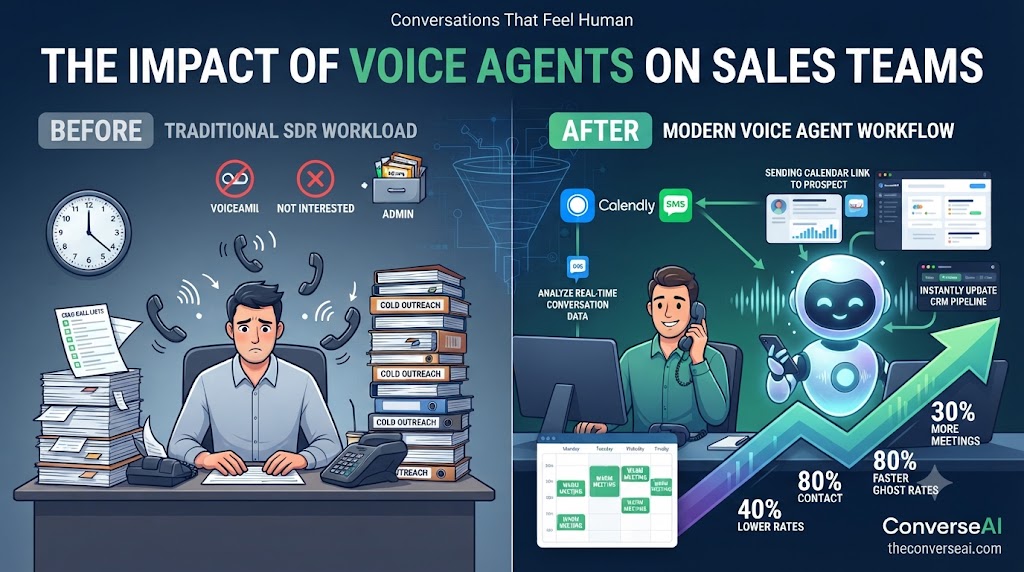
Voice agents for sales appointments use AI to handle outbound dialing, run a 2–3 question qualification check, and book the meeting directly onto the SDR's calendar — all during the call. Teams using this approach book 30% more meetings from the same lead pool, because the agent never stops following up and contacts every lead within minutes, not days.
Sales Appointments With Voice Agents: How SDR Teams Book 30% More Meetings
Your SDRs are spending 60% of their time on outreach that leads nowhere. Voicemails nobody returns. Cold calls that hit a wall at "not interested." Email sequences that get opened and ignored. Every hour spent on that outreach is an hour not spent in a real sales conversation.
A voice agent doesn't replace the SDR. It does the dialing and qualification so the SDR only talks to people who actually want to meet. The agent dials, qualifies, books, and hands off. The SDR shows up to a calendar full of warm meetings instead of spending the morning grinding through cold lists.
That shift — from dialing machine to conversation closer — is where the 30% improvement comes from.
The SDR Capacity Problem
Sales development is expensive whether you hire in India or the US.
An SDR in India runs ₹20,000–30,000 per month all-in. In the US, budget $4,000–6,000 per month before you factor in tools, management overhead, and the ramp period. At those costs, you need every hour to count.
It doesn't. Here's what the average SDR actually spends their time on:
60% on cold outreach — dialing, leaving voicemails, sending follow-up emails on sequences that get no response
~20% on admin — CRM updates, scheduling coordination, internal meetings
~20% on actual qualified conversations
Cold call callback rates sit at 5–8%. That means for every 100 dials, your SDR gets 5–8 conversations worth having. The rest is wasted capacity.
The follow-up problem is worse. Research consistently shows that most leads need 5–8 touches before they'll commit to a meeting. The average SDR gives up after 2. Not because they're lazy — because they have 200 leads in the queue and the third and fourth call on the same person feels like harassment when there are new leads to hit.
The math is simple: most of your pipeline is dying in the follow-up gap, not because the lead wasn't interested, but because nobody called back at the right time.
How Sales Booking Voice Agents Work
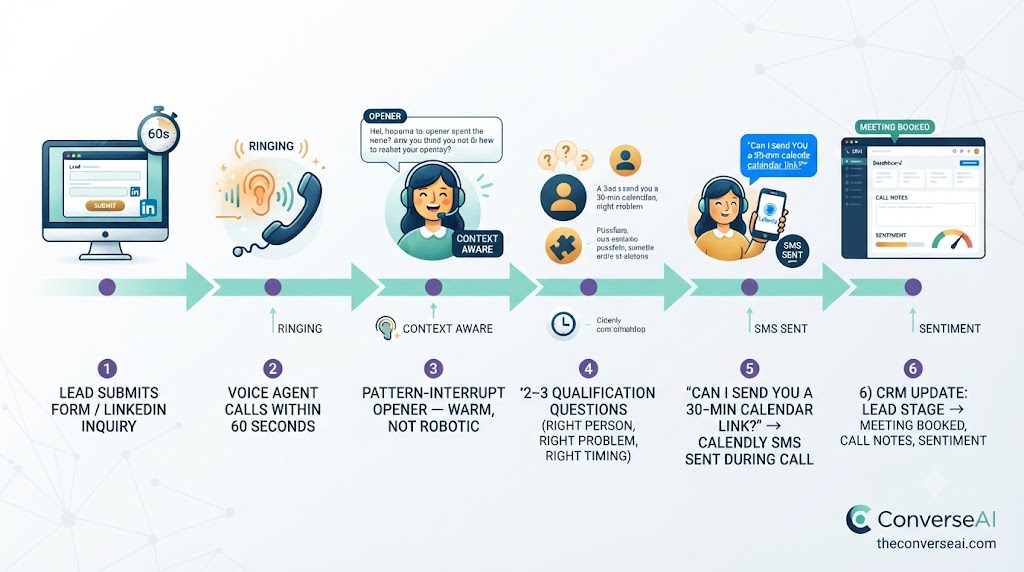
A voice agent for sales appointments isn't a robocall system. It's an AI that can carry a context-aware, adaptive conversation — and route to booking at the right moment.
Here's how a well-built outbound booking flow works:
1. Trigger: Lead enters the pipeline
A lead comes in from a Facebook ad, a LinkedIn inquiry, a webinar registration, or a CRM stage change. The voice agent dials within minutes — not hours. This matters enormously: research shows lead conversion drops 80% after 5 minutes of no contact. The SDR chasing that lead at 9am the next day is competing against a very different level of intent.
2. Opening hook — pattern interrupt, not pitch
The opening line makes or breaks the call. Not:
"Hi, this is an automated message from XYZ Company calling to tell you about our exciting solution for..."
That's a hang-up in 3 seconds.
A consultative opener sounds like this:
"Hey [Name], this is Maya from [Company] — you filled out the form on our site about [specific topic]. Quick question before I let you go — are you looking to solve this in the next 30 days, or is this more exploratory right now?"
The pattern interrupt works because it shows context (they filled out a form), respects their time ("quick question"), and asks something that invites a real answer rather than a reflexive rejection. ConverseAI trains booking agents on this style — consultative hooks with genuine qualifying intent, not "Hi I'm calling to discuss our product" scripts that everyone has learned to tune out.
3. Qualification mini-check — 2–3 questions maximum
The agent isn't trying to run a discovery call. It's checking three things in under 90 seconds:
Right person — Are they the decision-maker or the right referral point?
Right problem — Does their situation match what you solve?
Right timing — Is there a reason to meet now, or are they 6 months out?
If the answers qualify, the agent moves to booking. If they don't, the agent segments the lead correctly in the CRM and sets a future callback — it doesn't kill the lead.
4. Booking — Calendly link sent via SMS during the call
"I'd love to get you 20 minutes with our team to walk through exactly how we've handled this for companies like yours. I'm going to send you a quick link right now — takes 10 seconds to pick a time."
The SMS fires while the lead is still on the phone. Conversion rate on that in-call link is dramatically higher than a follow-up email with a Calendly link. The lead picks the time while their intent is live.
5. CRM update — real-time, automatic
The agent writes the call outcome, key qualification notes, meeting booked status, and a sentiment score to Salesforce or HubSpot immediately. No manual entry. No lost context.
The Follow-Up Sequence: Where Most Sales Fall Apart
Booking the first meeting is the easy part. Getting the prospect to actually show up is where most sales operations bleed.
70% of booked meetings need at least one reminder contact before the meeting happens. Without it, ghost rates run high — decision-makers book a meeting with good intentions and then let it slide when the calendar fills up.
A well-built voice agent handles the post-booking sequence automatically:
Day-before confirmation call
The agent calls or sends a WhatsApp message the day before: "Hi [Name], confirming your meeting tomorrow at [time] with [SDR name] — you're still on for that, right? Quick yes or no works." A direct confirmation ask — not just a notification — gets a response and re-commits the prospect.
1-hour before SMS
Short, practical, zero friction: "Your call with [SDR] starts in an hour. Join link: [link]. See you then."
No-answer reschedule offer
If the prospect doesn't join, the agent doesn't wait for the SDR to notice 30 minutes in. It immediately sends: "Looks like we missed you — want to pick a new time? [Calendly link]"
The result: ghost rates after booking drop by 40% with this three-touch reminder sequence. That's 40% more of your booked meetings actually happening, from leads you already converted once.
Calendly + CRM Integration: Making the Booking Stick
The booking is only as good as the system behind it. A voice agent that books a meeting but doesn't write it cleanly to your CRM creates chaos for the SDR who walks into that call with no context.
Here's what a properly integrated booking agent does in real time:
During the call:
Sends Calendly or Google Calendar link via SMS
Monitors for booking confirmation (webhook from Calendly)
Confirms the time with the lead verbally once the slot is selected
Immediately after booking:
Creates the meeting record in Salesforce/HubSpot with: lead stage updated to "Meeting Booked," call transcript summary, 2–3 qualification notes, sentiment score (positive/neutral/hesitant)
Sends the SDR a Slack or email notification: "Meeting booked: [Name], [Company], [Time]. They mentioned [key context from call]. Sentiment: Positive."
The SDR doesn't just get a calendar invite. They get briefed. They walk into the meeting knowing who they're talking to, what problem was surfaced on the booking call, and how engaged the prospect sounded.
That context turns a cold intro meeting into a warm conversation from the first 30 seconds.
What Separates Booking Agents From Cold Call Robots
There's a reason most people's reaction to "AI sales calling" is skepticism. They've experienced the robocall version — monotone, obviously synthetic, scripted to a dead end, incapable of handling anything outside a fixed path.
That version of AI calling does more damage than good. Hang-up rates are high, brand perception takes a hit, and the leads who might have responded to a better approach are now poisoned.
The difference between a cold call robot and a consultative booking agent comes down to three things:
Tone and pacing. A good booking agent sounds human — not because it's trying to deceive anyone, but because it's built on natural conversation models that understand pacing, pause, and response cues. It doesn't read a script at a fixed pace. It adapts.
Context awareness. The agent knows who it's calling and why. It references the form they filled out, the event they attended, or the specific problem they listed. Personalization isn't a marketing buzzword here — it's what separates a 3–5x booking rate from a hang-up.
Graceful exits. A booking agent that handles objections poorly destroys pipeline. ConverseAI's booking agents are trained to recognize "not interested," "send me an email," and "talk to my assistant" — and respond with genuine options (follow-up text, email sequence, specific callback date) rather than forcing the script forward. A lead that says "not right now" and gets a good exit experience will take your call in 3 months. One that gets harassed won't.
India vs US Context: One Agent, Different Rules
Voice outreach works very differently depending on market.
India:
Decision-makers answer their mobile phones. A call from an unknown number doesn't immediately go to voicemail. WhatsApp is ubiquitous — a voice call followed by a WhatsApp message with the booking link is a natural, familiar flow. Regional language capability matters: a booking agent handling leads from Tamil Nadu or Maharashtra needs to be comfortable with English, Hindi, and regional code-switching. ConverseAI's India-market agents operate across Hindi, English, and Hinglish depending on lead context — this alone improves connection rates in regional B2B markets.
United States:
Voicemail culture is real. Many mobile numbers go straight to voicemail on the first dial from an unknown number. The booking agent needs a voicemail drop strategy alongside the live call — a short, specific voicemail that gives a reason to call back, followed by an SMS. Text-first sequences (SMS → call → email → call) often outperform call-first in the US market. Callback rates on cold calls are lower (5–8%), which means the persistence of the voice agent — hitting every lead across 6–8 touches — matters even more.
The architecture is the same. The sequence logic and language models are tuned to market.
Cost Model: Voice Agent vs SDR Team
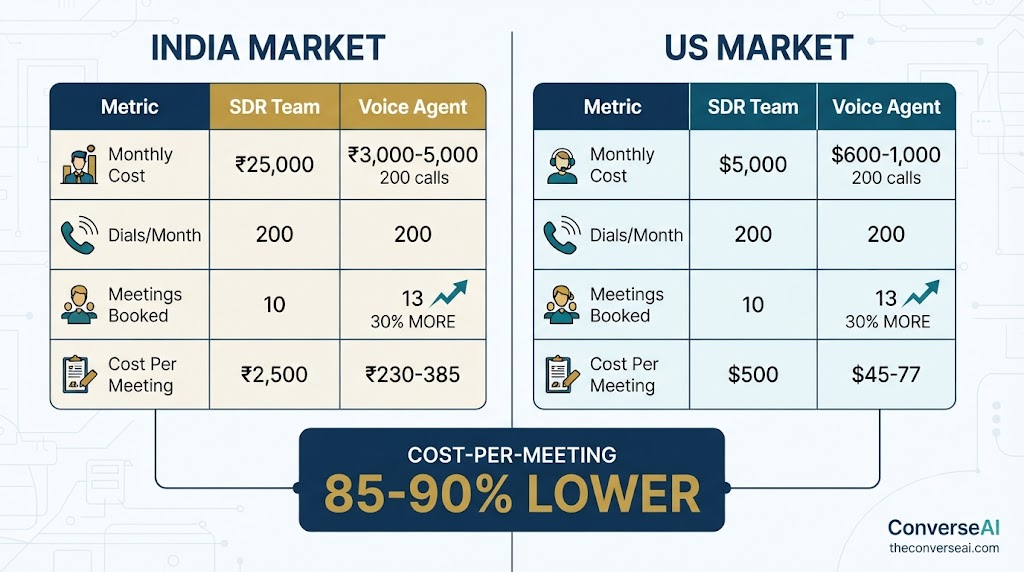
Let's put the economics on the table.
India Market — Monthly Comparison
Metric | SDR (India) | Voice Agent |
Monthly cost | ₹25,000 | ₹12,500 (500 calls × ₹25/call) |
Dials per month | 900–1,200 | 2,000–5,000 |
Qualified conversations | 60–90 | 200–350 |
Meetings booked | 18–25 | 35–45 |
Cost per meeting booked | ₹1,000–1,400 | ₹280–360 |
Follow-up consistency | 2 touches avg | 6–8 touches (every lead) |
US Market — Monthly Comparison
Metric | SDR (US) | Voice Agent |
Monthly cost | $5,000 | $1,500–2,000 |
Dials per month | 800–1,000 | 2,000–4,000 |
Qualified conversations | 50–80 | 160–280 |
Meetings booked | 15–22 | 30–38 |
Cost per meeting booked | $230–330 | $45–65 |
Follow-up consistency | 2 touches avg | 6–8 touches (every lead) |
Where the 30% improvement comes from:
The headline isn't that voice agents are 3x cheaper per meeting (though they are). It's that SDR teams using voice agents for the dialing and qualification layer book 30% more meetings from the same lead pool — because:
1. Every lead gets contacted within minutes, not the next business day
2. Every lead gets 5–8 touches instead of 2
3. Ghost rates after booking drop 40% with the reminder sequence
4. SDRs spend their time on the 20% of interactions that require human judgment, not the 80% that are grinding through cold volume
The voice agent doesn't replace SDR capacity. It multiplies it.
FAQ
Q. What is a voice agent for sales appointments?
A voice agent for sales appointments is an AI-powered outbound calling system that dials leads, runs a short qualification check, and books a meeting directly onto a calendar during the call. It updates the CRM and notifies the SDR with call notes and a sentiment summary — all without human involvement in the dialing phase.
Q. How much can a voice agent improve meeting booking rates?
Teams consistently report 25–35% more meetings booked versus SDR-only outreach, with 30% being the median improvement. The gain comes from two places: faster first contact (leads contacted within 5 minutes convert 80% better) and persistent follow-up through 5–8 touches instead of the 2 most SDRs manage.
Q. Does a voice agent replace SDRs?
No. A voice agent handles the high-volume, repetitive part of outreach — dialing, qualification, and initial booking. SDRs take the qualified meetings and run them. Most teams use voice agents to expand their pipeline capacity without increasing headcount, not to eliminate the SDR role.
Q. Can a voice agent integrate with Calendly and HubSpot/Salesforce?
Yes. A properly built voice agent sends a Calendly or Google Calendar booking link via SMS during the call, confirms the slot, writes the meeting record to HubSpot or Salesforce, and triggers an SDR notification — all in real time. The SDR receives context (who they are, what was said, sentiment) before the meeting starts.
Q. What makes a voice agent sound consultative instead of robotic?
Three things: context-aware openers that reference why you're calling (form fill, event, specific pain point), natural pacing that adapts to the conversation rather than reading a fixed script, and graceful objection handling that offers real alternatives instead of forcing the path. Robotic agents pitch. Consultative agents ask, listen, and qualify.
Q. How does the follow-up sequence work after a meeting is booked?
The voice agent handles a three-touch post-booking sequence: a day-before confirmation call or message, a 1-hour-before SMS with the join link, and an immediate reschedule offer if the prospect doesn't join. This drops ghost rates by 40%.
Q. What happens if the lead says "not interested"?
The agent has trained exit paths for common objections. A "not interested" response triggers a soft exit with a specific follow-up offer — a text summary, a callback at a stated future date, or an email with relevant case studies. The lead stays in the pipeline rather than being marked dead. Many "not right now" leads convert on touches 4–6.
Q. Can voice agents work in regional Indian languages?
Yes. Booking agents built for India's B2B market can handle English, Hindi, Hinglish, and regional code-switching. This is particularly important for leads from Tier 2 cities and regional businesses where comfort in the local language improves connection rates meaningfully.
Q. How fast can a voice agent contact a new lead?
Immediately. The voice agent triggers on lead creation — form fill, ad conversion, CRM stage change — and dials within seconds to minutes depending on configuration. This is the single biggest conversion advantage over SDR-driven outreach, where leads often wait hours or until the next morning.
Q. What does setup look like for a voice agent booking system?
ConverseAI builds and manages voice agents as a service — the agent script, CRM integrations, Calendly configuration, reminder sequences, and ongoing optimization are all handled. Most teams are live within 2–4 weeks. The SDR team is briefed on what the handoff looks like, and from there, they run their meetings while the agent handles the pipeline.
Q. Is cold calling dead, and do voice agents change that?
Cold calling isn't dead — it's just hard. The callback rate on cold calls is 5–8%, which is low but not zero. Voice agents don't magically convert cold leads into warm ones. What they do is ensure that every cold lead actually gets called (most don't after the second touch), gets contacted fast enough that intent hasn't evaporated, and gets followed up consistently enough that the 15–20% who would have said yes eventually — actually do.
Related Reading
Complete guide to AI voice agents — How voice agents work, what they can and can't do, and where they fit in your GTM stack
Voice agents for lead qualification — Qualification comes before booking; how to structure the qualification layer
Voice agents vs chatbots — When LinkedIn or WhatsApp chat initiates the conversation, voice closes it
Appointment reminders with voice agents — The post-booking reminder sequence that drops ghost rates by 40%
How to build a voice agent — Technical architecture, stack decisions, and what to expect from a build
ConverseAI AI Voice Agents Service — How we build and run voice agents for sales teams
Sales Intelligence & Outreach — Full outbound stack: research, sequencing, and voice agent booking
Ready to get started?
Want your SDRs spending 100% of their time on qualified conversations? Book a free call to see how sales booking voice agents work for your pipeline.
Book your free discovery call → theconverseai.com/book-demo