

A voice agent for lead qualification calls your inbound leads in under 60 seconds, runs a structured BANT conversation, books a meeting if the lead qualifies, and writes every data point back to your CRM — without a single SDR touching the queue. Teams using this setup convert 40–50% of inbound leads into qualified pipeline, compared to 8–15% on manual follow-up workflows.
Lead Qualification With Voice Agents: How to Stop Losing Deals in the First Hour
The 5-minute rule is dead.
Harvard Business Review measured it over a decade ago: respond to an inbound lead within 5 minutes and you're 100x more likely to make contact than if you wait 30 minutes. That was 2011. Since then, attention spans have collapsed, buying decisions happen across three competing vendors simultaneously, and the actual window has compressed to 60 seconds.
Your leads are not waiting. The moment someone submits a form on your site, they've got three other tabs open and a competitor's SDR who might get there first. Most sales teams call back in 2–3 hours. Some in 24–48. By then, 80% of conversion potential is already gone.
A voice AI agent changes this math completely. It calls the lead in under 60 seconds — automatically, every time, regardless of time zone or team capacity — runs a full qualification conversation, and either books a meeting or routes the lead appropriately. No queue. No delay. No dropped ball.
This is not a futuristic concept. It is running in production at businesses across SaaS, D2C, real estate, and automotive right now. Here is exactly how it works.
The Lead Qualification Gap: Why SDRs Can't Keep Up
Take a mid-size SaaS company. 500 inbound leads per month from a mix of paid ads, organic, and partner referrals. The current state looks like this:
SDRs respond within 24–48 hours on average
Only 20% of leads ever get properly qualified
BANT scoring is inconsistent — one rep asks about budget, another doesn't
Leads that came in on Friday evenings are stone cold by Monday morning
Pipeline data is incomplete because not every call gets logged properly
This is not a people problem. It is a capacity and consistency problem. A team of 3–4 SDRs physically cannot call 500 leads fast enough, hold a structured 3-minute BANT conversation with each one, and log every output — especially while also working warm prospects and closing deals.
The result: your best leads — the ones who filled out the form with high intent — are going cold because a human couldn't get to them fast enough. Meanwhile, your SDRs are grinding through a mix of hot and cold leads with no way to tell which is which until they've spent 10 minutes on the phone.
Voice agents solve both problems simultaneously: speed and consistency.
How Voice Agents Qualify Leads: The Real Mechanics
A voice agent for lead qualification operates on a trigger-response model. Here is the architecture:
Inbound trigger: Lead submits a form → webhook fires to the voice agent platform → agent initiates call within 60 seconds.
Outbound trigger: CRM creates a new lead record → voice agent dials automatically → no human queues it, no task is assigned.
The call itself follows a defined conversation structure:
1. Open intent — The agent introduces itself, confirms who it's speaking with, and sets context: "I'm calling because you just requested information about [product]. I have a couple of quick questions to make sure I connect you with the right team."
2. BANT qualification — Budget, Authority, Need, Timeline — covered conversationally, not as an interrogation. (See the full dialogue example in the next section.)
3. Routing decision — If the lead hits your qualification threshold (e.g., budget ≥ X, timeline ≤ 6 months, decision-maker on the call), the agent offers calendar slots and books the meeting live.
4. CRM write-back — Every signal captured during the call — interest level, use case, budget range, timeline, sentiment — is written back to your CRM record before the call ends.
What the agent does not do: pitch, hard-sell, push, or attempt to close. Its job is qualification and routing. The selling happens with your human reps, who receive a fully qualified, pre-booked lead.
BANT in Practice: What the Agent Actually Says
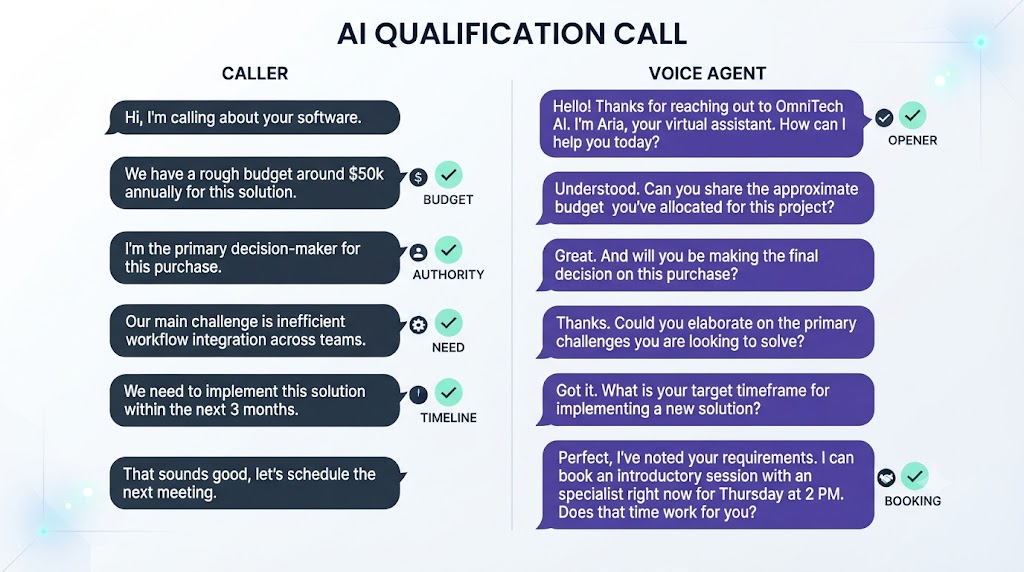
This is where most people ask the right question: "Does it sound like a robot interrogating someone?"
Done well, no. Here is an example of what a real qualification call sounds like:
Voice Agent: Hi, is this Priya?
Lead: Yes, speaking.
Voice Agent: Hi Priya, this is Maya calling from ConverseAI. You just requested information about our AI agent solutions — great timing. I have a couple of quick questions so I can make sure I get you connected with the right person on our team. Do you have two minutes?
Lead: Sure, go ahead.
Voice Agent: Perfect. So what's driving the interest right now — is there a specific process you're looking to automate, or more of an exploratory call?
Lead: We're specifically looking at automating our inbound lead calls. We have an SDR team but they can't keep up with volume.
(Agent captures: Need confirmed — inbound lead automation, SDR capacity constraint)
Voice Agent: That makes a lot of sense — it's one of the most common use cases we handle. Quick question: when you say SDR capacity, are we talking 50 leads a month, 500, more?
Lead: Closer to 400–500 a month right now, growing to maybe 800 by end of year.
(Agent captures: Scale = 400–500/month, growth trajectory noted)
Voice Agent: Got it. And for a project like this, do you have a rough budget range in mind — or is that still being figured out?
Lead: We've set aside somewhere between 3 and 5 lakh a year for this kind of automation.
(Agent captures: Budget = ₹3–5L/year, confirmed)
Voice Agent: That's very workable. One last thing — are you the right person to make a call on this, or would someone else need to be looped in?
Lead: I'm the VP Sales, so yes, this is my decision.
(Agent captures: Authority = VP Sales, decision-maker confirmed)
Voice Agent: And in terms of timeline — are you looking to get something in place in the next month or two, or is this more of a Q4 initiative?
Lead: Ideally we'd want to be live before our next campaign cycle, so within 6–8 weeks.
(Agent captures: Timeline = 6–8 weeks, high urgency)
Voice Agent: Brilliant. You're a great fit for what we do. Let me get you on a call with one of our solutions architects. I have Thursday at 3 PM or Friday at 11 AM — which works better?
Lead: Thursday at 3 works.
Voice Agent: Perfect. You'll get a calendar invite and a WhatsApp confirmation in the next two minutes. Thanks Priya — looking forward to the conversation.
Total call length: 2 minutes 40 seconds. All four BANT signals captured. Meeting booked. No pressure. No pitch.
This is the standard — not a best-case scenario. When the conversation flow is designed correctly, the lead often doesn't realize they've just been fully qualified.
Multi-Language Lead Qualification
For businesses operating across India or targeting diaspora markets internationally, language is a genuine conversion variable — not a nice-to-have.
Current ASR (automatic speech recognition) performance:
English: 95%+ accuracy — essentially production-grade
Hindi: 72–85% accuracy — functional for qualification, with occasional clarification loops
Hinglish (code-switching): Handled by modern LLM-backed agents that understand mixed input mid-sentence
Markets where multi-language qualification creates the biggest lift:
Tier 2 and Tier 3 India — EdTech, NBFC, insurance, real estate. Leads come in via Hindi-language ads and convert significantly better when the first call is in their preferred language.
SMB SaaS selling into Indian manufacturing or retail — Decision-makers often prefer Hindi or regional language even if they read English.
NRI markets (US/UK/Canada) — Hinglish is natural; an agent that can code-switch feels culturally fluent, not robotic.
A voice agent configured for Hindi + English + Hinglish is not a novelty — it is a revenue-affecting capability for most India-market businesses. The same lead pool, qualified in the caller's preferred language, produces meaningfully higher meeting booking rates.
CRM Integration: The Hidden Key to ROI
Voice agent qualification is only as valuable as the data that survives the call.
If the agent runs a perfect BANT conversation but that information doesn't land in your CRM — cleanly, structurally, queryable — your reps are flying blind. The agent has just become an expensive phone call with no memory.
Here is what a properly integrated voice agent writes back to your CRM on every completed qualification call:
Field | What Gets Logged |
Interest level | Hot / Warm / Cold (agent-scored) |
Use case | Free-text summary of stated problem |
Budget range | Exact figures or bracketed range |
Authority | Decision-maker / Influencer / End user |
Timeline | Specific dates or urgency bracket |
Sentiment score | Positive / Neutral / Negative across call |
Meeting booked | Yes / No, with timestamp and calendar link |
Call recording | Linked audio + full transcript |
Disqualification reason | If lead was routed out, why |
CRM integrations that are live in production: Salesforce, HubSpot, Zoho CRM, Freshsales, Leadsquared. The write-back happens via native API or webhook — under 5 seconds from call end.
This matters for the downstream workflow too. Your SDR who picks up the pre-qualified lead on Thursday sees: budget confirmed, VP Sales confirmed, timeline 6–8 weeks, meeting already booked. They walk in prepared. Conversion rates from first AE call to proposal improve because the rep isn't wasting 20 minutes re-establishing basics.
Cost Comparison: Voice Agent vs SDR Team
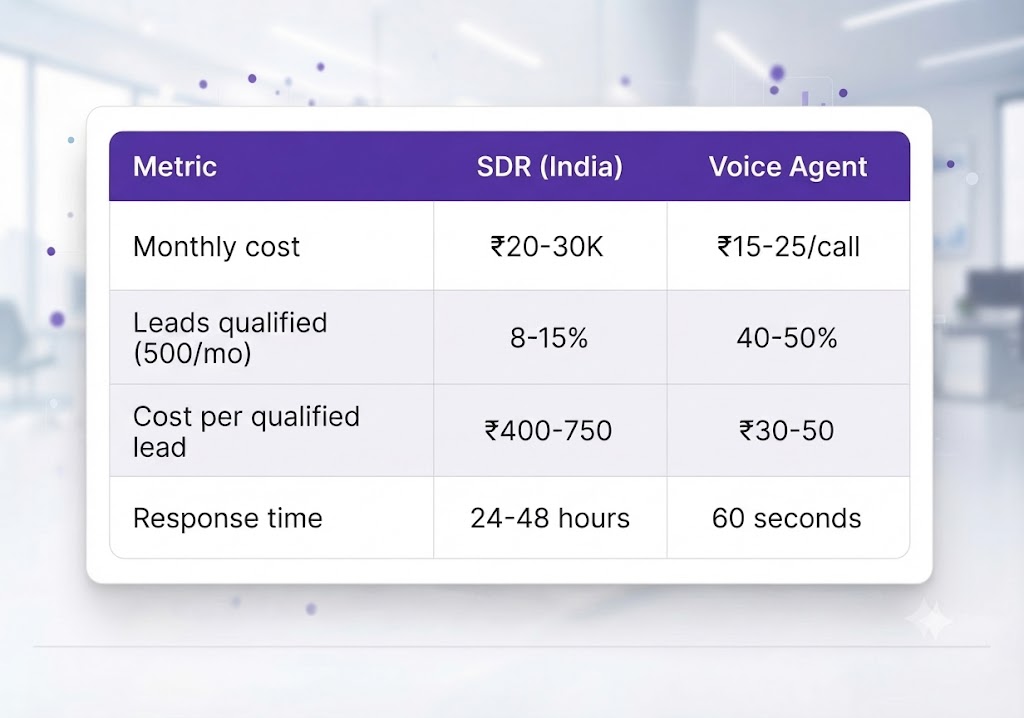
Let's put the economics on the table directly.
SDR Team Cost (Fully Loaded)
Market | Junior SDR Monthly Cost | Calls/Month (Qualification) |
India | ₹20,000–₹30,000/month | 300–500 calls |
USA | $4,000–$6,000/month | 300–500 calls |
This does not include management overhead, recruitment cost, training, attrition (which in SDR teams runs 30–40% annually), or the inconsistency tax of having multiple reps qualify differently.
Voice Agent Cost Per Call
Market | Cost Per Qualification Call |
India | ₹15–25/call |
USA | $3–5/call |
At 500 Leads/Month
SDR Team (India) | Voice Agent (India) | |
Monthly cost | ₹60,000–₹90,000 (2 SDRs) | ₹7,500–₹12,500 |
Coverage hours | 9 AM–6 PM, Mon–Fri | 24/7/365 |
Response time | 2–48 hours | Under 60 seconds |
BANT consistency | Variable (rep-dependent) | 100% consistent |
Qualified pipeline conversion | 8–15% | 40–50% |
Meeting bookings (direct) | Manual scheduling | 20–30% direct bookings |
The math is not close. At 500 leads/month, a voice agent is running at roughly 15–20% of the cost of a 2-person SDR team, while covering every lead immediately and qualifying at 3–5x the rate.
The SDR team's time is then redirected to working qualified leads — a role they are actually well-suited for and where human judgment genuinely adds value.
What Makes a Good Qualification Call Flow
Not all voice agent implementations are created equal. Here is what separates a 40–50% pipeline conversion from a 12% one.
Call length: 2–4 minutes maximum. Anything longer and drop-off climbs sharply. If your BANT requires 8 questions, you have too many questions.
Tone: Consultative, not interrogative. The agent should sound like it is trying to connect the lead with help, not gatekeep access. Framing matters: "To make sure I get you to the right team" lands differently than "We need to check a few things first."
When to hand off immediately:
Budget stated above your threshold
Decision-maker confirmed on the call
Specific use case articulated (not just "exploring")
Timeline under 3 months
When NOT to book a meeting:
Lead cannot state any budget range after two prompts
Lead is clearly a student, researcher, or competitor
No stated use case after two open-ended questions
Call drops under 60 seconds (no engagement)
Unqualified routing is just as important as qualified routing. Leads that don't meet threshold should get a nurture sequence — not a dead end. Route them to a WhatsApp or email drip based on their stated interest. Some of them will re-qualify in 60–90 days.
Common Failures: Why Voice Agent Qualification Breaks Down
Most voice agent qualification failures are implementation failures, not technology failures. Here are the ones we see most often:
1. Too many questions. If your script has 12 BANT questions, it feels like a tax audit. Five well-chosen questions in 3 minutes is the ceiling. Pare it down.
2. Hard-sell tone triggers hang-ups. Agents scripted to push for a meeting before qualification is complete — or that won't take "I need to think about it" for an answer — see hang-up rates of 40–60%. The agent should make it easy to say no.
3. No CRM write-back. Without structured data landing in your CRM, every qualified lead is just a verbal note that gets lost. This makes the ROI invisible and makes it impossible to A/B test qualification approaches.
4. No follow-up sequence for unqualified leads. You spent money acquiring that lead. If they don't qualify today, route them to nurture. A lead with a 9-month timeline today may re-qualify in Q2.
5. Single-language only. For India-market businesses, running English-only qualification on a Hindi-language ad campaign is a guaranteed conversion leak.
6. No A/B testing on the conversation flow. The first version of your qualification script is rarely the best one. Build in a structure where you can test different opening lines, different BANT question orders, and different routing thresholds.
FAQ
Q. What is a voice agent for lead qualification?
A voice agent is an AI-powered phone system that automatically calls inbound or outbound leads, runs a structured qualification conversation (typically BANT), books meetings with qualified prospects, and logs all captured data to your CRM — without human involvement in the call itself.
Q. How fast does a voice agent call a new lead?
Under 60 seconds from the moment a lead form is submitted. The trigger is automated via webhook or CRM event — no human approval or queue.
Q. What qualification framework does a voice agent use?
BANT (Budget, Authority, Need, Timeline) is the most common. Voice agents can also be configured for MEDDIC, CHAMP, or fully custom frameworks. All criteria are covered conversationally in a 2–4 minute call.
Q. Can a voice agent book meetings directly?
Yes. When a lead clears your qualification threshold, the agent offers calendar slots in real time and confirms the booking on the call. The lead receives an SMS/email confirmation within minutes of hanging up.
Q. What conversion rates should I expect?
Well-implemented voice agent qualification typically converts 40–50% of engaged inbound leads into qualified pipeline, with 20–30% booking meetings directly on the call. Compared to 8–15% on manual SDR workflows.
Q. What languages can a voice agent qualify leads in?
English (95%+ ASR accuracy), Hindi (72–85%), and Hinglish code-switching. For India-market businesses, multi-language support is a meaningful revenue lever, particularly in Tier 2/3 markets.
Q. How does the voice agent integrate with my CRM?
Via native API or webhook to Salesforce, HubSpot, Zoho, Freshsales, Leadsquared, and others. The write-back includes interest level, use case, budget, authority, timeline, sentiment, booking status, and a full call transcript. It completes within 5 seconds of call end.
Q. Does the voice agent replace our SDR team?
No. It replaces the first-touch cold qualification call — the one SDRs make 2–48 hours late and often skip logging. Your SDRs work the pre-qualified pipeline and close more. The team becomes more effective, not redundant.
Q. What happens to leads that don't qualify?
They should be routed into a nurture sequence — WhatsApp drip, email sequence, or a scheduled callback trigger if their timeline extends to 6–12 months. A voice agent that just dead-ends unqualified leads is wasting half its value.
Q. How long does it take to deploy a voice agent for lead qualification?
A basic qualification agent on a standard BANT flow can be live in 2–3 weeks. More complex flows — multi-language, multi-product routing, custom CRM integrations — typically take 4–6 weeks to build, test, and go live.
Q. What does it cost to build and run a voice agent qualification system?
At ConverseAI, this is delivered as a managed service. You get the build, the integrations, ongoing optimization, and monitoring — not a SaaS tool you have to configure yourself. Contact us for a scoping call based on your lead volume and tech stack.
Related Reading
Complete AI voice agents guide — Architecture, use cases, and how to evaluate platforms
Voice agents vs chatbots: which qualifies better? — When the chatbot qualifies first and voice follows up
Voice agents for customer support — The same infrastructure, different workflow
Voice agents for sales appointments — What happens after qualification: booking, confirmation, and no-show recovery
How to build a voice agent — Technical walkthrough: ASR, LLM, telephony, and CRM integration
AI voice agents service — ConverseAI's managed voice agent offering
AI strategy audit — Not sure where to start? Map your full automation opportunity first
ConverseAI builds and runs AI agent systems for businesses across SaaS, D2C, real estate, and financial services. 50+ businesses. 100+ AI systems. 500+ integrations. theconverseai.com
Ready to get started?
Getting leads but losing them before your SDRs can call back? Book a free discovery call — we'll show you how voice agents qualify 40-50% of your inbound leads in under 3 minutes.
Book your free discovery call → theconverseai.com/book-demo