
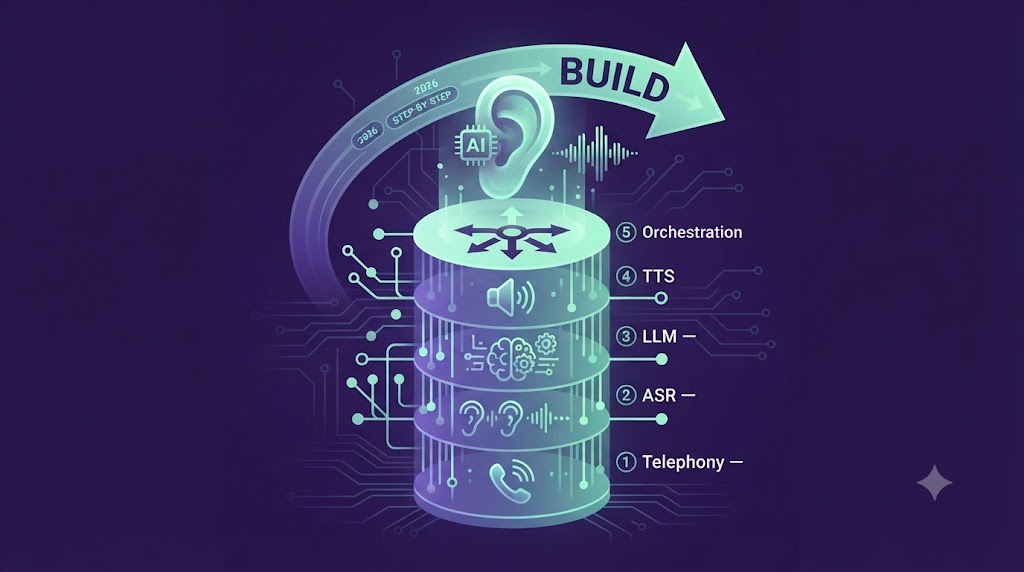
To build a production-grade AI voice agent, you need five technical components working together in under one second: ASR to transcribe speech, an LLM to generate a response, TTS to synthesize audio, telephony to carry the call, and an orchestration layer to coordinate all four. Beyond the stack, you need 50+ real call recordings, a tightly scoped conversation design, CRM integrations, and a testing protocol before you go live.
How to Build & Deploy a Voice Agent: Step-by-Step Guide for 2026
Before you pick a platform, you need to answer one question: are you building a voice agent for a specific, scoped problem — collections, lead qualification, appointment reminders — or trying to build a general-purpose voice AI? The first works. The second usually fails.
General-purpose voice AI sounds impressive in demos. It collapses under the weight of real conversations, regional accents, evasive responses, background noise, and the thousand ways humans say "maybe" when they mean "no." The voice agents that go live and stay live are built around a single workflow, a defined success metric, and real data from real calls.
This guide covers the full build process: stack selection, training data, conversation design, integration, testing, and launch. If you want the broader picture on what voice agents are and when to deploy them, start with our complete AI voice agents guide.
Before You Build: Define the Problem Precisely
Scope narrowing is not a preliminary step. It is the most important step. Every wasted hour in voice agent development traces back to a vague brief.
Answer these three questions before writing a single line of code or selecting a single vendor.
What is the call volume? Voice agents justify their build cost at roughly 200+ calls per month. Below that, a human team is almost always cheaper. At 200+ calls, the economics flip — and at 2,000+ calls, a voice agent becomes the only sustainable path.
What is the success metric? Not "handle calls better." Define it precisely: resolution rate (percentage of calls where the agent achieves the intended outcome without escalation), booking rate (percentage of callers who book an appointment), or payment commitment rate (percentage of collection calls where the debtor makes a commitment). Pick one primary metric. Build toward it. Measure everything against it.
What data do you have? If you can't produce at least 50 call recordings or transcripts before the build starts, you are not ready to build. You can plan, but you cannot build. Voice agent NLU training on insufficient data creates an agent that works in demos and fails on real calls.
If you're unsure which voice agent type fits your workflow, the comparison between voice agents and IVR is a useful architectural starting point.
The Technical Stack: What You Actually Need
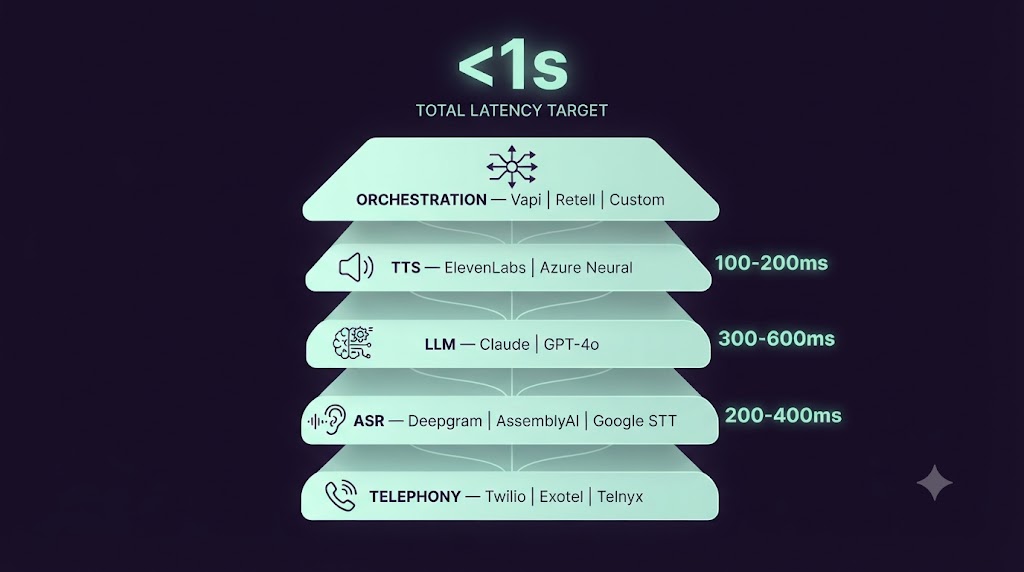
A production voice agent is not a single product you install. It is a pipeline of five layers, each with latency, cost, and accuracy tradeoffs. The total round-trip target is under 1,000ms — that is the threshold at which the conversation feels natural rather than robotic.
Here is what each layer does and what the real options look like in 2026:
ASR — Automatic Speech Recognition
ASR converts spoken audio into text. It is the first layer in the pipeline and the one that fails most visibly in multilingual environments.
Provider | Latency | English Accuracy | Hindi Accuracy | Tamil Accuracy | Notes |
Deepgram Nova | 150-250ms | 95%+ | 75-82% | 68-74% | Best latency; strong for code-switching |
AssemblyAI | 200-350ms | 95%+ | 72-80% | 65-72% | Good speaker diarization |
Google STT | 250-400ms | 94%+ | 78-85% | 70-75% | Strongest Indian language support overall |
The critical tradeoff: English ASR is a solved problem. Indian regional languages are not. If your agents will handle Hindi, Tamil, Telugu, or Bengali calls — especially with English code-switching — test each provider against your own call sample before committing. A 10% accuracy gap at the ASR layer compounds through the entire pipeline.
LLM — Large Language Model
The LLM is the reasoning layer. It receives the transcribed text and generates a response based on the conversation state, the agent's instructions, and any data retrieved from your CRM.
Provider | Latency | Reasoning Quality | Cost | Notes |
Claude Sonnet | 300-500ms | Excellent | Mid | Strong instruction-following; reliable on constrained flows |
GPT-4o | 350-600ms | Excellent | Mid-High | Strong overall; higher latency at peak |
GPT-4o mini | 150-300ms | Good | Low | Better for simpler, scripted flows |
For most production voice agents, the LLM does not need to "think freely." It needs to follow a tightly defined conversation flow, stay within compliance guardrails, and choose the right action from a limited option set. Instruction-following quality and latency matter more than raw reasoning power. Claude Sonnet performs consistently well on constrained flow execution.
TTS — Text-to-Speech
TTS converts the LLM's text response back into audio. This is where naturalness is won or lost — a robotic-sounding agent destroys caller trust regardless of how accurate the ASR or how smart the LLM is.
Provider | Latency | Naturalness | Cost | Notes |
ElevenLabs | 100-200ms | Excellent | Higher | Best naturalness; wide voice library |
Azure Neural | 80-150ms | Very Good | Mid | Reliable at scale; enterprise SLAs |
Google TTS | 100-180ms | Good | Lower | Solid for high-volume, cost-sensitive deployments |
For collections and recovery workflows where caller trust is fragile, ElevenLabs is worth the premium. For high-volume, cost-sensitive deployments like appointment reminders at scale, Google TTS or Azure Neural will hold quality without the cost.
Telephony
Telephony is the layer that carries the actual phone call. It determines audio quality, call initiation (inbound vs. outbound), DND screening capability, and regional compliance.
For India deployments: Exotel is the recommended provider. It has robust DND registry integration (critical for TRAI compliance in any outbound calling scenario), strong uptime SLAs, and good support for Indian carrier infrastructure.
For US deployments: Twilio is the standard. Mature API, broad carrier coverage, extensive documentation.
Platform wrappers (Vapi, Retell, Bland): These sit between your orchestration layer and your telephony provider. They abstract the ASR-LLM-TTS-telephony integration into a single API. For teams without dedicated voice infrastructure engineers, they significantly reduce build time. Our detailed Retell vs Vapi vs Bland AI comparison covers each platform in depth.
Platform | End-to-End Latency | Cost per Minute | Notes |
Retell | ~600ms | $0.09–$0.13 | Lowest latency of the three; good default choice |
Vapi | ~700ms | $0.07–$0.25 | Most configuration flexibility |
Bland AI | ~800ms | $0.11–$0.14 | Simpler setup; less flexible at edge cases |
Orchestration: Build vs. Buy
The orchestration layer coordinates the entire pipeline: managing conversation state, routing between tools, handling errors, and deciding when to escalate. You have two choices: build custom orchestration or use a platform like Retell or Vapi that handles it for you.
Build custom if: you have proprietary telephony infrastructure, highly specific compliance requirements, or call volume above 50,000/month where platform costs become a meaningful line item.
Use a platform if: you're at under 50,000 calls/month, your team doesn't have voice infrastructure expertise, and you want to move from scoped brief to production in 4-8 weeks rather than 4-6 months.
Training Data: The Step Everyone Gets Wrong
If you take nothing else from this guide, take this: training data quality determines agent quality more than any technology choice you make.
You need a minimum of 50 call recordings or transcripts before you begin. More is better — 200+ gives you meaningful coverage of edge cases. But raw quantity is not the goal. Quality-filtered data is.
The Quality Audit
Before you annotate a single call, audit your dataset and remove:
Calls where agents were aggressive, non-compliant, or used coercive language
Calls with severe audio quality issues that distort natural speech patterns
Calls that ended in escalated disputes (unless you are specifically building escalation handling)
Calls from agents who were not following your standard playbook
Why this matters: In one collections voice agent deployment, the initial training dataset contained approximately 30% aggressive calls — calls where human agents were pushing hard on debtors in ways that were technically off-brand. The resulting voice agent sounded like a 1990s debt collector. Callers hung up. Complaint rates spiked. After re-training on a filtered dataset of 70% quality calls, output quality improved measurably — resolution rates rose approximately 40% compared to the first version.
Annotation
Once you have a clean dataset, annotate each call for:
Intent: What the caller was trying to accomplish or avoid ("pay now," "dispute charge," "request callback," "stall")
Entities: Named values the agent needs to capture (amount, date, reference number, preferred contact time)
Sentiment: Caller emotional state at each turn (neutral, frustrated, cooperative, hostile)
Edge Cases You Must Cover
This is where most voice agent builds fall short. The edge cases that will break your agent in production:
Code-switching: Hindi-English mixed speech ("haan bhai, amount kitna hai?")
Regional accents: If your callers are from Tamil Nadu, Rajasthan, and West Bengal, your ASR performance will vary significantly across those groups
Evasive responses: "Haan, dekh lunga" — one of the most common Hindi evasion phrases in collections. It translates roughly to "Yes, I'll look into it." It is not a commitment. An agent trained without this labeled explicitly as evasion will log it as a payment commitment. That debtor won't pay, and your resolution rate reporting will be wrong.
Angry callers: How does the agent de-escalate without making the caller feel dismissed?
Ambient noise: TV in the background, children, traffic — all affect ASR accuracy
Conversation Design: How to Write Agent Scripts
This is not a script. It is a flow — a decision tree with language attached to each branch.
Turn Structure
Every voice agent call follows a consistent structure. Define each turn before you build:
1. Greeting: Identify the agent, state the purpose, verify you're speaking to the right person. Keep it under 15 seconds.
2. Problem identification: What does the agent need to establish? For collections, it's the outstanding balance and the debtor's willingness to engage. For lead qualification, it's timeline, budget, and decision authority.
3. Action: What does the agent propose? Payment arrangement, appointment booking, callback scheduling, information delivery.
4. Resolution or escalation: The call ends in one of three ways — success (outcome achieved), soft close (follow-up scheduled), or escalation (human agent takes over).
Tone Calibration
The tone of your voice agent must match the context. A collections agent and an appointment reminder agent should not sound identical. Define tone along these axes: formality level (formal vs. conversational), warmth (neutral vs. warm), urgency (calm vs. time-aware), and firmness (soft ask vs. clear expectation).
Write tone guidelines in plain English, then test whether the LLM's outputs match those guidelines on 20-30 test prompts before moving to full build.
Non-Negotiable Rules
Two rules that should be hardcoded in every voice agent, regardless of use case:
Rule 1: Honor "I want to speak to a human" immediately. The agent should never argue, never ask why, never attempt one more pitch. Transfer immediately. Any other behavior erodes trust and, in many jurisdictions, creates compliance exposure.
Rule 2: Handle non-understanding gracefully. When the agent doesn't understand input, it should acknowledge and rephrase — never repeat the same question verbatim twice. After two failed attempts to understand, offer a human transfer. Callers who feel unheard become angry callers.
Integration: What the Agent Actually Connects To
A voice agent without CRM integration is a disconnected phone call. The value is in what the agent reads before the call, writes after the call, and triggers during the call.
Read Integrations (Before/During Call)
CRM account data: Customer name, account status, outstanding balance, previous call history, open tickets. The agent needs this before it says hello.
Calendar availability: For appointment booking agents, real-time slot availability from your scheduling system.
Product or policy data: For support agents, the current state of the customer's subscription, order, or case.
Write Integrations (After Call)
CRM call outcome: What happened on the call — commitment made, date promised, dispute raised, callback requested.
Sentiment tag: How the caller presented emotionally. This feeds your escalation prioritization.
Next action: Auto-create a follow-up task for the human team if the call didn't fully resolve.
Compliance log: For collections specifically, every call requires a compliant audit trail — date, time, agent ID, debtor response, any commitments made.
API Design Considerations
Voice agent integrations fail most often due to latency, not logic errors. A CRM API call that takes 2 seconds adds 2 seconds to your response time — in a phone call, that is an eternity. Design your integrations to pre-fetch account data before the first ring, cache it for the duration of the call, and write outcomes asynchronously after the call ends rather than during it.
Testing: Before You Go Live
A voice agent that sounds perfect in internal demos can perform poorly on live calls. The gap is almost always about edge cases and realistic caller behavior.
Role-Play Testing
Have 3-4 team members play callers across a range of scenarios: cooperative, evasive, confused, angry, non-English-dominant. Run at least 50 simulated calls before launch. Document every failure and fix it.
Edge Case Testing
Run the specific edge cases you annotated in your training data as live tests:
Hindi code-switching mixed with English
Angry caller who refuses to engage
Ambiguous responses ("maybe," "let me think," "call me later")
Background noise scenarios (play ambient TV audio while testing ASR)
Very fast speech and very slow speech
Load Testing
Simulate concurrent calls — not just serial calls. Most telephony platforms handle concurrency differently, and bottlenecks emerge at scale. If you expect 100 concurrent calls at peak, test at 120.
Compliance Testing
Before any outbound campaign launches:
Confirm DND registry screening is active and working
Test that consent language is delivered correctly on recorded calls
Verify that "I want a human" triggers an immediate transfer in 100% of test cases
Confirm compliance log writes are completing and searchable
Launch: Go-Live Protocol
Do not launch at 100% call volume on day one. This is how you discover catastrophic failures at maximum scale.
Soft Launch (Week 1)
Route 5-10% of call volume to the voice agent. Keep human agents handling the remaining 90%. Monitor daily: resolution rate, escalation rate, call length, CRM write success rate, and caller sentiment distribution.
Week 1 Adjustment Cycle
Expect to make 3-7 meaningful adjustments in the first week. Common first-week fixes:
ASR is missing specific phrases your callers use frequently → add to training vocabulary
Agent is escalating too aggressively (or not aggressively enough) → calibrate escalation threshold
CRM writes are failing for a specific call outcome type → debug the API integration
Call length is 30% longer than expected → tighten the conversation flow at one specific turn
Scale After Baseline Confirmed
Increase volume to 25%, then 50%, then 100% only after your key metrics have stabilized over at least 5 business days. "Stabilized" means the resolution rate and escalation rate are consistent day over day, not improving rapidly — rapid improvement means you're still in learning mode, and scaling into learning mode inflates your failure rate.
Monitoring & Optimization: The Ongoing Work
Building the agent is not the end. A voice agent that isn't actively monitored will drift — callers evolve, new objection types emerge, integrations change, and ASR models get updated with new defaults.
Weekly Metrics to Track
Metric | What it tells you | Healthy range (varies by use case) |
Average call length | Efficiency of conversation flow | Decreasing or stable |
Resolution rate | Agent achieving intended outcome | Increasing over time |
Escalation rate | Calls requiring human intervention | Decreasing over time |
Sentiment score distribution | Caller emotional response | Stable or improving |
CRM write success rate | Integration reliability | 99%+ |
When to Retrain
Retrain when: resolution rate drops more than 5 percentage points week-over-week; you launch in a new geography with a different accent profile; your product, policy, or compliance rules change; or more than 20 new edge case types have accumulated in your failure log.
How to Handle New Edge Cases
When a new failure pattern emerges — a phrase or scenario the agent consistently mishandles — the process is: document the transcript, label the correct response, add to training data, retrain, and regression-test before deploying. Treat the agent like a team member: regular feedback cycles, not annual reviews.
DIY vs. Managed Service: Being Honest About What This Requires
Building a voice agent in-house is technically feasible. It requires a specific skill set, sustained engineering time, and ongoing operational capacity that most businesses underestimate before they start.
DIY Build | ConverseAI Managed Service | |
Team required | 2-4 AI/ML engineers, telephony specialist, QA | ConverseAI team handles all of it |
NLU expertise | Must hire or develop in-house | Included |
Telephony integration | Your team configures and maintains | Included |
Training data annotation | Your team or a labeling service | Included |
Ongoing monitoring | Dedicated internal resource | Included |
Typical time to launch | 3-6 months for first production agent | 2-8 weeks depending on complexity |
Best for | Companies with existing ML teams and voice infrastructure | Companies that want the agent, not the engineering work |
Who should build in-house: Companies with established ML engineering teams, proprietary voice infrastructure they're already maintaining, or call volume above 100,000/month where build economics justify the investment.
Who should use a managed service: Everyone else. The honest answer for most businesses is that you want a working voice agent — not a voice engineering team. If you don't have that team already, building one to ship a single use case is rarely the right economic decision.
ConverseAI has built and run 100+ AI systems across 50+ businesses since 2021. The full managed model covers design through deployment through monitoring — clients receive a production agent, not an unfinished build to operate themselves.
If you're not sure whether your use case justifies a build, an AI strategy audit will give you a clear answer before you commit budget.
Frequently Asked Questions
How long does it take to build a voice agent?
Build time depends on complexity. A simple appointment reminder agent takes 2-3 weeks. A lead qualification agent takes 3-4 weeks. A collections agent with compliance handling and sentiment tracking takes 6-8 weeks. These timelines assume call recordings, CRM access, and telephony credentials are ready at kickoff. Delays in any of these extend the timeline.
What call volume do I need to justify a voice agent?
The break-even point is roughly 200+ calls per month. Below that, a human team is almost always more cost-effective. At 2,000+ calls per month, the math strongly favors automation.
How much call data do I need?
A minimum of 50 call recordings or transcripts — quality-filtered, not raw. More is better. 200+ recordings will give you meaningful edge case coverage. But quantity without quality audit is counterproductive.
What is the total latency of a voice agent?
Target is under 1,000ms end-to-end. ASR contributes 200-400ms, LLM adds 300-600ms, TTS adds 100-200ms. Retell achieves approximately 600ms end-to-end with a well-tuned stack.
Which ASR is best for Indian languages?
English ASR hits 95%+ accuracy across all major providers. Hindi typically achieves 72-85%. Tamil achieves 65-75%. Google STT has the strongest overall Indian language support, but Deepgram is competitive for Hindi, particularly with code-switching. Test against your own call sample — aggregate accuracy numbers don't predict performance on your specific caller population.
What does "Haan, dekh lunga" mean for NLU training?
It is one of the most dangerous phrases in Hindi collections NLU. Literally "Yes, I'll look into it" — but in practice, it is an evasion, not a commitment. An agent trained without this phrase explicitly labeled as evasive will interpret it as a payment commitment. The debtor won't pay, your resolution reporting will be inflated, and you won't know why until you audit. Label every evasion pattern explicitly in your training data.
What telephony provider should I use in India?
Exotel is the recommended provider for India deployments. It has robust DND registry integration (required for TRAI compliance on any outbound calling), strong uptime SLAs, and good documentation for API integration.
What is the cost to build a voice agent?
It depends on whether you build or use a managed service. As a reference point, a high-volume collections agent handling 5,000-7,000 calls/month runs approximately ₹1.75L one-time plus ₹4.50/min ongoing. DIY builds require 2-4 engineers for 4-10 weeks plus ongoing operational headcount — the total cost is often higher, just distributed differently.
How do I handle "I want to speak to a human"?
Transfer immediately. No retry, no redirect, no "let me try to help you first." This is a non-negotiable rule in every voice agent we build. Any other behavior erodes trust and, in regulated industries, creates compliance exposure.
When should I retrain the model?
Retrain when: resolution rate drops 5+ percentage points week-over-week; you expand to a new geography with different accent profiles; your product or compliance rules change; or 20+ new edge case types have accumulated in your failure log.
What's the difference between Vapi, Retell, and Bland AI?
All three are orchestration platforms that abstract the ASR-LLM-TTS-telephony integration. Retell offers the lowest latency (~600ms) at $0.09-$0.13/min. Vapi offers more configuration flexibility at $0.07-$0.25/min. Bland AI is the simplest to set up at $0.11-$0.14/min but is less flexible at edge cases. See our full comparison for a detailed breakdown.
Related Reading
What Are AI Voice Agents? A Complete Guide — Start here if you're evaluating voice agents for the first time
Voice Agents vs IVR: Architectural Comparison — Understand the technical difference before you decide what to build
Voice Agents for Collections: Compliance and Design Guide — Deep dive on the most complex voice agent use case
Lead Qualification with Voice Agents — How to qualify inbound leads at scale without burning human sales time
Customer Support Voice Agents — Reducing Tier-1 support volume with automated voice handling
Voice Agents for Appointment Reminders — The simplest starting point; 2-3 week build, measurable ROI from week one
Ready to get started?
Building a voice agent in-house is hard. If you'd rather have it built and running in 4 weeks with zero ops burden on your team, book a free discovery call.
Book your free discovery call → theconverseai.com/book-demo