
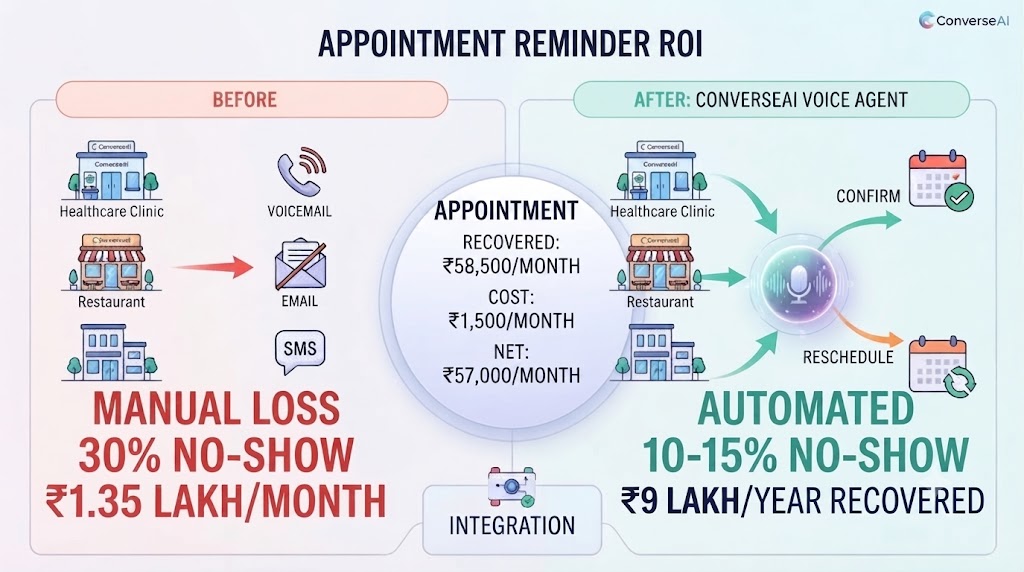
Voice agents for appointment reminders reduce no-show rates by 15-25% by placing a warm, conversational call 24-48 hours before the appointment — confirming attendance, detecting hesitation, offering immediate rescheduling, and writing outcomes back to the booking system. Across healthcare clinics, restaurants, hotels, and professional services, a single 60-second call recovers more revenue than any SMS or email reminder sequence.
Appointment Reminders With Voice Agents: Cut No-Shows by 15-25% Across Healthcare, Hospitality & Professional Services
A 30% no-show rate isn't a scheduling problem. It's a revenue leak.
Healthcare clinics, salons, consultants, and restaurants all bleed money the same way — no reminders, or reminders that don't actually get through. An SMS sits unread. An email goes to the promotions tab. A WhatsApp message gets seen but not acted on. Nobody calls because calling is expensive, and staff time is better spent on the patients and guests who actually show up.
Voice agents fix this with a 60-second call that actually gets answered. Not a robocall with a pre-recorded message — a real conversational AI that hears the patient, responds to their hesitation, offers to reschedule on the spot, and marks the outcome in your CRM before the call ends.
This post walks through exactly how these systems work, what makes them different for healthcare versus hospitality versus professional services, and the revenue math that makes the ROI case obvious.
The No-Show Revenue Problem
Before talking about the fix, it's worth sitting with how expensive the problem actually is.
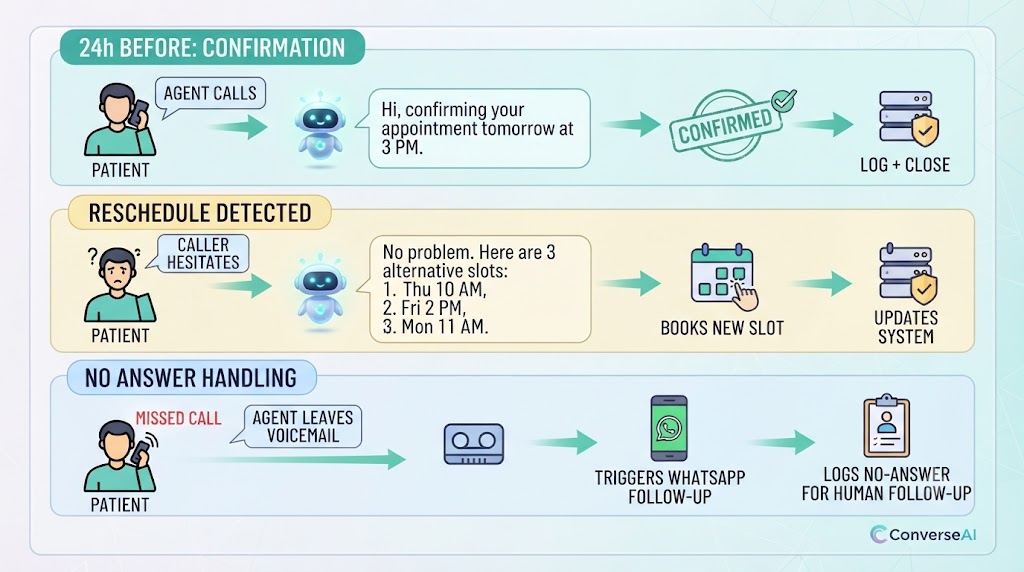
Take a mid-sized clinic running 20 appointments per day. A 30% no-show rate means 6 empty slots daily. At ₹500 to ₹1,000 per appointment slot, that's ₹3,000 to ₹6,000 in direct revenue lost — every single day. Over a working month of 26 days, you're absorbing ₹78,000 to ₹1,56,000 in avoidable losses. Over a year, you're quietly writing off ₹9 to ₹18 lakh because patients didn't show up and no one caught them before they didn't.
The numbers compound in hospitality. A restaurant with 80 covers per service, running at 30% no-show on peak-hour reservations, loses 24 covers per session. At ₹800 average spend per cover, that's ₹19,200 per service, ₹38,400 on a full day. Weekend losses for a popular restaurant can run into lakhs per month — all from tables that were booked but never filled.
For professional services — lawyers, consultants, financial advisors — the calculus is simpler and more brutal. One missed appointment at ₹5,000 per billable hour, with a 90-minute slot, is ₹7,500 gone. With five such appointments per week, you're losing ₹1,50,000 to ₹1,80,000 per month in unbillable time.
Manual reminder calls don't scale. Staff who make outbound calls hit voicemail 40-60% of the time, leave messages nobody listens to, and log nothing useful. The calls that do connect take 3-4 minutes of staff time for a conversation that could have been automated in under 90 seconds. It's the wrong use of expensive human attention.
How Appointment Reminder Voice Agents Work
The mechanics are straightforward but the details matter.
Call timing. The single biggest mistake with automated reminders is calling too late. Day-of reminders reduce no-shows marginally — but by then, the patient either shows up or doesn't, and there's no time to fill the slot anyway. The right window is 24 to 48 hours before the appointment. Early enough that a patient who can't make it can reschedule, freeing the slot for someone else. Late enough that the appointment is top of mind.
Conversation flow. A well-built voice agent follows a structured but natural conversation arc:
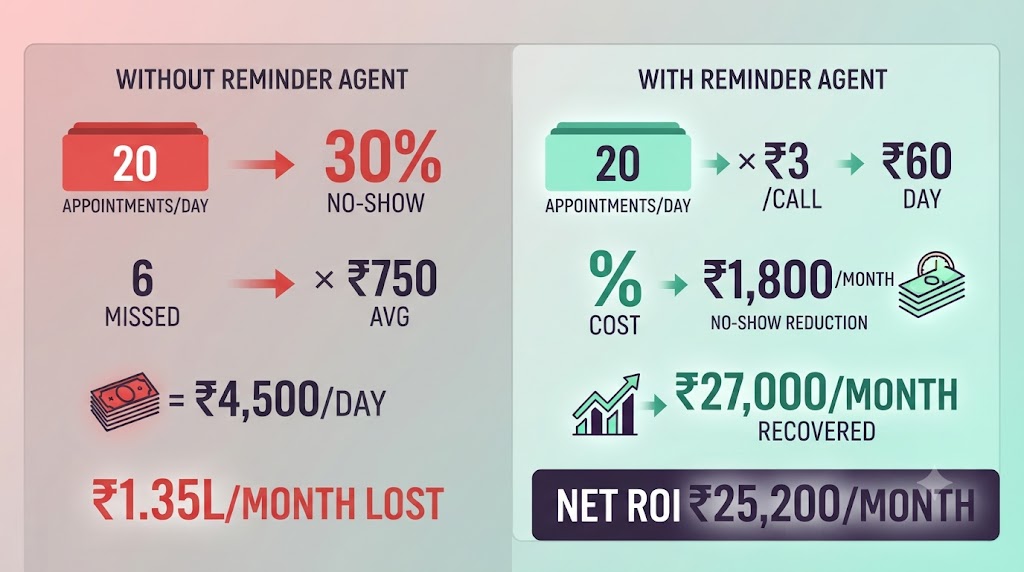
1. Confirm identity — "Is this Priya Sharma? I'm calling from Dr. Mehta's clinic about your appointment tomorrow at 3 PM."
2. Seek confirmation — "Are you still able to make it?"
3. Detect hesitation — if the patient pauses, says "I think so," or sounds uncertain, the agent acknowledges: "No problem if your plans have changed — we can find another time that works for you."
4. Offer reschedule — three available slots pulled live from the booking system, presented conversationally.
5. Log outcome — confirmed, rescheduled, or cancelled — written back to the CRM or booking platform before the call ends.
Tone. This is where most voice agent deployments fail. An automated-sounding voice triggers the instinct to hang up. The goal is warm, unhurried, human-adjacent — a voice that sounds like it's genuinely calling because your appointment matters, not because a cron job fired. Persona calibration, speech pacing, and filler management are what separate a good reminder call from one that patients reject.
System integration. The agent needs read access to the booking system (to pull patient name, appointment time, slot type) and write access (to update status, book reschedules). Most clinic management systems, restaurant reservation tools, and CRMs expose APIs or webhooks that make this possible. ConverseAI has built these integrations across 100+ AI systems and 500+ integration touchpoints since 2021.
Healthcare: The No-Show Playbook
Healthcare no-shows are structurally different from restaurant no-shows in one important way: anxiety.
A patient skipping a dental appointment often isn't forgetting — they're avoiding. A patient who hasn't confirmed their diagnostic scan might be anxious about the results. A first-time clinic visit for a new patient carries uncertainty about the process, the location, the paperwork.
An effective healthcare reminder call does more than confirm attendance. It gives the patient something to hold onto: what to bring, where to park, how long to expect to be there, whether the doctor is running on time. This informational layer reduces anxiety-driven no-shows — the ones that no amount of reminder frequency will fix without actually addressing the underlying concern.
Language selection. For corporate health groups, English works fine. For clinics in tier-2 cities, small-town hospitals, and regional chains, Hindi (or the local language) sees meaningfully better answer and confirmation rates. Hindi ASR currently runs at 72-85% accuracy — lower than English's 95%+ — but the engagement improvement more than compensates. A patient who picks up and understands the call is far more valuable than one who lets an English call ring out.
Example conversation — Hindi, clinic setting:
Agent: Namaste, kya main Rajesh Verma ji se baat kar sakta hoon? Main Dr. Sharma ke clinic, Apollo Diagnostics, se call kar raha hoon.
>
Patient: Haan, main hi bol raha hoon.
>
Agent: Rajesh ji, aapki kal subah 11 baje blood test appointment hai. Bas confirm karna tha ki aap aa rahe hain. Koi problem toh nahi?
>
Patient: Haan, aa raha hoon.
>
Agent: Bilkul. Yaad rakhiyega ki test se 8 ghante pehle kuch khana peena nahi hai. Aur parking clinic ke peeche available hai. Kal milenge — dhanyavaad.
Compliance. Patient data flowing through voice agent calls needs to be handled with the same care as any PHI. Call recordings should not be retained without explicit consent, data should not pass through third-party LLM providers in an unencrypted or logged form, and outcomes should be stored only in systems already authorized to hold patient records. ConverseAI builds these systems with compliance as a first-class architectural constraint, not a retrofit.
Hospitality: Table and Room Confirmations
Restaurant and hotel reminder calls have a different texture than healthcare — the tone is warmer, more anticipatory, less clinical.
For restaurants, the primary goal is protecting peak-hour covers. A Saturday evening table at 8 PM is worth far more than a Tuesday lunch slot, and the slot is also far harder to fill last-minute. A voice agent calling Friday evening to confirm the booking does two things: it catches cancellations while there's still time to reseat the table, and it creates a moment of hospitality before the guest even walks in.
Upsell layer. A reminder call is also a low-pressure upsell opportunity. When a guest confirms, the agent can naturally surface: "We've noted your table for four. Is there anything we should be aware of — dietary preferences, allergies, or a special occasion?" The response gets logged against the reservation. The kitchen knows. The host knows. The guest feels seen before they arrive.
For hotels, check-in confirmation calls serve a similar dual function. A call the evening before arrival — confirming check-in time, offering early check-in if available, noting any parking or transport needs — reduces no-shows on premium bookings and surfaces upsell opportunities (room upgrades, spa bookings, airport transfers) in a context where the guest is already engaged and looking forward to the stay.
The voice that works in hospitality is different from the voice that works in healthcare. Healthcare calls are warm but efficient. Hospitality calls are warm and unhurried — they sound like the beginning of an experience, not an administrative task.
Professional Services: Billable Hour Recovery
For lawyers, consultants, financial advisors, and chartered accountants, a no-show is among the most expensive events in the business calendar. A 90-minute consultation at ₹5,000 per hour is ₹7,500 of billable time that cannot be recovered. Unlike a restaurant table, a missed professional appointment usually cannot be backfilled on the same day — the professional's calendar is structured around it.
Voice reminder calls in professional services carry an additional layer of utility: pre-appointment confirmation.
A good reminder call for a client meeting doesn't just confirm the time — it confirms that the client received the briefing document, knows the Zoom link (or the office address for an in-person meeting), and has their documents ready. Clients who arrive prepared for a meeting move faster, and professionals who know the client is prepared can structure their time better.
Example call — financial advisory:
Agent: Good afternoon, is this Ananya Kapoor? I'm calling from Sharma Financial Advisors about your portfolio review tomorrow at 2 PM.
>
Client: Yes, that's me.
>
Agent: Wonderful. Just confirming you're able to make it — and that you received the pre-read document we sent yesterday?
>
Client: I did, yes. Actually, can we push it to 3 PM?
>
Agent: Of course. Let me check — yes, 3 PM works. I've moved the appointment. You'll receive a calendar update shortly. Is there anything else you'd like to note before the meeting?
The call took 90 seconds. No staff involvement. The outcome is logged, the calendar is updated, and the client feels like the firm is organized and attentive — before the meeting even happens.
For voice agents in sales and outbound appointment contexts, the dynamic is different — but the reminder use case is purely defensive: recover revenue that's already been committed.
What Good Escalation Looks Like in Reminder Calls
Not every reminder call ends cleanly. The agent needs to handle real-world conversation paths, not just the happy path.
Rescheduling intent. The patient says "I need to move this." The agent responds: "No problem at all — let me find a few options that work for you." It pulls three available slots from the booking system and presents them conversationally: "We have Thursday at 10 AM, Friday at 2 PM, or the following Monday at 11 AM. What works best?" The patient picks one. The agent confirms, books it, and ends the call. Zero staff involvement.
Clinical concern. The patient says "I'm actually not sure about the procedure — my doctor explained it but I have questions." The agent should not try to answer clinical questions. The right move: "I completely understand. Let me connect you with someone at the clinic who can help you with that." Warm handoff to the front desk or a nurse line. The agent has done its job — it surfaced a concern that would have become a no-show.
Cancellation without reschedule. The patient says they won't make it and don't want to reschedule. The agent confirms the cancellation, thanks the patient, and logs the outcome. The slot opens up in the booking system immediately, available for another patient. Recovery rate on these slots depends on how much notice is given — 24-hour cancellations can often be filled; same-day cannot.
No answer. The agent leaves no voicemail (most are not listened to) and instead triggers a secondary channel — a WhatsApp message or SMS — with a confirmation link. Voice and WhatsApp work best as a complementary system, not competing ones. For more on how these channels compare, see our breakdown of voice agents vs chatbots.
ROI Calculation
The math is not complicated, but it's worth making it explicit.
Metric | Without Voice Agent | With Voice Agent |
Appointments per day | 20 | 20 |
No-show rate | 30% | 10-15% |
Daily no-shows | 6 | 2-3 |
Revenue per slot (₹) | ₹750 avg | ₹750 avg |
Daily revenue lost (₹) | ₹4,500 | ₹1,500–₹2,250 |
Monthly revenue lost (₹) | ₹1,17,000 | ₹39,000–₹58,500 |
Monthly revenue recovered (₹) | — | ₹58,500–₹78,000 |
Voice agent cost (₹2-4/call × 20/day × 26 days) | — | ₹1,040–₹2,080/month |
Net monthly ROI | — | ₹56,000–₹77,000 |
Break-even. At ₹2-4 per reminder call, even a clinic running 10 appointments per day breaks even in the first week. The economics become undeniable at 20+ appointments per day, and scale linearly from there.
Additional recovery from rescheduling. Clinics that allow the voice agent to handle rescheduling in-call see a further 5-10% reduction in no-show rate, because patients who cannot attend on the scheduled day convert to a future appointment rather than churning. This is recoverable revenue that pure cancellation does nothing to capture.
For a full breakdown of how AI voice agents work and how to architect one, see our complete guide.
FAQ
Q. How much can voice agents reduce no-show rates?
Voice agents for appointment reminders typically reduce no-show rates by 15-25%. Clinics and businesses that also allow rescheduling through the call see an additional 5-10% improvement, because patients who cannot attend get a frictionless way to free up the slot instead of simply not showing up.
Q. When should a voice agent call to remind about an appointment?
The optimal timing is 24-48 hours before the appointment. Day-of reminders are too late for meaningful rescheduling and generate friction without reducing no-shows in any actionable way.
Q. How much do AI appointment reminder calls cost?
Voice agent reminder calls typically cost ₹2-4 per call. A clinic running 20 appointments per day spends roughly ₹1,200-2,400 per month on outbound reminder calls — a fraction of the revenue recovered from reducing no-shows.
Q. Can a voice agent handle Hindi-language appointment reminders?
Yes. Modern voice agents support Hindi with ASR accuracy of 72-85%, compared to 95%+ for English. For clinics in tier-2 cities and smaller towns, Hindi-language reminder calls see meaningfully better answer and confirmation rates than English calls.
Q. What happens when a patient wants to reschedule during the reminder call?
A well-built voice agent detects rescheduling intent in real time, offers three available slots from the booking system, and books the patient's chosen slot — all within the call. Zero staff involvement required.
Q. Are voice agents compliant for healthcare reminder calls involving patient data?
Voice agents can be deployed in a compliant architecture — call recordings are not retained beyond logging, data flows through encrypted channels, and PHI is not stored in third-party LLM providers. Compliance configuration depends on your deployment setup; ConverseAI builds these systems with compliance as a first-class constraint.
Q. What's the difference between a voice agent reminder call and a robocall?
A robocall plays a pre-recorded message and cannot respond to what the patient says. A voice agent listens, understands natural language, responds to the actual content of the conversation, handles rescheduling, and logs structured outcomes — it's a two-way conversation, not a broadcast.
Q. Do voice agents replace human reminder calls entirely?
For standard confirmation and rescheduling, yes. For complex clinical inquiries, emotional conversations, or situations requiring judgment, voice agents escalate to a human. The agent handles volume; humans handle exceptions.
Q. How do voice agents integrate with clinic management software or CRMs?
Via API or webhook. Most clinic management systems, restaurant reservation platforms, and CRMs expose appointment data through standard interfaces. ConverseAI has pre-built integrations across 500+ systems and can typically connect a new booking system within days.
Q. How does voice compare to WhatsApp for appointment reminders?
Both have a role. WhatsApp reminders are asynchronous — the patient responds when they get to it, which may be after the optimal rescheduling window. Voice calls get answered in real time, which drives higher confirmation rates for high-stakes slots. WhatsApp and voice work best as a complementary system — voice for 24-hour confirmation, WhatsApp for follow-up and day-of logistics.
Q. How quickly can a voice reminder agent be deployed?
Depending on the complexity of the booking system integration and required language/persona configuration, a standard voice reminder agent deployment takes 2-6 weeks. Simpler implementations with existing API connectors can go live faster.
Related Reading
What Are AI Voice Agents? A Complete Guide — How voice agents work, where they apply, and how to evaluate platforms
Voice Agents vs Chatbots: When to Use Which — Why text reminders and voice reminders solve different parts of the no-show problem
Customer Support Voice Agents — How the same voice AI handles post-appointment follow-up and queries
Voice Agents for Sales Appointments — Outbound booking calls versus inbound reminder calls: different architecture, same platform
How to Build a Voice Agent — Technical guide to conversation design, ASR selection, and CRM integration
A 30% No-Show Rate Is a 30% Revenue Tax: The WhatsApp Flow That Kills It — The WhatsApp-native approach to the same problem; voice and WhatsApp as a combined system
ConverseAI AI Voice Agents Service — How ConverseAI builds and runs voice reminder systems as a managed service
Ready to get started?
Losing revenue to no-shows? Book a free call to see how appointment reminder voice agents work for your vertical — healthcare, hospitality, or professional services.
Book your free discovery call → theconverseai.com/book-demo