

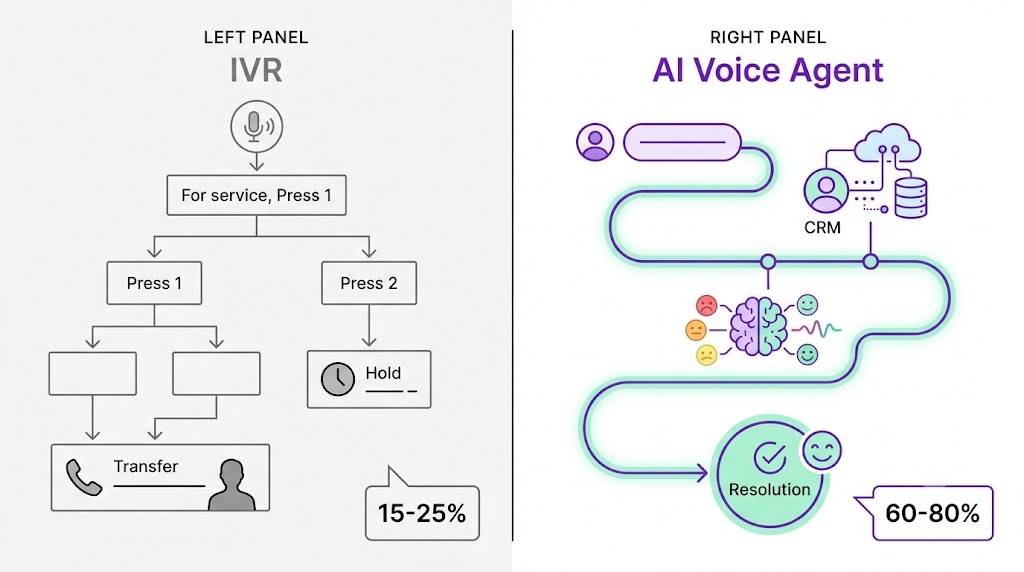
Featured Snippet: IVR (Interactive Voice Response) routes callers through rigid menu trees and resolves only 15–25% of calls without human intervention. AI voice agents understand natural language, hold context across a full conversation, and resolve 60–80% of calls autonomously. For any business handling complex inbound volume — collections, lead qualification, support — the gap between these two systems is no longer marginal; it's the difference between a working phone channel and an expensive dead end.
AI Voice Agents vs IVR: Why Businesses Are Dropping Interactive Voice Response
You've called a company's support line. The hold music starts. Then the voice:
"Press 1 for billing. Press 2 for technical support. Press 3 for sales. Press 4 for account management. Press 5 to repeat these options."
You press 2. You get another menu. You press 3. You're on hold again. Twenty minutes later, a human finally picks up — and you have to explain everything from scratch.
This is IVR. And for decades, businesses have accepted it as the cost of doing customer service at scale.
They don't have to anymore.
AI voice agents have crossed a capability threshold where they can handle the full conversation — not just route it. The resolution rate gap between the two technologies is now so wide that holding onto a legacy IVR system for anything beyond simple routing is an active choice to deliver a worse customer experience.
This post breaks down exactly what that gap looks like, where it matters, and what a migration from IVR to AI voice agents actually requires.
What IVR Actually Is (and Why It Was Built)
Interactive Voice Response was engineered in the 1970s and commercialised widely through the 1980s and 1990s. The problem it solved was real: call centers were drowning in volume, most calls fell into predictable categories, and routing them manually to the right agent wasted everyone's time.
IVR's solution was elegant for its era. Record a set of prompts. Map keypad inputs to destinations. Route accordingly. No AI required — just telephony hardware and decision trees.
By the time speech recognition arrived in the 2000s, vendors bolted it onto the existing IVR architecture. Callers could now say "billing" instead of pressing 1. But the underlying logic didn't change: the system still matched voice input to a fixed set of expected phrases, then routed accordingly. Miss the expected phrase and you'd hear "I'm sorry, I didn't understand that" — usually twice, then you'd get dumped to an agent queue anyway.
Why IVR is failing in 2026:
Call intents have become more complex. "I want to check my EMI status for loan ending in 4872 and understand why a penalty was added" doesn't fit into a menu tree.
Customer tolerance for friction has collapsed. If your phone channel is frustrating, they'll switch to a competitor who makes it easy.
IVR's self-service ceiling is structural — it cannot reason, remember context, or pull live data. You can make the menus deeper, but that only makes it worse.
Only 15–25% of calls get resolved by IVR without a handoff to a human agent. The rest still require live staff.
IVR was a productivity tool for a world where the alternative was human-routed calls. That world is gone. The alternative now is a voice agent that actually converses.
What AI Voice Agents Do Differently
An AI voice agent is not a smarter IVR. It's a fundamentally different architecture.
Where IVR matches inputs to a decision tree, a voice agent runs real-time natural language understanding (NLU) on everything the caller says — then reasons about what they need, checks relevant systems, and responds with a generated answer. The difference plays out in four specific capabilities:
1. Natural language understanding, not menu matching
A caller can say "I got a message about a missed payment but I already paid last week" and the agent understands the intent, the urgency, and the context — without the caller navigating a single menu. There is no "say that again" dead-end because the system matches on meaning, not on phrase patterns.
2. Context across the full conversation
IVR resets after every routing action. An AI voice agent maintains conversation state across the entire call. If a caller mentions their account number in the first sentence, the agent carries that through every subsequent exchange. If they pivot from a payment question to a service query, the agent doesn't lose track.
3. Live system integration
A voice agent can query your CRM, your loan management software, your ticketing system, or your inventory database — in real time, mid-conversation. It doesn't just route callers to information; it retrieves and delivers the information itself.
4. Adaptive response generation
Every caller response is generated fresh, not played from a recording. This means the agent can handle follow-up questions, handle corrections ("No, I meant my business account"), and adjust based on what the caller actually said. IVR cannot do any of this.
The cumulative result: AI voice agents resolve 60–80% of calls without human intervention, versus 15–25% for IVR. For a business running 5,000 calls a month, that's the difference between 750 resolved calls and 3,500 resolved calls from the same phone infrastructure.
Ready to see what voice agents can do? Book a free discovery call
IVR vs Voice Agent: Full Comparison
Dimension | Traditional IVR | AI Voice Agent |
Decision model | Rigid menu tree / phrase matching | Real-time NLU + multi-turn reasoning |
Flexibility | Fixed; any new intent requires redevelopment | Adapts to novel intents without reprogramming |
Language understanding | Keyword/phrase-matched only | Full semantic understanding |
Conversation memory | None — resets each routing step | Full context retained across entire call |
Self-service resolution rate | 15–25% | 60–80% |
CRM / system integration | Limited or none (routing-only) | Live read/write during the call |
Adaptation to caller | None | Adjusts tone, language, and depth dynamically |
Multilingual support | Pre-recorded language menus only | Live multilingual NLU; can switch mid-call |
Hindi ASR accuracy | N/A (recorded prompts only) | 72–85% |
Tamil ASR accuracy | N/A | 65–75% |
English ASR accuracy | N/A | 95%+ |
Setup time | Days–weeks for menu trees | 3–8 weeks for full agent build |
Cost per call | Low once deployed; high maintenance | ₹8–15/min or ₹3–6 for simple transactions |
Human agent cost comparison | Still requires humans for 75–85% of calls | ₹30–50K/month per human agent replaced |
Escalation trigger | Caller frustration / menu exhaustion | Intelligent detection; smooth warm handoff |
Compliance logging | Basic call logs only | Full conversation transcripts, intent logs, audit trails |
After-hours handling | Static menu; no resolution | Full capability 24/7 |
Concurrent calls | Limited by telephony lines | Unlimited |
Customer experience | Frustrating for complex queries | Conversational; comparable to a knowledgeable human |
When IVR Still Makes Sense
This is an honest comparison, so here's the case for IVR:
Simple, stable routing with very low intent complexity. If 90% of your callers need one of three things — store hours, branch address, or to be connected to a specific department — and those needs don't change, a lightweight IVR handles this well and cheaply. There's no reason to build an AI agent to tell someone your closing time.
Legacy telephony environments with no API surface. Some businesses run telephony infrastructure that simply cannot integrate with modern AI systems. If your phone system is a 15-year-old on-premise PBX with no outbound API, the integration cost of adding a voice agent may outweigh the benefit — at least until you migrate the infrastructure.
Very low call volumes with stable, simple intents. If you receive 50 calls a month and they're almost entirely routing calls, the build cost and ongoing tuning of an AI voice agent is hard to justify. IVR is cheaper to run for this profile.
Regulatory environments that prohibit AI-generated responses. Rare, but some highly regulated contexts (certain financial advisory or medical contexts) may have restrictions on automated response generation. Know your compliance requirements before deciding.
The key point: IVR is not bad technology. It's misapplied technology — deployed in contexts where it structurally cannot perform, because it was the only available option for decades. Now there's a better option for most use cases.
When You Need a Voice Agent Instead
If any of the following describes your call patterns, IVR is the wrong tool and you're paying for that mismatch every day.
Collections and EMI recovery (NBFC, lending, fintech). Collection calls require live account data, negotiation logic, payment commitments, and compliance-grade logging. IVR cannot retrieve account status mid-call or dynamically offer a settlement. A voice agent built for collections can handle the full conversation — from reminder to payment confirmation — without a human on the line.
Lead qualification at volume. If your sales team is spending time on calls to qualify leads who aren't ready or aren't a fit, a voice agent can run the qualification script, ask follow-up questions based on answers, score the lead, and book meetings with only the right prospects. See how voice agents handle lead qualification for the full breakdown.
Complex inbound support. Any call where the resolution depends on knowing the caller's account state, order history, or policy details — and where the answer varies by individual — is a poor fit for IVR and a strong fit for a voice agent with CRM integration.
Appointment reminders and confirmations at scale. Outbound calls to confirm appointments, collect confirmations, and handle rescheduling are highly repetitive and human-intensive. Voice agents handle this at any volume, 24/7, with zero hold time.
Multilingual customer bases. If your callers speak Hindi, Tamil, Gujarati, or English and you currently serve them with either English-only IVR or four separate recorded-language menus, a multilingual voice agent unifies all of this in one system — and can switch languages mid-call based on what the caller says.
Ready to see what voice agents can do? Book a free discovery call
Real example: Salasar Auction runs 5,000–7,000 calls per month across Hindi and English. Their ConverseAI voice agent cost ₹1.75L to build and runs at ₹4.50/min. That's total autonomy at a fraction of the staffing cost, with better consistency and full transcription logs.
The Migration Problem: You Don't Have to Rip and Replace
The single biggest reason businesses stay on IVR longer than they should is the assumption that replacing it requires a complete overhaul of their phone infrastructure. That assumption is wrong.
The hybrid approach: Your IVR can stay in place for the routing it does well — a simple front-end menu that handles your two or three highest-volume, simplest intents. Layer a voice agent on top of one specific call type: collections, support, or lead qualification. Run both in parallel. Measure the resolution rate difference in 30 days.
This is how most successful migrations start. Not a rip-and-replace project, but a single use case that proves the economics — and then expands.
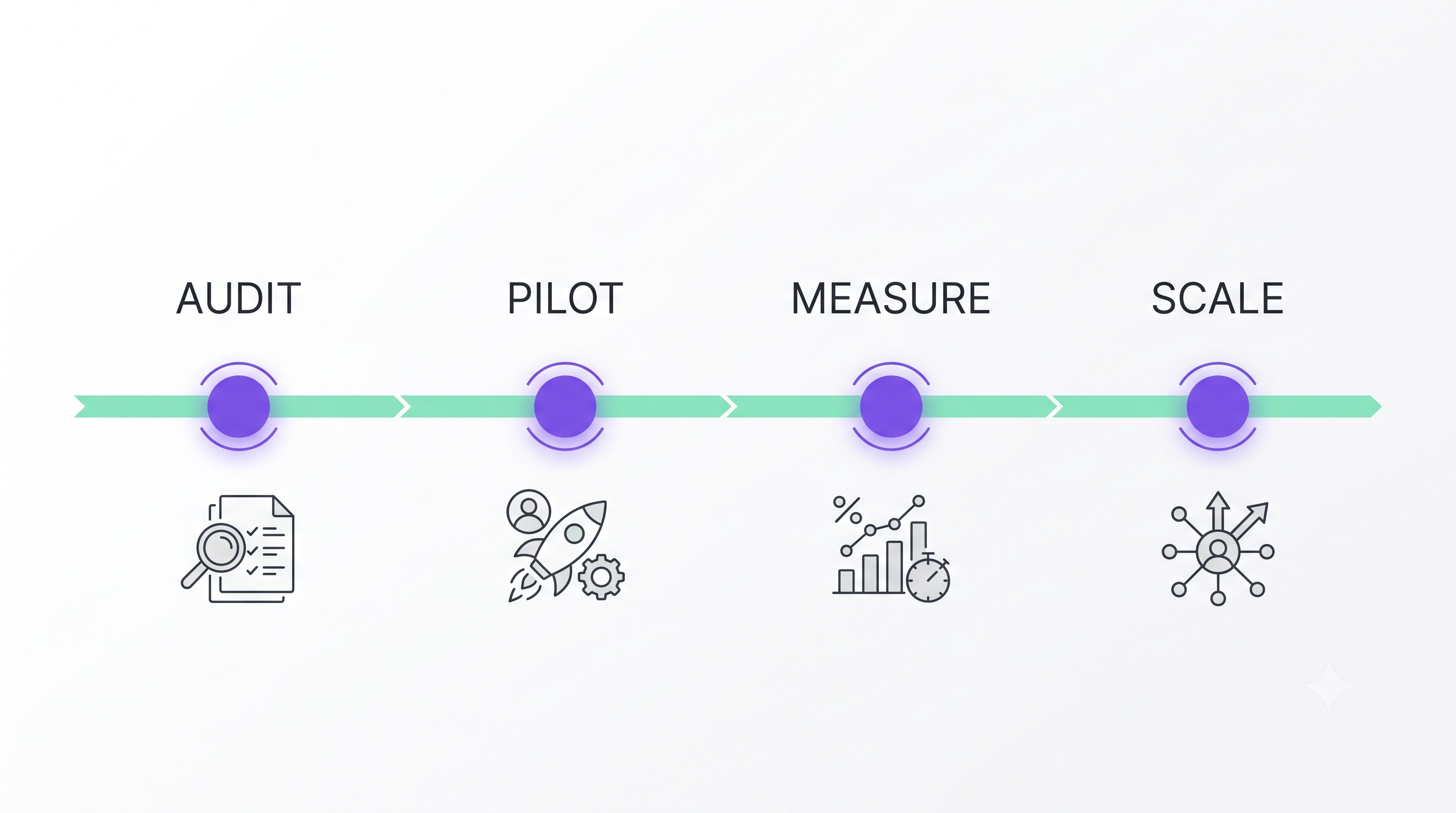
The phased migration path:
1. Audit your current call mix. Pull 30 days of call logs and categorise by intent. Find the use case with the highest volume and the lowest IVR resolution rate. That's your pilot.
2. Build and run one agent. Get it live on a single intent category. Don't try to automate everything at once.
3. Measure and tune. Resolution rate, escalation rate, call duration, and CSAT are your four metrics. Tune over 4–6 weeks.
4. Expand. Once one use case is running cleanly, add the next. Eventually your IVR becomes a thin routing layer or disappears entirely.
If you want to understand the technical build process, our guide on how to build a voice agent covers architecture, tooling, and deployment options in detail.
The businesses that wait for the "perfect time" to migrate are the ones still explaining to customers how to press 2 in 2028.
FAQ
Q1: What exactly is an IVR system?
A: IVR stands for Interactive Voice Response. It's a telephony technology that plays pre-recorded voice prompts and routes callers based on keypad input or basic speech recognition. It was designed for simple call routing and does not understand natural language or hold a real conversation.
Q2: What is an AI voice agent?
A: An AI voice agent is a software system that conducts real-time voice conversations using natural language understanding, dialogue management, and live system integration. It can understand what a caller is asking, retrieve relevant information from connected systems, and resolve queries autonomously — without transferring to a human agent.
Q3: What is the resolution rate difference between IVR and AI voice agents?
A: IVR self-service resolution sits at 15–25% — meaning 75–85% of calls still require a human agent. AI voice agents resolve 60–80% of calls fully autonomously. For businesses with high call volumes, this difference has direct, measurable impact on staffing costs and customer experience.
Q4: How much does it cost to deploy an AI voice agent compared to maintaining IVR?
A: Costs vary by use case and build complexity. ConverseAI builds range from a few lakhs for a focused agent to more for complex multi-intent systems. Per-minute pricing runs ₹8–15/min, or ₹3–6 per call for simple transactional flows. Compare that to a human call center agent in India at ₹30,000–50,000/month who handles one call at a time and works fixed hours. The voice agent runs 24/7, handles unlimited concurrent calls, and doesn't require benefits, training time, or attrition replacement.
Q5: Can a voice agent handle Indian languages like Hindi and Tamil?
A: Yes. Current ASR accuracy for Hindi runs 72–85%, for Tamil 65–75%, and for English 95%+. A multilingual voice agent can detect which language the caller is using and switch mid-call — something that IVR systems can only approximate with separate pre-recorded language menus.
Q6: Is a voice agent better than an IVR for compliance-heavy industries like NBFC or banking?
A: Significantly better. AI voice agents generate full conversation transcripts, intent logs, and timestamped audit trails automatically. IVR systems produce basic call logs. For collections, lending, and financial services — where RBI and internal compliance mandates require call documentation — voice agents provide a stronger compliance record with less manual effort.
Q7: Can I compare voice agents to chatbots?
A: They're related but different modalities. A chatbot handles text-based conversations. A voice agent handles spoken conversations — which introduces additional complexity around speech recognition, speaker variations, background noise, and real-time latency. The underlying AI logic can be similar, but deployment and optimization are distinct. Our post on voice agents vs chatbots covers this in detail.
Q8: How long does it take to build and deploy a voice agent?
A: A focused, single-use-case voice agent typically takes 3–8 weeks from scoping to live deployment, depending on the complexity of integrations required. A system handling multiple intents with deep CRM integration may take longer. IVR systems can be configured faster, but they also solve a much simpler problem.
Q9: What happens when a voice agent can't resolve a call?
A: A well-built voice agent includes intelligent escalation logic. When it detects caller frustration, reaches the boundary of its defined scope, or is explicitly asked to transfer, it hands off to a human agent — with a full summary of everything discussed in the call so far. The human agent does not need to ask the caller to repeat anything.
Q10: Do AI voice agents work for outbound calling too?
A: Yes. Voice agents are often more impactful on outbound than inbound. Use cases include EMI and payment reminders, lead follow-up, appointment confirmations, post-service feedback collection, and re-engagement campaigns. Outbound voice agents can run thousands of simultaneous calls at scheduled times — something no human call center can replicate at the same cost.
Q11: What CRM systems can AI voice agents integrate with?
A: Modern voice agents can integrate with any system that exposes an API — Salesforce, HubSpot, Zoho CRM, Freshdesk, custom loan management software, ERPs, and proprietary databases. The integration layer is typically built during the agent development phase. ConverseAI has built over 500 integrations across the 100+ AI systems it runs for clients.
Q12: Is the voice agent market in India mature enough to rely on?
A: Yes. Hindi and English voice agents in particular have reached production-grade reliability. Tamil, Marathi, Bengali, and other regional languages are maturing quickly. ConverseAI has been building and running AI systems since 2021, serving 50+ businesses across sectors including fintech, real estate, healthcare, and logistics.
Related Reading
AI Voice Agents: Complete Guide for 2026 — What they are, how they work, and what they can and can't do
Voice Agents vs Chatbots: Which One Do You Need? — When to use voice vs text, and the cases where you need both
Voice Agents for Collections and Compliance — How NBFCs and lenders use voice agents for EMI recovery
Lead Qualification with Voice Agents — Automating the top of your sales funnel with AI calling
How to Build a Voice Agent — Architecture, tooling, and deployment for teams considering a build
ConverseAI AI Voice Agents Service — How ConverseAI builds and runs voice agents as a managed service
Still running an IVR on calls your agents shouldn't be handling? Book a free discovery call with ConverseAI— we'll show you exactly what a voice agent would do with your current call mix.
Ready to get started?
Ready to see what voice agents can do for your business? Book a free discovery call — we'll walk you through the IVR vs voice agent decision for your specific use case.
Book your free discovery call → theconverseai.com/book-demo