

AI voice agents for collections automate outbound debtor calls with built-in RBI compliance controls — enforcing call frequency limits, time-of-day restrictions, and DND screening automatically on every call. For NBFCs managing hundreds or thousands of debtors, they cut collections operating costs by 60–70% compared to manual calling teams while generating a full compliance audit trail on each interaction.
AI Voice Agents for Collections: RBI Compliance, NBFC Playbook & Real ROI
Consider a mid-market NBFC with 500 debtors in default. Running a manual collections operation at that scale requires 50+ calling agents — each earning ₹30,000/month — to meet the call frequency expectations across a full portfolio. That's ₹15 lakh per month in base salaries alone. Add management overhead, training costs, compliance monitoring, and the inevitable attrition, and you're looking at ₹18–20L before any recovery even happens.
And that cost is growing. Not because the portfolio is growing — because compliance is tightening. Every DND violation is a fine. Every call made outside permitted hours is an audit flag. Every agent who uses language that doesn't meet the Fair Practices Code is a liability. With a team of 50 humans on phones all day, the operations head cannot hear every call. The compliance officer cannot review every transcript. The risk is structural, not individual.
The math doesn't work anymore. And there's a better architecture.
The Collections Problem: Why Manual Calling Is Breaking Down
Manual collections operations in India are being squeezed from four directions simultaneously.
Scale. As loan books grow, calling teams must grow linearly. There is no efficiency curve — more debtors means more agents. The cost scales with the portfolio. AI voice agents break this relationship entirely.
Compliance risk from human variability. RBI's Fair Practices Code is specific and measurable — maximum call frequency, restricted calling hours, mandatory self-identification. Human agents under pressure to hit collection targets cut corners. Not because they're bad people, but because the incentive structure rewards recoveries, not compliance. The result is a compliance gap that lives in your call logs until an audit surfaces it.
DND violations. TRAI's National Do Not Disturb registry imposes fines per violation, not per campaign. A calling agent who doesn't check DND before each call — or checks it once at the start of the day without accounting for same-day registrations — is generating regulatory risk with every dial. At 50+ agents making 100+ calls per day, the exposure accumulates fast.
Agent burnout and inconsistency. Collections calling is high-stress, high-churn work. Agents start strong in the morning and degrade in quality by afternoon. Tone becomes harsh. Language shifts. Scripts get abandoned. The debtor who gets called at 9AM gets a compliant conversation; the debtor who gets called at 5PM gets whatever the agent has left. That inconsistency is invisible in your aggregate recovery numbers until it becomes a complaint.
What AI Voice Agents Do in Collections
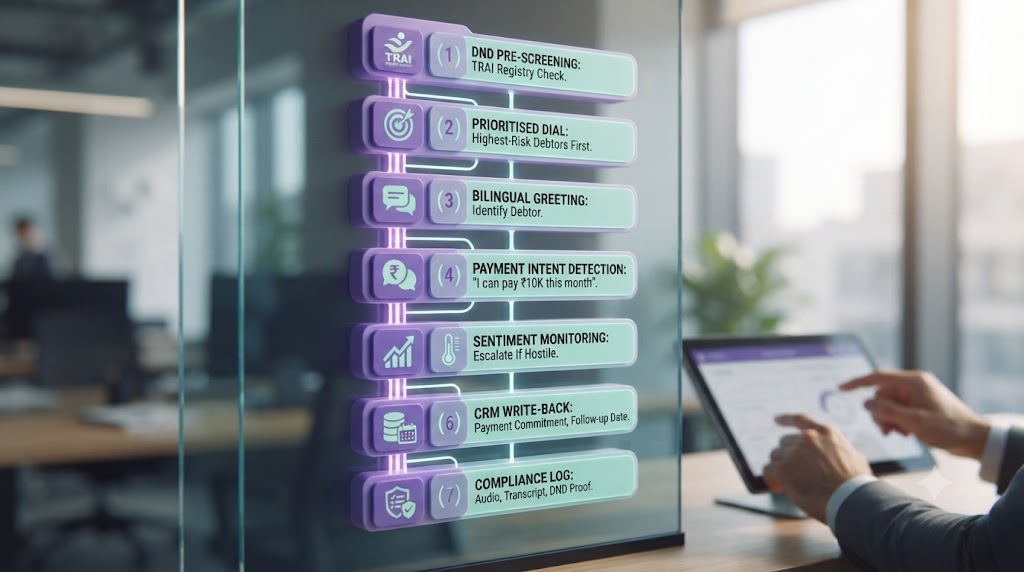
A collections voice agent isn't a robocall. It's a structured, intelligent conversation that follows a defined workflow while adapting to what the debtor actually says. Here's what the system does, step by step.
1. DND pre-screening. Before a single call is made, every number in the day's calling list is checked against the TRAI DND registry. Numbers that are registered do not get called. The check is logged. This happens automatically, on every call attempt, every day.
2. RBI rule enforcement. The dialer has the RBI compliance rules hardcoded — not as guidelines, but as operational constraints. If the current time is before 8AM or after 7PM IST, calls do not go out. If today is a Sunday or a national public holiday, calls do not go out. If a specific debtor has already received 2 calls this calendar week, no further call attempt is made for that debtor until the next week. None of this depends on a supervisor remembering to enforce it.
3. Prioritised dialing. Debtors are ranked by DPD (Days Past Due), principal outstanding, historical call response rate, and preferred contact window if known. The agent doesn't call in alphabetical order — it calls in the order most likely to generate recoveries.
4. Bilingual conversation — Hindi and English. The voice agent opens the call, identifies itself (as required by the Fair Practices Code), states the purpose of the call clearly, and confirms it is speaking with the correct person. It then moves into the collections conversation in the debtor's preferred language. Hindi and English are supported natively. Code-switching mid-conversation is handled.
5. Payment intent detection. This is where NLU quality matters enormously. The agent doesn't just transcribe — it classifies intent. A debtor who says "haan, kal kar dunga" (I'll do it tomorrow) is classified differently from a debtor who gives a specific date and amount. The system distinguishes confirmed commitment from vague deflection. More on this in the mistakes section.
6. Sentiment monitoring in real time. As the call progresses, the system tracks sentiment signals — rising frustration, distress indicators, aggression. If sentiment crosses a defined threshold, the call is flagged for immediate escalation to a human agent, who is briefed with the live transcript before being connected.
7. CRM write-back. Every call result — payment commitment date, amount confirmed, dispute raised, callback requested, or no answer — is written to the CRM in real time. No end-of-day data entry. No missed updates.
8. Full compliance log. Every call generates: a full audio recording, a timestamped transcript, a decision log (which rules fired, which actions were taken), a sentiment timeline, and a compliance checklist confirming DND screen, time-of-day check, and self-identification. This is the audit trail.
9. Escalation with context. When a call needs a human — either because the debtor requested one, the dispute is complex, or sentiment spiked — the escalation carries everything. The human agent sees the transcript, the sentiment timeline, what was offered, and what the debtor said. The conversation continues, not restarts.
RBI Compliance: What the Rules Actually Say
The RBI Master Circular on Fair Practices Code for NBFCs and Lenders is specific. Operations heads and compliance officers should know exactly what it mandates for collections calling.
Call frequency. Maximum 2 calls per week per debtor. Not per account — per debtor. If the same individual has multiple loan accounts with your NBFC, the limit applies to them as a person.
Calling hours. No calls before 8:00 AM or after 7:00 PM Indian Standard Time. The restriction is on IST — not local time of the debtor's registered address, not the calling centre's local time.
Restricted days. No collections calls on Sundays or on gazetted public holidays.
Self-identification. Every call must begin with the caller identifying themselves and the purpose of the call. An agent — human or AI — cannot open a call without disclosing who they are and why they're calling.
Language and conduct. No abusive, threatening, or humiliating language. No false representations about the consequences of non-payment. No harassment of family members or references.
With a human calling team, every one of these rules is a policy commitment. With a voice agent, every one of these rules is a code constraint. The distinction matters enormously when an RBI auditor asks how you ensure compliance across 5,000 calls per month. "We train our agents" is a weaker answer than "here is the enforcement logic and here is the call log confirming it ran on every call."
The Consumer Protection Act 2019 applies equally to AI collections agents. The voice agent is bound by the same prohibitions on harassment and misrepresentation as a human agent — and unlike a human agent, every one of its calls is automatically recorded and auditable.
TRAI DND Registry: The Fine Print
The National Do Not Disturb registry is enforced by TRAI, not RBI — a distinction that matters because the two regimes are independent. Being compliant with RBI's Fair Practices Code does not exempt you from DND violations.
The penalty for calling a DND-registered number for commercial purposes is ₹10,000 or more per violation under the Telecom Commercial Communications Customer Preference Regulations. The fine applies per call, not per campaign. An operation making 200 calls per day with even a 2% DND miss rate generates 4 violations daily — ₹40,000/day in exposure.
The DND check must happen before each call attempt, not once per campaign or once per day per number. Numbers can be registered intraday. A number that was clean in the morning may be registered by afternoon.
A properly built collections voice agent runs the DND check as a non-bypassable gate before every dial attempt. The result of the check is logged. No human can override it. This is the only defensible operational posture.
Traditional IVR systems cannot do this — they have no intelligence layer capable of conditional pre-call screening, compliance rule enforcement, or real-time decision logging. This is one of the clearest functional gaps between IVR and AI voice agents.
A Real Deployment: What Collections Voice Agents Look Like in Practice
For reference context, consider the deployment model used for voice-intensive operations in the Indian market. A typical build for a collections-scale deployment — covering 5,000–7,000 outbound calls per month in Hindi and English — runs at approximately ₹1.75L as a build cost and ₹4.50/minute in operating cost, translating to roughly ₹45,000–63,000/month in call costs at that volume. (This is based on the Salasar Auction deployment model, which ConverseAI runs for auction-day calling at that call volume — the economics are directly comparable to NBFC collections workflows.)
Apply that model to an NBFC collections operation with 500 debtors and an average of 2 call attempts per debtor per week. That's approximately 4,000–4,500 call attempts per month. At an average call duration of 2.5 minutes, the monthly call cost runs ₹45,000–50,000. Compare that to ₹15L+ in human agent costs for the same portfolio coverage.
The operational shape of a typical run looks like this:
The outbound dialer activates at 9AM on a permitted calling day. DND checks run across the day's target list. Calls go out in priority order — highest DPD first. Each call opens with self-identification in the debtor's detected preferred language, confirms the debtor's identity, and states the overdue amount and account reference clearly.
In a typical conversation, the debtor either acknowledges and commits (logged as commitment with date and amount), requests a callback (logged with preferred time, callback scheduled), raises a dispute (flagged to human review queue with full transcript), goes silent or is evasive (flagged for follow-up attempt next permitted day), or escalates in frustration (real-time sentiment trigger, warm transfer to human agent with transcript brief).
By end of day, the CRM has every result logged, every commitment dated, and every escalation triaged. The compliance officer gets a batch report: call count, DND screens run, calls made, calls blocked by time restriction, escalations, self-resolution rate, and the compliance checklist confirmation for every call.
ROI Calculation: When Voice Agents Pay For Themselves
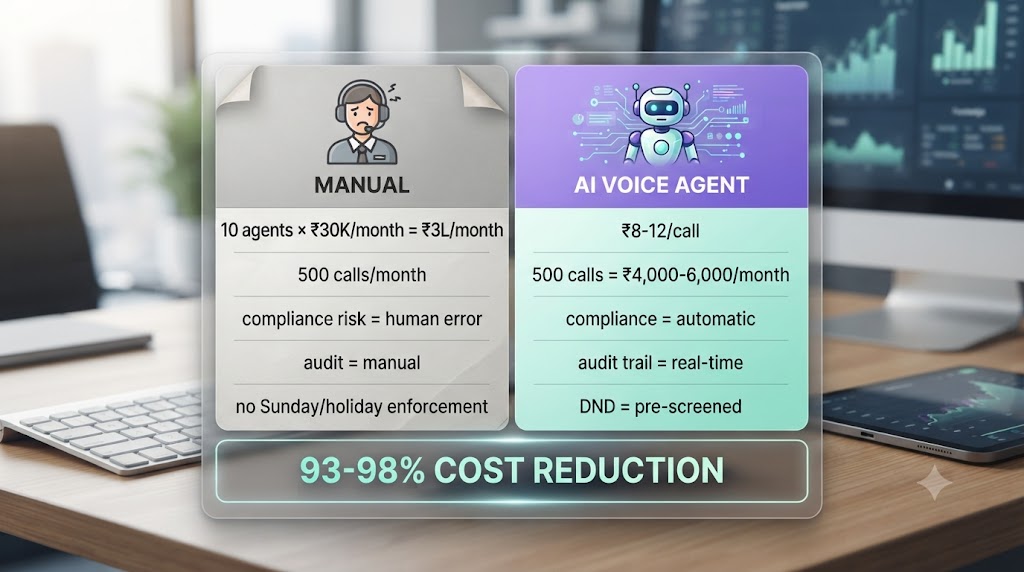
Cost Element | Manual Calling Team | AI Voice Agent |
Agents required (500-debtor portfolio) | 50+ agents | 1 deployed system |
Cost per agent per month | ₹30,000–50,000 | — |
Total monthly staff cost | ₹15L–25L | — |
Per-call cost | ₹50–80 (blended) | ₹8–12 |
Monthly call operating cost (4,500 calls) | ₹2.25L–3.6L | ₹36,000–54,000 |
Compliance monitoring overhead | High (random audits) | Zero (automated) |
DND screening reliability | Variable | 100% (automated gate) |
Self-resolution rate | 35–45% | 60–70% |
Audit trail quality | Spot-check logs | Full call record every call |
Break-even. At 200+ calls/month, an AI voice agent pays for itself versus marginal manual calling cost. For any NBFC running collections at scale, that threshold is cleared in week one of the first month.
The harder-to-quantify savings are in compliance cost avoidance. A single RBI compliance finding from an audit — triggered by a mis-timed call, a DND violation, or an agent using prohibited language — can result in remediation costs, penalty orders, and reputational exposure that dwarf months of collections operating cost. The voice agent eliminates the variability that creates those risks.
The 30–40% of calls that escalate to human agents are not wasted calls. They are pre-triaged, context-rich escalations. The human agent picks up a call where they already know the debtor's name, the overdue amount, what was said, the sentiment trajectory, and what the debtor objected to. Average handling time on escalated calls drops significantly compared to a cold call from a human agent.
Common Mistakes in Collections Voice Agent Deployments
Training on aggressive call transcripts. A collections voice agent trained on historical calls from a high-pressure human collections team will learn to sound like a high-pressure human collections team. The output is an AI that uses the kind of language that gets human agents put on performance improvement plans — and with the call volume of an AI system behind it. Train on compliant call recordings only. If your human call transcripts don't pass an RBI Fair Practices Code review, they should not be in your training corpus.
No sentiment escalation. A voice agent with no sentiment monitoring will complete a call with a distressed or irate debtor as if it went fine. The CRM will log it as a completed call. No one will know the debtor ended the call in the highest-risk state for complaint escalation. Build sentiment monitoring in from day one, not as a post-deployment retrofit.
Skipping DND pre-screening. Some implementations run DND checks in batch at the start of the campaign period rather than before each individual call. This creates a window where intraday DND registrations generate violations. Pre-call DND screening — every call, every time — is the only compliant implementation.
Poor Hindi NLU for evasion phrases. This is the most technically underestimated problem in Indian collections voice deployments. Standard Hindi NLU models are trained on general conversational Hindi, not the specific evasion register that debtors use when they want to end a call without committing. The canonical example: "Haan, dekh lunga" — literally "Yes, I'll look into it" — is NOT a payment commitment. It is a polite brush-off that debtors use to end the call. An off-the-shelf NLU model may classify this as a positive response. A collections-tuned NLU model flags it as evasion and triggers a follow-up sequence. The difference in portfolio recovery rates between these two classifications is material. Getting this right requires building your voice agent with domain-specific NLU tuning, not just plugging in a generic model.
No escalation playbook for disputed accounts. A voice agent that reaches a debtor who disputes the debt amount — "I already paid this" or "this amount is wrong" — must have a defined path. If the agent continues the collections conversation on a disputed account, you have an RBI problem. The escalation trigger for dispute language must route to human review immediately, with the call recording attached.
Frequently Asked Questions
Q: Are AI voice agents for collections legal in India?
Yes. AI voice agents for debt collection are legal in India when operated in compliance with RBI Fair Practices Code, TRAI DND regulations, and the Consumer Protection Act 2019. The legal requirement is compliance with the rules — the technology used to make the calls is not restricted.
Q: What RBI rules apply specifically to voice agent calls?
The RBI Master Circular on Fair Practices Code mandates: maximum 2 calls per week per debtor, no calls before 8AM or after 7PM IST, no calls on Sundays or public holidays, mandatory self-identification at the start of each call, and no abusive or threatening language. A properly built voice agent enforces all of these as code constraints, not policies.
Q: How accurate is Hindi speech recognition in collections?
Production Hindi ASR in collections contexts runs at 72–85% accuracy. This is sufficient for structured collections conversations — confirming identity, understanding payment commitment, detecting disputes. It is not sufficient for unstructured free-form conversation. Collections voice agents work because the conversation is structured: the agent guides the flow, asks specific questions, and interprets responses against a finite set of intents.
Q: What happens when a debtor raises a dispute?
A dispute trigger — any statement challenging the debt amount, the account status, or claiming prior payment — should immediately pause the collections conversation and escalate to a human review queue. The call recording and transcript are attached. A human agent or collections supervisor reviews and contacts the debtor within a defined SLA. Continuing a collections conversation with a debtor who has raised a dispute is a regulatory risk.
Q: Can the voice agent handle debtors who refuse to speak or hang up?
Yes. Non-response, hang-up, and call refusal are tracked outcomes with defined follow-up rules. A debtor who hangs up immediately is not re-called the same day. The next attempt respects the weekly frequency limit. Persistent non-response over multiple weeks can trigger an escalation to a different channel — SMS, WhatsApp, or a field agent — depending on the portfolio strategy.
Q: Is the call recording stored and accessible for RBI audits?
Every call generates a full audio recording, a timestamped transcript, a decision log, and a compliance checklist. These are stored in a structured format accessible for audit review. When an RBI auditor asks for evidence of Fair Practices Code compliance on a specific debtor account, you can produce the complete call record for every interaction in minutes.
Q: What's the difference between a voice agent and an IVR for collections?
IVR systems present menus and play recorded messages — they cannot hold a conversation, detect intent, monitor sentiment, or generate a compliance log. The functional gap between IVR and AI voice agents in a collections context is substantial. An IVR can notify a debtor that a payment is overdue. A voice agent can have a conversation about why, secure a commitment, detect evasion, and escalate when needed — with a full compliance audit trail.
Q: How long does it take to deploy a collections voice agent?
A standard NBFC collections voice agent deployment — covering Hindi/English bilingual calling, CRM integration, DND screening, RBI compliance constraints, and escalation routing — typically takes 4–8 weeks from scoping to go-live. The timeline depends heavily on CRM integration complexity and the quality of existing call recordings available for NLU tuning.
Q: Does the voice agent work for US collections compliance (TCPA/FDCPA)?
Yes, with different compliance parameters. TCPA requires prior written consent before autodialed calls, restricts calls to 8AM–9PM local time of the called party, and mandates opt-out mechanisms. FDCPA restricts abusive language, false debt representations, and contact with third parties. A US-configured collections voice agent enforces TCPA time windows and consent flags, and its conversation scripts are reviewed against FDCPA requirements. The same core architecture applies — the compliance rule set changes.
Q: What is the minimum portfolio size where a voice agent makes sense?
For outbound collections calling, the economics start to work clearly at 200+ calls/month. Below that threshold, a hybrid model — voice agent for standard follow-ups, human agent for complex accounts — is often the right architecture. For portfolios of 500+ debtors with regular calling cycles, a full voice agent deployment is almost always the better economic and compliance position.
Q: Are AI voice agents for collections legal in India?
Yes. AI voice agents for debt collection are legal in India when operated in compliance with RBI Fair Practices Code, TRAI DND regulations, and the Consumer Protection Act 2019. The legal requirement is compliance with the rules — the technology used to make the calls is not restricted.
Related Reading
Complete guide to AI voice agents — how voice agents work, use cases, and deployment architecture
AI voice agents vs IVR — why IVR can't do compliance logging or intent detection
Voice agents for lead qualification — the same technology applied to inbound and outbound sales
How to build a voice agent — technical architecture, NLU tuning, and CRM integration guide
WhatsApp for NBFC collections — combining voice agents with WhatsApp for higher contactability
ConverseAI AI Voice Agents service — how we build and run collections voice agents for NBFCs
AI Strategy Readiness Audit — assess your collections operation before committing to a build
ConverseAI builds and runs AI systems for businesses across India and the US. Founded 2021. 50+ businesses served. 100+ AI systems live in production. 500+ integrations. Meta Tech Provider Partner. Talk to us about your collections operation →
Ready to get started?
Running a collections operation in India? Book a free call to see how ConverseAI deploys RBI-compliant voice agents for NBFC collections — with full DND screening, audit trails, and Hindi NLU built in.
Book your free discovery call → theconverseai.com/book-demo